“Have no anxiety. Sometimes what’s worse than being sick is being afraid of getting sick. Leave it to God. Whatever God gives you is best for you. God never gives you a cross without first weighing and measuring it very carefully to make sure that the cross will result in your spiritual growth.”
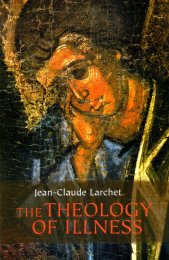
To the brief passage below, taken from The Theology of Illness by Jean-Claude Larchet, the author attaches four footnotes, in which he references St. John Chrysostom, St. Maximus the Confessor, St. Gregory Palamas, Vladimir Lossky and the Book of Job. He is a patristics scholar for sure! And he manages to incorporate many quotes from church fathers and Scripture in the main text as well, without making it hard to read. In fact, it is pure pleasure to follow Larchet’s explanations as he gathers from great minds of the church and reveals the unity of their thought and faith.
“God, who envisions the salvation of man and through man of the entire universe, does not allow the forces of evil to submerge and destroy His creation. Man and nature remain partially protected by His Providence, which imposes certain limits on the negative activity of the Devil and his demons. Thereby God stabilizes the cosmos in its slide toward nothingness, establishing a certain order in the very heart of disorder. Even if man has lost the ‘likeness’ of God which he began to acquire, he nevertheless remains bearer of the divine ‘image,’ even if that image is veiled, obscured, and deformed.
“Thus man is not totally deprived of grace. Even in his weakness he retains sufficient spiritual power to be able, if he wishes, to turn again toward God and to obey the commandments which he continues to receive from Him (Dt 30:11-19). And thereby he is able to maintain, according to God’s own promise, a certain mastery over nature (cf. Gen 9:1-2).
“Nonetheless, this new balance remains fragile. Man and nature have become a battleground where evil and good, death and life, wage a permanent, merciless combat against each other. This combat is made evident by sickness, infirmity and suffering; and until the Incarnation of Christ, its outcome was uncertain.”
One evening my housemate Susan baked a wonderful onion-and-potato dish, and as I walked through the kitchen I said, “Oh, my, that smells so good!” The next morning the cooking aromas were present still, and I didn’t think much about it, but the next morning…. What? How odd to have that smell hanging on. I tried putting some aromatic oil in the diffuser, but it made no difference. After a week I had figured out that this odor was not real; it was somehow generated by my own nose sending wrong information to my mind. When I researched the phenomenon online I found phantosmia, sometimes called an olfactory hallucination.
They say it can happen after a respiratory infection. I had recently (mostly) gotten over a cold and the flu. I was smelling a sort of burning-leaf scent. That’s the only thing I could think of to describe it, not that I am terribly familiar with that smell around here – but I was trying to come up with an imagination to match the fake sensation. It was there when I went to sleep, when I woke up, all day long, and when I drove to the next town for an appointment. I could taste my food, sort of, but the weird smell I was registering overpowered most other smells, so that tea was like water, and scented candles were unscented. The articles I had read say this condition “usually” goes away, but I’ve heard of people who have a permanently altered sense of taste, and that sounded like a terrible loss, so I hoped….
Also, I started taking zinc (my pharmacist friend’s recommendation) and Vitamin C, and doing more frequent saline nasal rinses (my doctor’s recommendation). After about ten days I thought maybe the odd smell was fading… and then one afternoon I returned from an errand and sniffed the evidence of my having roasted eggplant that morning – it wasn’t very pleasant, but it was a real cooking odor!
The next day, at church, incense, glorious and sweet and nothing like burning leaves. Thank you, Lord! The crowning delight was the morning I was a bit peeved at my building contractor, and without thinking why, I opened the front door, as though hoping to see a few construction guys driving up. I didn’t see anything out of the ordinary, but the scent of the daphne floated up and filled my nose and mind with its essence, welcome and true.
The day after I wrote about feeling my mortality, I was prompted to think more on the subject, first by Father Stephen Freeman, in an article about hospitals vs. hospice, and the importance of visiting the sick. When he was chaplain on a hospice team:
“It was the first time I ever saw a doctor listening carefully to nurses and chaplains. There was nothing ‘active’ that could be done other than providing comfort and support. The team stood in awe before the reality of dying, inevitably sharing the knowledge that what a patient was facing would be our own lot in time.”
For several years I’ve had more of that awareness myself, that every moment I go on living it is only because of God’s will and sustaining power. This understanding was only heightened when I was weak and sick, and not distracted by all the “active” things of my typical days, and could be in awe of the fact of existence.
This morning, I have a further reminder of death, and the scripture that tells us, “Precious in the eyes of the Lord is the death of His saints.” A woman about my age fell asleep in death this week and I will be helping to prepare her body for burial in just a couple of hours. We will pray and anoint her with oil and commend her to Christ, before she is moved to the church for her funeral. It is always a holy thing to join with a sister at this stage in her “journey to the kingdom.”
In the short movie linked below, the musings of a 97-year-old philosopher as he calmly and “philosophically” considers his own death show a sensibility much more deeply human and nuanced than what he wrote in his book on the subject when he was younger. Though he feels that he lost half of himself when his wife of 70 years died, at the same time he doesn’t want to die; he has just started noticing the beauty of trees the way he never did before. The intellectual history of his own mind tells him that “there is no point” to life, so it doesn’t make sense to him, he calls it foolish, that he should mind saying good-bye. But he does mind.
Maybe it was the death of his wife that shook up his life so that now he calls death “the one thing central to my existence.” And he doesn’t have it figured out. Though now he likely knows more than he did then, because he has actually crossed that river; the movie was made by his grandson in his memory. There is a short article with a little more information at The Atlantic.
“The monastic tradition of the Church has the notion that we should always keep death before our eyes. In a culture where sickness and death are hidden from view, such a notion can seem morbid and wrongly formulated. St. Paul said of himself, ‘I die daily’ (1Cor. 15:31).
“More completely, he said, ‘I am crucified with Christ, nevertheless I live. Yet not I, but Christ lives in me. And the life that I now live, I live by the faith of the Son of God, who loved me and gave Himself for me’ (Gal. 2:20).
“These are not morbid notions, but remembrances of the truth. If you lived on the edge of a cliff, only disaster could come from forgetting that fact. We remember the truth of our existence (including its end) so that our life might be shaped by the conscious remembrance of the name of God. When we pray, ‘Lord, Jesus Christ, have mercy on me,’ we proclaim the futility and emptiness of our self-existence, while more profoundly proclaiming the goodness and kindness of God in Christ who, in us, tramples down death by death.
“There is a monastic saying in Orthodoxy: ‘If you die before you die, then you won’t have to die when you die.'”

 One evening my housemate Susan baked a wonderful onion-and-potato dish, and as I walked through the kitchen I said, “Oh, my, that smells so good!” The next morning the cooking aromas were present still, and I didn’t think much about it, but the next morning…. What? How odd to have that smell hanging on. I tried putting some aromatic oil in the diffuser, but it made no difference. After a week I had figured out that this odor was not real; it was somehow generated by my own nose sending wrong information to my mind. When I researched the phenomenon online I found
 Gladsome Lights