Tag Archives: Jean-Claude Larchet

This new balance remains fragile.

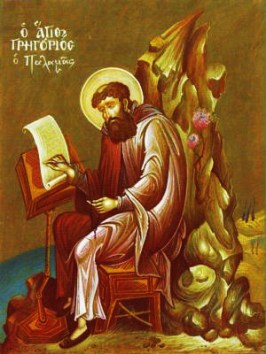
St. Gregory Palamas

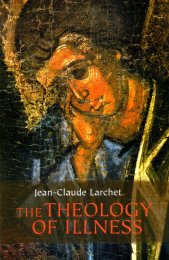
To the brief passage below, taken from The Theology of Illness by Jean-Claude Larchet, the author attaches four footnotes, in which he references St. John Chrysostom, St. Maximus the Confessor, St. Gregory Palamas, Vladimir Lossky and the Book of Job. He is a patristics scholar for sure! And he manages to incorporate many quotes from church fathers and Scripture  in the main text as well, without making it hard to read. In fact, it is pure pleasure to follow Larchet’s explanations as he gathers from great minds of the church and reveals the unity of their thought and faith.

“God, who envisions the salvation of man and through man of the entire universe, does not allow the forces of evil to submerge and destroy His creation. Man and nature remain partially protected by His Providence, which imposes certain limits on the negative activity of the Devil and his demons. Thereby God stabilizes the cosmos in its slide toward nothingness, establishing a certain order in the very heart of disorder. Even if man has lost the ‘likeness’ of God which he began to acquire, he nevertheless remains bearer of the divine ‘image,’ even if that image is veiled, obscured, and deformed.
“Thus man is not totally deprived of grace. Even in his weakness he retains sufficient spiritual power to be able, if he wishes, to turn again toward God and to obey the commandments which he continues to receive from Him (Dt 30:11-19). And thereby he is able to maintain, according to God’s own promise, a certain mastery over nature (cf. Gen 9:1-2).

“Nonetheless, this new balance remains fragile. Man and nature have become a battleground where evil and good, death and life, wage a permanent, merciless combat against each other. This combat is made evident by sickness, infirmity and suffering; and until the Incarnation of Christ, its outcome was uncertain.”

-Jean-Claude Larchet, The Theology of Illness


The body is a nave.

Jean-Claude Larchet is a contemporary French patristics scholar and theologian who has written on diverse subjects such as the Theology of Illness, life after death, and mental disorders. (I’m currently reading his The New Media Epidemic.) Several years ago our parish did a study of his book, Theology of the Body, and last week when I was thinking on that topic I was glad to find it still on my shelf.
In the chapter on “The Body in Spiritual Life,” Larchet discusses the physical aspects of our worship, beginning with the tradition of standing in church, “… a posture that symbolizes the resurrection, that key point of the Christian faith and hope.”

“In addition, mention may also be made of the ‘passive’ liturgical participation of the body in the setting that is so characteristic of the Orthodox Church, where the splendor of the celebration, so often misunderstood by those who have no experience of its meaning, has an important spiritual role to play – the beauty of the architecture and the ‘decoration’ of the churches whose walls are covered with frescoes and icons; the solemn character of the services; the richness of the celebrants’ vestments; the magnificence of the chants; the incense; the lights of the lamps and candles; and so on. All these things – which never cease to awaken a sense of wonder in the faithful – have a fourfold meaning.”

Two of those “folds” are 1)symbolizing the kingdom of heaven, and 2) giving the faithful, in a symbolic way, a taste of the riches and glory of the kingdom of heaven, and also of the new conditions of existence there, when the body is transfigured along with all the senses….”

The next and last paragraph I will share here struck me as alluding to realities so holistic and fundamental that they must constitute the very business of our life. The story we can read in the specific details tells who we are and what we are made for, and includes many mystical, or hidden, elements, no less real for their hiddenness. It is the true story of humanity:

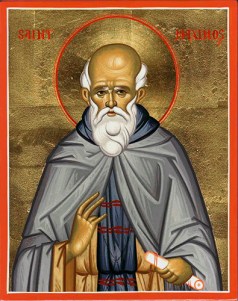
“The very interior of an Orthodox church introduces the body into a space that is different from the ordinary; it is a space transfigured and sacred, whose profound symbolism is superbly analyzed by St. Maximus the Confessor in his Mystagogia. He stresses in particular that the church’s spatial structure symbolizes the human being: the altar representing the spirit, the sanctuary the soul, and the nave the body. Conversely, the human being symbolizes the church: his spirit is, as it were, an altar; his soul, a sanctuary; and his body, a nave. And this is not simply by their nature but by their own specific functions in spiritual life: the body represents in particular the practical or ethical dimensions; the soul stands for the contemplative dimension; and the spirit its pinnacle, theologia, in which the believer receives from the Holy Spirit supernatural knowledge of the divine mysteries.”

Nagging that cuts the soul in pieces.

From the book New Media Epidemic:

Jean-Claude Larchet

Spiritual life…requires what is traditionally called recollection, the capacity to turn all one’s faculties inward, away from the world, there in one’s heart to unite and consecrate them to God in meditation and prayer. Recollection is the stage of preparation for prayer that precedes concentration. 

But as we have seen, the new media [cell phones, tablets, internet, etc] push man’s faculties in the opposite sense, always outwards toward the world. They are dispersed by a stream of discordant nagging that cuts the soul in pieces, and destroys the unity and identity of the inner man.

The new media encourage strongly two elements of ancestral sin:

(1) the loss of the inner unity of the faculties, which once were united in knowledge of God and doing His Will, dispersing them among physical objects and their representations (thoughts, memories, and images), or the desires and passions that they arouse;

(2) the resulting division, chopping up, and inner dispersion, which, according to St Maximus the Confessor, “breaks human nature into a thousand fragments.”

As other holy ascetics have said, the intelligence [attention/nous] is then constantly distracted, floating, erring, and wandering here and there in a state of permanent agitation, quite the opposite of the deep peace it experienced in its former contemplation. The thoughts that once were united and concentrated become manifold and multifarious, spreading out in a ceaseless flow. They divide and disperse, leaking out in every direction, dragging and dividing the whole being of man in their wake.

This leads St Maximus the Confessor to speak of: “the scattering of the soul amongst outer forms according to the appearance of sensory things,” for the soul becomes multiple in the image of this sensory multiplicity…which is simply an illusion… Stirred up and excited by a multitude of passions, they pull in many directions, often opposed, at once, and make of man a being divided at every level. This process of the fall of man, described by the Church Fathers of Late Antiquity, continues today faster than ever, driven on by the new media. They offer such a rich and speedy flow of temptations that they multiply the sensory objects that attract the senses…

—Jean-Claude Larchet

(from a church bulletin)