Tag Archives: John Drinkwater

I take my quotes with breakfast.

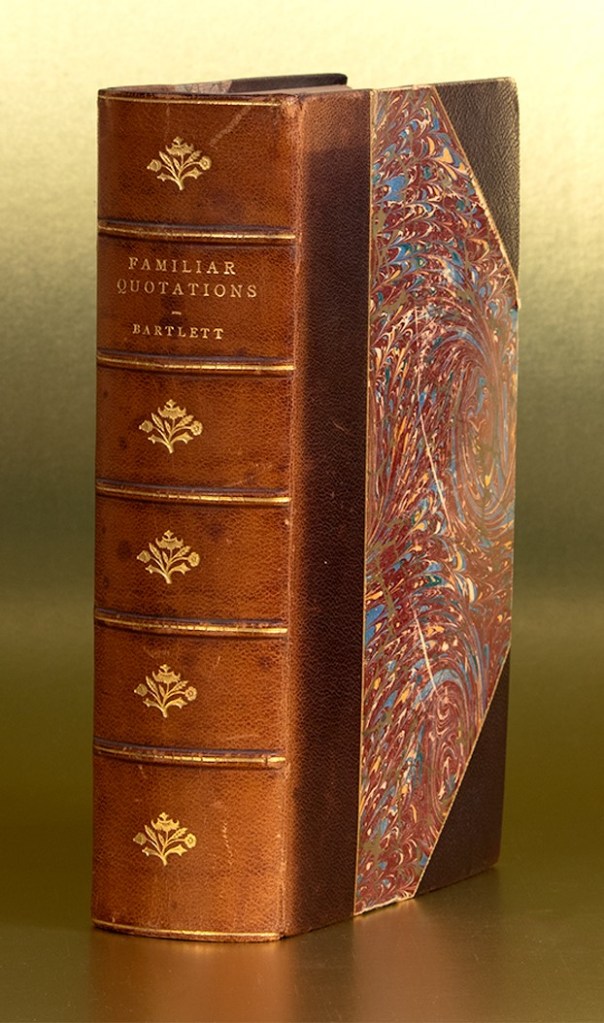
9th Edition, 1909

I read part of it all the way through.
     -Samuel Goldwyn

This morning when I sat down to eat my egg scramble, I opened the Fourteenth Edition of Bartlett’s Familiar Quotations, which some of my children thoughtfully gave me last Christmas. As I read some very pithy, humorous or wise sayings, I immediately began to think of how I might use them in a blog post sometime. One after another made me wonder this, and I soon realized that it’s not likely to happen. So I will just share a few random quotes here all at once, out of any context — that is, the context in which they first appeared.

Truth exists, only falsehood has to be invented.
     -Georges Braque

This “enlarged edition” I have before me is copyright 1968, so it includes many entries that I never saw in the older edition I owned for a brief while. The very first was published in 1855, and the current version is the 19th, from 2022.

Bartlett said, upon coming out with the 4th Edition, that “…it is not easy to determine in all cases the degree of familiarity that may belong to phrases and sentences which present themselves for admission; for what is familiar to one class of readers may be quite new to another.”

Shakespeare, by John Taylor

Indeed. I wonder what he would think of the challenge of assembling such a book in this era, when many people have not learned to appreciate the beauty of good writing, nor do they have a collective familiarity with a body of it, as previous generations might have had, as with the Bible or Shakespeare, for example.

Thus we play the fools with the time, and the spirits of the wise sit in the clouds and mock us.
     -William Shakespeare, Henry IV

John Bartlett began his project when he managed the University Book Store in Cambridge, Massachussetts, by writing quotations in a commonplace book. He oversaw the publication of nine editions before his death in 1905. The next editions, in the 20th century, had several different editors, but at first they continued in what was considered the “ideologically inclusive spirit of the first fifteen editions.”

It is a good thing for an uneducated man to read books of quotations. Bartlett’s Familiar Quotations is an admirable work, and I studied it intently. The quotations when engraved upon the memory give you good thoughts. They also make you anxious to read the authors and look for more.
     -Winston Churchill

Hearkening to a tradition that is no more, it is unsurprising that Bartlett’s could not endure as it was, and critics have pointed out the ways in which it has devolved, as the culture from which it draws has fragmented. My public library system has the latest edition, but I don’t plan to borrow it.

This be my pilgrimage and goal,
Daily to march and find
The secret phrases of the soul,
The evangels of the mind.
     -John Drinkwater

John Drinkwater

My breakfast is long over, and though I would like to keep leafing through Bartlett’s to share more quotes with you, I must go on to other things now. Whatever time of day it is that you are reading this, I hope something here has been a nourishing snack for your own soul.

Women are wiser than men because they know less and understand more.
     -James Stephens
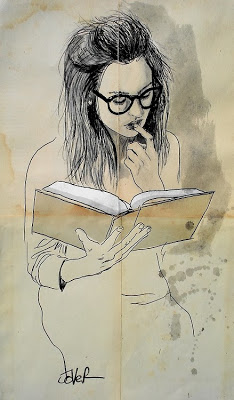
By Loui Jover

The moon dapples the apples.

MOONLIT APPLES

At the top of the house the apples are laid in rows,
And the skylight lets the moonlight in, and those
Apples are deep-sea apples of green. There goes
A cloud on the moon in the autumn night.

A mouse in the wainscot scratches, and scratches, and then
There is no sound at the top of the house of men
Or mice; and the cloud is blown, and the moon again
Dapples the apples with deep-sea light.

They are lying in rows there, under the gloomy beams;
On the sagging floor; they gather the silver streams
Out of the moon, those moonlit apples of dreams,
And quiet is the steep stair under.

In the corridors under there is nothing but sleep.
And stiller than ever on orchard boughs they keep
Tryst with the moon, and deep is the silence, deep
On moon-washed apples of wonder.

-John Drinkwater


What is all your argument?

POLITICS

You say a thousand things,
Persuasively,
And with strange passion hotly I agree,
And praise your zest,
And then
A blackbird sings
On April lilac, or fieldfaring men,
Ghostlike, with loaded wain,
Come down the twilit lane
To rest,
And what is all your argument to me?

Oh yes — I know, I know,
It must be so —
You must devise
Your myriad policies,
For we are little wise,
And must be led and marshalled, lest we keep
Too fast a sleep
Far from the central world’s realities.
Yes, we must heed —
For surely you reveal
Life’s very heart; surely with flaming zeal
You search our folly and our secret need;
And surely it is wrong
To count my blackbird’s song,
My cones of lilac, and my wagon team,
More than a world of dream.

But still
A voice calls from the hill —
I must away —
I cannot hear your argument to-day.

-John Drinkwater, 1917

Van Gogh, Lilac Bush

Printless as eyelight.

I came upon this haunting poem again, and though it seems I must have posted it here many times before, the evidence shows that I have restrained myself. Today, I indulge myself instead. I’m sharing the photo and thoughts from a previous post, because nothing has changed, except my readership.

I continue to wonder about layers of meaning in the poem… “printless as eyelight” is a phrase appropriately elusive to me. Are they “beautiful flocks of the mind” only because their image stays with us as memory, or because they represent some of our own less dull thoughts?

DEER

Shy in their herding dwell the fallow deer.
They are spirits of wild sense. Nobody near
Comes upon their pastures. There a life they live,
Of sufficient beauty, phantom, fugitive,
Treading as in jungles free leopards do,
Printless as eyelight, instant as dew.
The great kine are patient, and homecoming sheep
Know our bidding. The fallow deer keep
Delicate and far their counsel wild,
Never to be folded reconciled
To the spoiling hand as the poor flocks are;
Lightfoot, and swift and unfamiliar,
These you may not hinder, unconfined
Beautiful flocks of the mind.

-John Drinkwater

When my grandson asks what is my favorite animal, I have to say it is the deer. To watch one bound away after it is startled in the forest is a captivating sight, none the less that it is normally quite a brief glimpse, of great strength and speed combined with grace.

[In 2009] we visited a farm where white-tailed deer are kept as livestock, and viewed the corrals where the lovely animals are kept but evidently not tamed (“never to be folded reconciled”). The deer in the pen closest to us seemed to be frightened at our presence. The farmer was not there at the time and I don’t know if his presence is any less disturbing. I couldn’t take my eyes off the deer zigzagging nonstop in its cage; to watch that beauty without it disappearing into the trees was very odd. We weren’t there long enough for me to get used to the vision that is usually so rare. Nor did I begin to feel reconciled myself to coming near upon their pastures.

The photo of deer above was taken while walking down the street in an Oregon neighborhood. Perhaps those deer are calm because they are still “keeping their counsel wild.” No one is threatening them. If I’d had my camera that day at the corral, I might have taken a sad video of a wild animal from whom I was at that moment stealing something. In that moment I wasn’t thinking about these things; I didn’t think there was anything wrong with breeding wild deer. But since I came home and read Drinkwater’s poem again -– I have treasured it and worked at memorizing it for decades -– I am reconsidering.