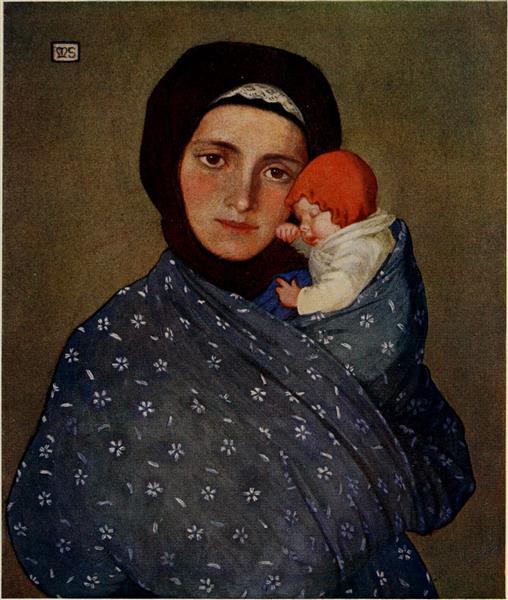
“After birth, the child further develops this primal resonance. This doesn’t happen haphazardly. The child achieves a kind of symbiosis with the mother through its creative imitations of her sounds and facial expressions; in this way, it will feel what she feels. As it takes on its mother’s happy expression, it also feels her joy; if it takes on her sad expression, it shares in her unhappiness.
“Something similar applies to the exchange of sounds: In the clinking and clanging of the mother’s language trembles the well and woe of her being, and the child who imitates that language resonates with it on the same psychological wavelength. This early resonance between child and its (social) environment leads to a unique phenomenon: The young child’s body gets ‘loaded’ with a series of vibrations and tensions that become embedded in the deepest and finest fibers of its body. They form a kind of ‘body memory’ that not only programs the function of the musculature, glands, nerves, and organs, but also predisposes the child to certain psychological conditions, or disorders.
“The human body is, in the most literal sense, a stringed instrument. The muscles that span the skeleton, and the body’s other fibers, are put on a certain tension in early childhood through imitative language exchanges. This tension determines with which (social) phenomena one will resonate; it determines the frequencies to which one will be sensitive in later life. That’s why certain people and certain events can literally strike a chord; they touch the body and, as such, touch the soul. It is for this reason that the voice can make the body ill. Or, conversely, heal it. That is why the voice is of vital importance, especially at an early age. Lack of a voice is fatal to the young child.”
–Mattias Desmet


 Gladsome Lights