Tag Archives: mock orange

June flowers make me feel at home.

My front garden had turned into a jungle by the time I returned after nearly three weeks away; I expected that, but didn’t anticipate all of the species that would get tangled together. Some of them, like the nigella and poppies, were way past their prime and I could simply pull them out.

Black Medick

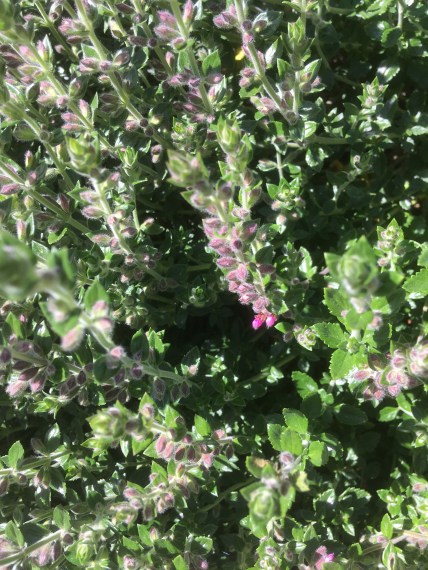
There was a certain weed that had flourished under the asparagus fronds and was climbing by means of its yard-long stems up behind and over the germander, which is just starting to bloom. It also was growing in the cracks in the walkway. I knew I had seen it before somewhere, but never in this quantity, so I looked it up: Black Medick. I pulled at least most of it out, and added that to the green bin.
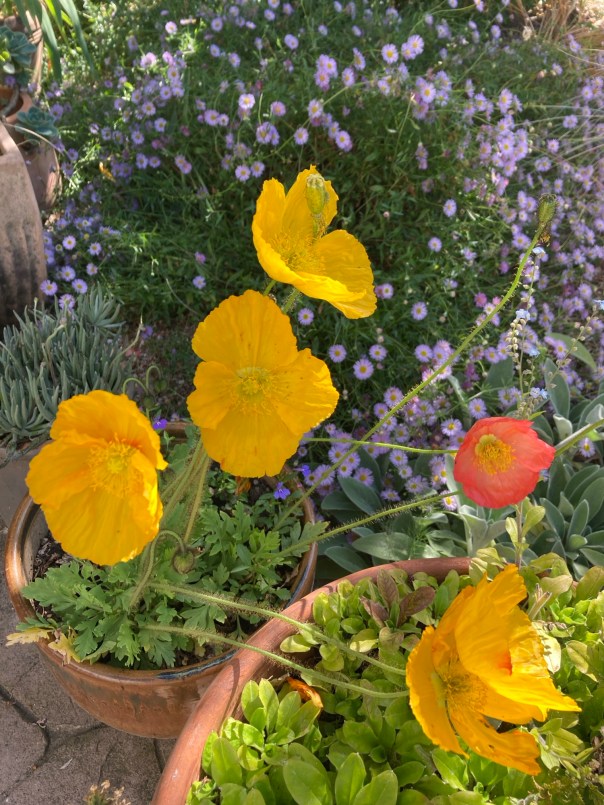
I bought cosmos and some shorter flowers to replace all the things that I removed; and a few basil, summer squash and zinnia plants to put in the planter boxes. Because spring was cool here, the Iceland poppies are still blooming, and welcomed me home.

The Showy Milkweed is blooming and the bees are on it.

In Greece, in addition to the live, rustic and thorny version of acanthus I’d seen on Paros, I saw plenty of carved acanthus leaf designs in the ancient Byzantine architecture in Thessaloniki. I came home to see my own plants looking more majestic than ever.

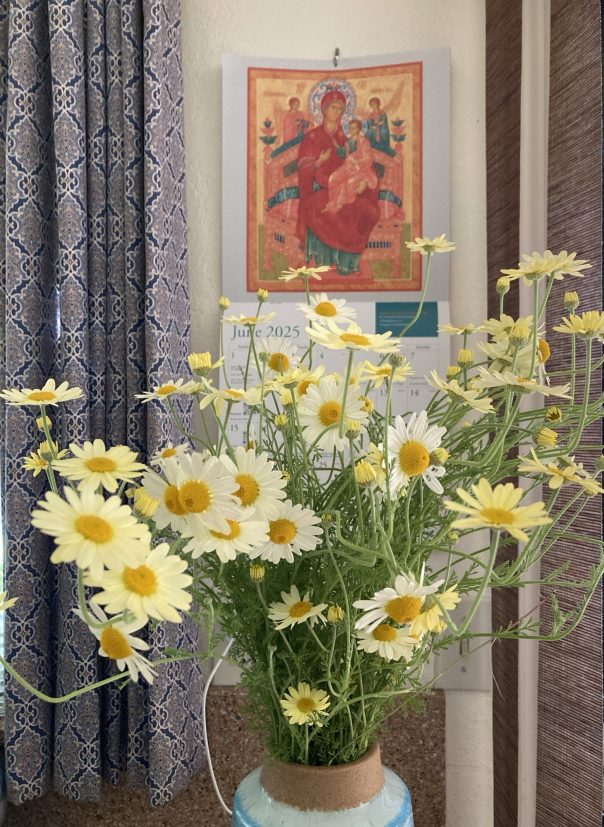
The lavender has come out, and the Mock Orange, and the little campanula that hides under the Mock Orange. The Golden Marguerite that I’d pulled out of the front garden last year — it returned, and was  aggressively invading my new landscape, so I cut it back, and stuck the clippings in a vase. After all that, and a few days recovery from jet lag, I’m beginning to feel myself again ❤
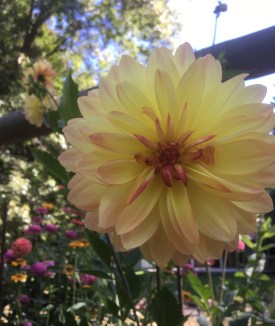
Only the day and I are here.

The glory of 2020

When I was at Pippin’s I got to help water her garden, and pull ever encroaching forest ferns out of the blueberry patch. Many years ago she planted four varieties of blueberries, two of each, aiming for a harvest that would stretch from one end to the other of the season, and they mostly are growing and spreading, and bearing fruit.

She had recently taken her dahlia tubers out of winter storage and planted them inside the deer fence; they were almost all coming up. Often I have visited in September, for Ivy’s birthday, when those flowers are in their glory.

Four years ago I visited their homestead in this month of June, and it’s interesting to see my pictures of different plants and activities from back then. I don’t know yet when I will be able to return….

The glory of this day

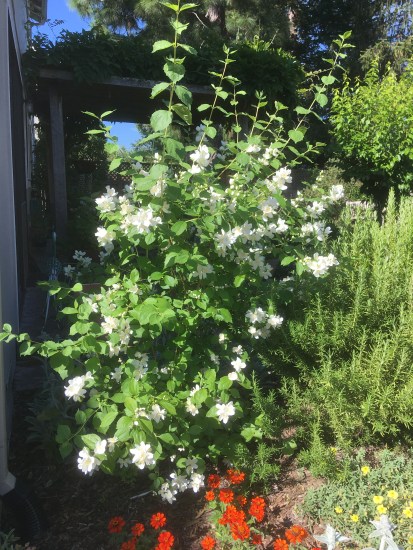
Anyway, I drove home yesterday, and immediately went out to water the potted plants; the mock orange is stealing the show right now. I am thankful to have my own garden to play in.  Out there I can forget what month or year it is — or what century! — if only for a moment.

DEW LIGHT

Now in the blessed days of more and less
when the news about time is that each day
there is less of it I know none of that
as I walk out through the early garden
only the day and I are here with no
before or after and the dew looks up
without a number or a present age

-W.S. Merwin

I sip nectar with the tiniest.

I sat in my garden reading Penelope Lively, who when writing about garden fashions that come and go, kept using the word “rill.” I picked up my phone to look up that word and see what the British might mean by it, and quick as a wink a tiny fly, almost too tiny to see without reading glasses, lit on the screen, with its wings open for about one second, a flash of shimmering rainbows.

Then it fell off, on to my book. Was that the fly, merely a black gnat? I got him to crawl on to my finger and back on to the screen, where he was kind enough to display his bright wings again for a moment, and then took flight.

On my walk yesterday I saw just one insect in a sea of catsear blooms. And I worked hard to get a picture of a flower with him on it. Not like most years of my photography, when I tried to avoid bugs on blooms, and would be disappointed if my flower were spoiled by a spider or something I hadn’t noticed when I clicked. But most of those critters had come out blurry anyway. No, getting a sharp image of an insect is not easy with a little phone camera. But I have time, don’t I? And a lot of digital storage, too, in case I don’t get around to deleting all those blurry pictures.

I started looking for flowers with insects, and of course, there were bees! It was so warm by this time, they were flying fast and furious, and couldn’t decide which of many privet or blackberry blooms to drink from, like kids in a candy store. The best shot I got was of one flying away with her loot. And I found a near relation to catsear beetle closer to home, descending a wide staircase of rose petals.

Obviously, I also am a kid in my own candy store, and can’t choose just one or two pieces of ambrosia to gaze upon or aim my camera at or share with you. If the temperature were constantly mild when I sit out in that paradise, I think I would fill to bursting with the joy of the place. But usually I get too hot or too chilly or find a task to do, so I don’t get dangerously stretched.

In my front garden many insects are buzzing back and forth and not lighting on any flower. I think they are just hanging around, or more precisely, swooping around — coming back to check every few minutes, so they can be the first to drink at the ocean of teucrium flowers that are going to start opening any minute now. I’m not sure that walkway will be wide enough for human feet to walk without colliding with honeybee wings.

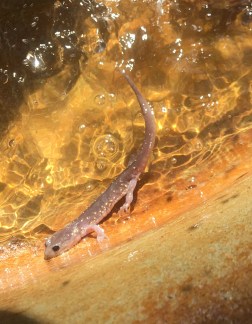
Many of the cistus, Jerusalem sage and helianthemum already need shearing! Alejandro my sometimes gardener was here yesterday and we moved one of the big pots that hold olive trees, and found two salamanders underneath! How they ended up in this droughty place I don’t understand, but I didn’t think about that at the time.
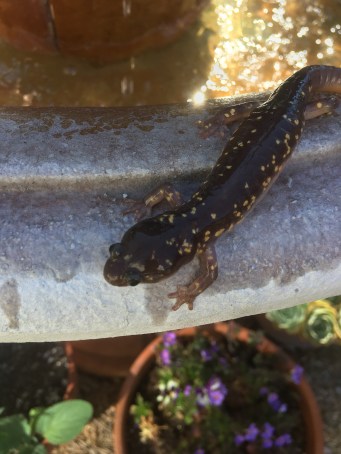
I grabbed the two of them, who looked like Mama and Baby, and put them to swim in the fountain for a minute while I ran into the house for my camera. Then I released them near a faucet with good luck wishes. Maybe I should have carried them to the creek? (Which reminds me, a rill in a British garden is a water feature.)


Back to the insect kingdom and their food… The word nectar carries a heady meaning. Drink of the gods – delicious. But the origin of the word is also pretty tasty if you like words: The first step back is to the Greek nektar (we’re talking about Greek gods, after all), “which is perhaps an ancient Indo-European poetic compound of nek- ‘death’ + -tar ‘overcoming,’ ‘cross over, pass through, overcome.'” No one used this word for the sweet liquid in flowers until about 1600.

Those links to the thought of overcoming of death could lead to an intellectual/writing exercise about how it’s all connected, but I’m not willing for that kind of workout today. I just want to join my fellow creatures in imbibing the sweets.


Water, watercress, and catsear.

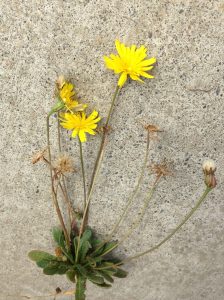
Dandelions and false dandelions – Over the last couple of years the false kind, or catsear, Hypochaeris radicata L., has flourished in dead or dying lawns in our town. Many people have let their lawns go, because of the drought, and there’s no recovering them now just because the winter was wet.
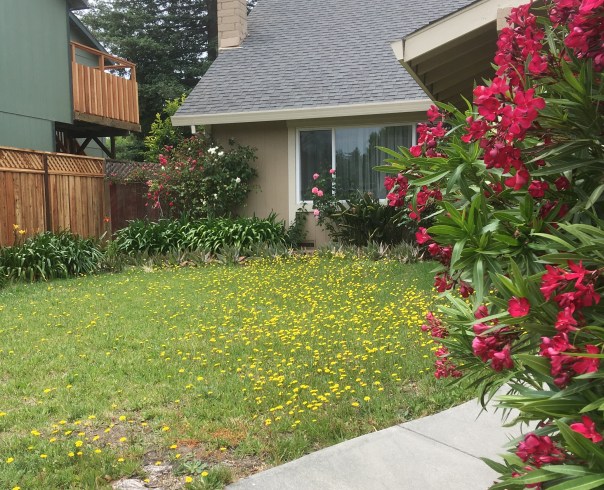
The catsear is prettier, I think, because the flowers are on long stems that wave in the breeze. I had them before my re-landscaping project began, and several of my neighbors still have them in abundance; here I am showing Ray’s place, as good as it ever looks, because he never does anything but mow once or twice a year….

And below, Vera’s front yard. Unlike Ray, Vera likes to garden, and she gave me my aloe saponaria start many years ago.

I never see real dandelions anymore. They must need more water, and the recent conditions are letting the catsear dominate.

I walk by this rose bush several times a week. It’s not cared for, and looks generally bad, but on this particular morning there was one rare perfect bloom proudly standing out from the mess.

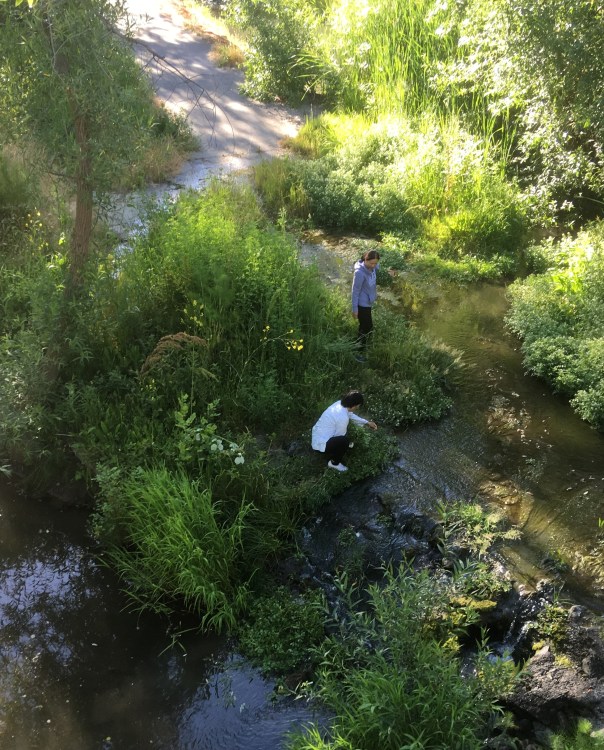
The most interesting thing I’ve seen in a long time on my walks was two Asian women down at the creek gathering watercress.

And the prettiest thing was bees on Russian sage. I can’t resist trying to photograph one more bee on one more flower, especially if it is a pairing of insect and flower that I haven’t captured before. I was so happy on my walk this morning, I didn’t want it to end, so I changed my route to add a few more blocks, and that’s how I happened to see these bees.


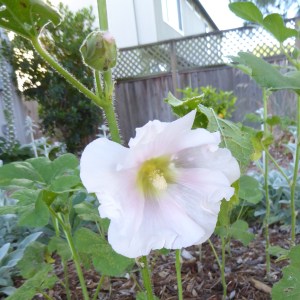
Back in my own garden, more plants are blooming. Kim gave me hollyhock seeds three years ago, and I planted them in my new greenhouse last fall and transplanted them to a spot that I think must be too shady, because the plants are diminutive – but the first bloom is out!


When designing my backyard garden, we deliberately planted the salvia near the dodonea, to get this color contrast. It’s working right now!

Above: fig tree, mock orange, and sea holly.

I have two kinds of lamb’s ears: the old ones that were propagated from my old garden, and which are all sending up long flower spikes right now.

…and new ones bought at a nursery, which have broad leaves, more green, and may not flower much. Lots of people have told me that their lamb’s ears don’t. But one of them is sneaking out a flower, only to send it on to the sidewalk to risk a trampling.

June has brought warmer temperatures, and I hope to spend more time in the garden again. Yesterday my dear godmother came over and we did sit eating our ice cream where we could hear the bees humming and the see the goldfinches at the feeder.

And we could smell the sweet peas! I ended up picking four bouquets of them yesterday, including one to send home with her. I also had to trim back some of the stems to keep them from squishing the pole beans. So this may be the peak of the bloom. There’s not much room for me to grow anything else just yet, because it’s the Year of the Sweet Peas!