Tag Archives: Mountain Pride

In the weeds and happy about it.

On my way up the mountain earlier in the week I came across several plants whose common names include the word weed: Two tarweeds and two vinegarweeds. They all got my attention by the way they added color to the drying-out landscape of late summer.

When I was still only approaching the foothills, I saw bluish plants dotting the yellow-brown expanse stretching out away from the road, and it didn’t look like anything I had ever noticed before.

It may be that in the past they were not as tall and visible from the road, and that this year’s extra rainfall helped Trichostema lanceolatum to thrive. It was hard to get a picture of it without my socks attracting various stickers waiting in ambush, but this closeup on Wikipedia shows what a graceful flower form is hidden in the overall unimpressive bush:

“The plant is an important pollen source for native bees and other insects. When a pollinating insect alights on the lower lobes of the corolla, and inserts its mouth parts into the nectar-containing lower section of the same tube, the narrow corolla portion above is straightened and snaps rapidly downward brushing pollen onto the insect’s back.

“The volatile oils make it unpalatable to grazing and foraging animals.

“The indigenous peoples of California used this as a traditional medicinal plant, as a cold and fever remedy, a pain reliever, and a flea insect repellent.”

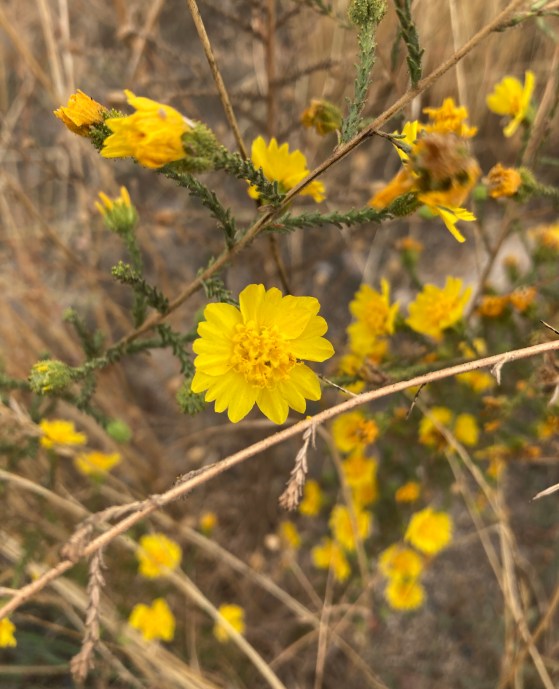
The two species of tarweeds caught my eye a little further on. I think it was mostly Fitch’s Tarweed, Centromadia fitchii, that had turned the slopes and flatlands gold in large swaths on either side of the highway.

But the more photogenic plant I managed to get close to was Heermann’s Tarweed (according to my Seek app), Holocarpha heermannii. Both of these plants are in the Aster Family, but different genera. A lot of tarweeds are in the Madia Family, but it seems that Heermann’s is irregular.
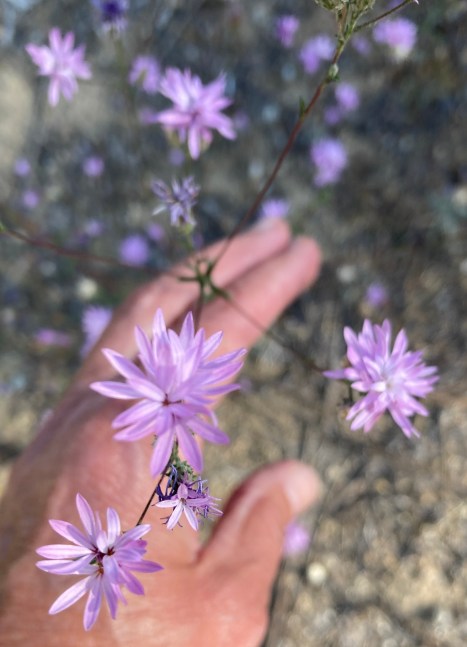
The second plant called vinegarweed grows along the roads in the High-er Sierra. When I first met it in 2009, it didn’t occur to me to taste it; maybe if I had, the idea of vinegar would have been uppermost? But my mind immediately wanted to call it Purple Haze, or Lavender Mist.
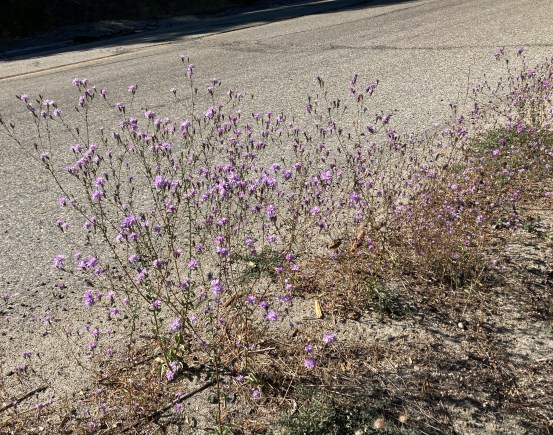
It typically gets my attention as I come  around a curve in the road, floating as a long pastel smudge on the shoulder. That first sighting was long before I had any kind of nature identification app, and when I eventually found someone who could tell me what it was (Sierra Vinegarweed or Lessingia leptoclada), that amateur botanist told me that if it had been up to her, she’d have named it Lavender Groundsmoke. The hope of encountering these flowers again would alone be enough to bring me up to the mountains every summer.
The last plant I will share has no connections to vinegar or tar; it is the favorite Mountain Pride, or Newberry’s Penstemon. In an average year, its flowers would have faded to brown by now, and in fact most of them have. But the snow hung on so late here this summer, till the end of July, that the earliest wildflowers had to wait at least a couple of weeks longer to emerge. I was happy to find one bloom of Mountain Pride still fresh and bright. These plants that sit overlooking the lake are a landmark for me, announcing at the end of my journey to the cabin, You have arrived!
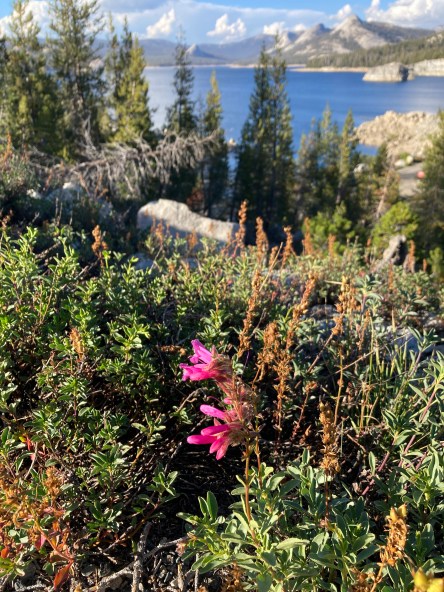
The very thing.

Web photo

The hawk dropped down to the shoulder of the road just ahead of where I was driving down the mountain. It was at the elevation where you start to see the elderberries that don’t grow much higher, about 6,000 feet. He carried something in his talons that touched the ground just before he did.

I didn’t see any cars in my rear view mirror, so I slowed to a stop in the middle of the road and looked out the window at him, a few feet away on the other side of the road. He looked calmly at me. I should say, he looked in my direction, because I don’t know… what if I were the first human he had ever seen? Does a bird focus on another creature’s face and eyes, the way a human baby does? I stared and he looked a little bored, for ten long seconds, and then he flew into a tree nearby.

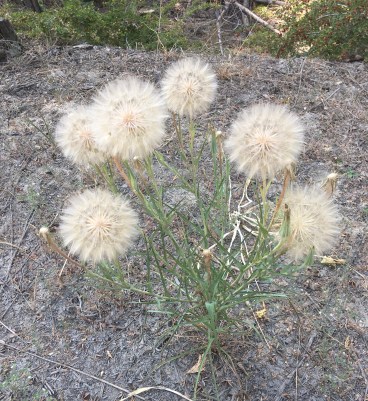
salsify

That meeting was one of the exciting events of my drive down from the mountains this week. I’d stayed at the cabin two more nights after my family departed, and had anticipated that when I finally left I would do my typical stop-and-go meandering for at least the first few thousand feet of descent, say, from 8,000 to 5,000 feet elevation. Because in July there are many more wildflowers than in September, the month in which I most often have visited this part of the High Sierra.

When the rain began to fall, and fell harder the morning I was to leave, it seemed my plans would have to change, and I might only be collecting rocks for my garden, instead of wildflower pictures. I always love rain at the cabin, so I did not complain at all. And it surely wouldn’t be a bad thing if I got home sooner rather than later. But — about the time I’d finished closing up the place and packing my car, the clouds began to break up, so that this was my last view of the lake:

The first wildflower I found, one I hadn’t seen for years, was Mountain Pride, bordering the road. It and Wavyleaf Paintbrush had few flowers remaining, but they provided a bright contrast to the sky, water and granite. This is a picture of them taken four years ago nearly to the day, in the same place. The snow melted earlier this year, as there was not much of it, so the bloom peaked before I got here.

I noticed or met for the first time no fewer than 18 different species of wildflowers that day, most of which I wrote down in a little notebook each time I got back into my car to drive further along the road, going slow and keeping my eyes open for spots of color, or whatever else might appear. Some of the flowers that I won’t show you were:

Spreading Dogbane
Arrowleaf Senecio
Goldenrod
Deer Vetch
Ranger’s Buttons
Spanish Clover
California Aster
Delta Sunflowers
Groundsmoke

My favorite flower of the day by far was Bigelow’s Sneezeweed, a darling thing which I first saw in this area many years ago. I pulled over for it several times, and the last time was the best display, with bees and two kinds of butterflies drinking at the blooms.

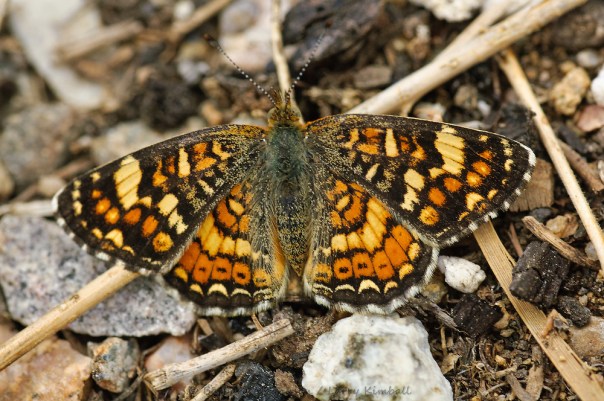
One of them was the Field Crescent, of whom I didn’t get a good shot, but here is one I found online of this little insect:

Field Crescent Butterfly [Phyciodes campetris]
Mormon Fritillary

Should Nature at times, on our awakening, propose to us
The very thing to which we were disposed,
Then praise at once swells in our throats.
We feel we are in paradise.

-Francis Ponge

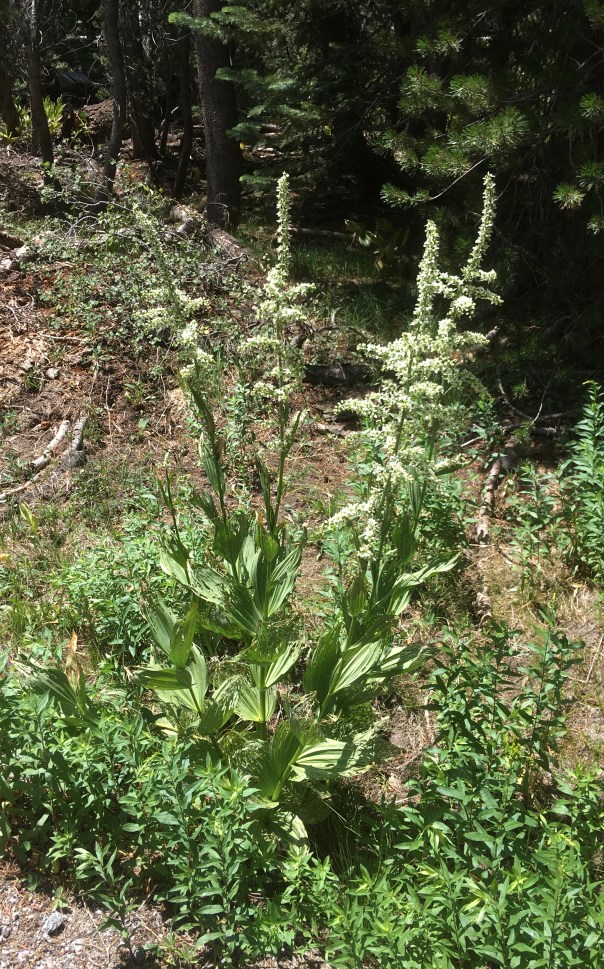
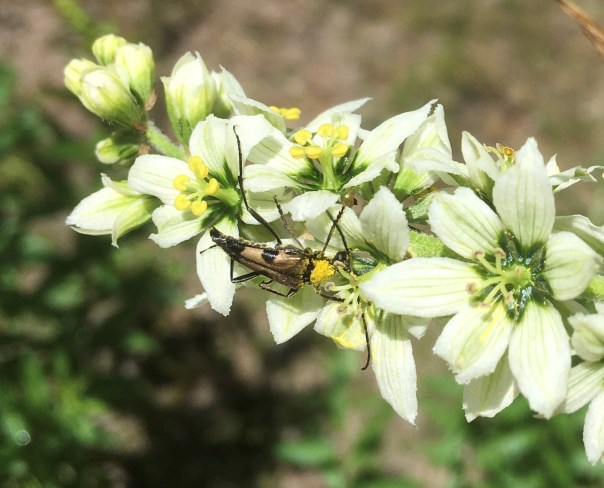
The corn lilies were blooming, and a beetle was on site for that glorious event, seeming to have lost its head over pollen:

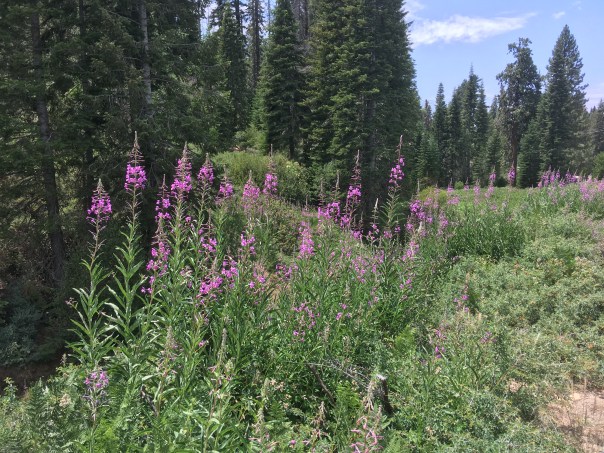
Fireweed waved its purple flowers in the breeze. “It earned its name because this plant is the first colonizer in the soil after forest fires.”


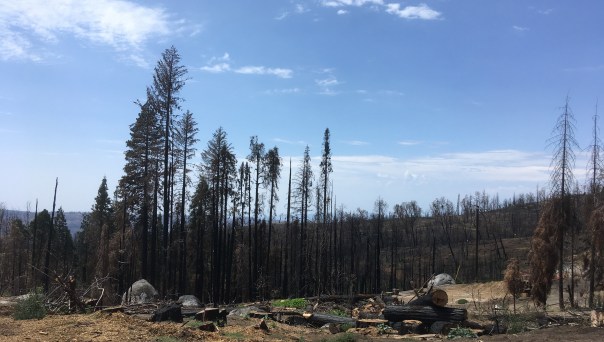
This next picture shows an area ripe and ready for some fireweed to sprout and grow; it is a landscape resulting from the Creek Fire last fall.

That was the huge fire that necessitated closing the highway that we use to get to our cabin, the same week that Soldier’s family and I had planned to be up there. We went to the beach and took smoky pictures instead.

Already I saw wild roses blooming among the stumps, and this healthy milkweed:

I often have run across wildflowers with buckwheat as part of their common name. This page shows you how vast is that family, called Polygonaceae, that includes mountain sorrel, curly dock — and rhubarb, of all things. But the strange species I saw a lot of on my drive was Naked Buckwheat.

It has strong, wire-like stems that are tall and bare for most of their length, with white puff-balls at the tip.

Bridges’ Penstemon

I wanted to get a nice picture of the elder bushes in flower, and when I squeezed in close this bright and rather large beetle got my attention:

I began to think of all the fascinating and complex creatures that live their (often short) lives in “obscurity.” I bet no one else had ever seen that bug. God lavishes the earth with life and beauty as an expression of His generosity and love.

As I went down the mountain, it was like an hours-long birthday party with Him saying, “Stop here. See that flower? It’s one of the special gifts I’m giving you today.” Then, “Look there! A red and black bug I chose just for you.”

He gave me sneezeweed because they are my old friends. He introduced me to a hawk for something new. Butterflies fluttered, proposing the very thing to which I was disposed. This place was not paradise, we can tell that by the fire damage, and many other aspects. But there was a little taste of Paradise in my soul, and praise swelling in my heart.