Tag Archives: mystery

Open, wide-awake eyes.

“The lack of mystery in our modern life is our downfall and our poverty. A human life is worth as much as the respect it holds for the mystery. We retain the child in us to the extent that we honor the mystery. Therefore, children have open, wide-awake eyes, because they know that they are surrounded by the mystery. They are not yet finished with this world; they still don’t know how to struggle along and avoid the mystery, as we do. We destroy the mystery because we sense that here we reach the boundary of our being, because we want to be lord over everything and have it at our disposal, and that’s just what we cannot do with the mystery….

Living without mystery means knowing nothing of the mystery of our own life, nothing of the mystery of another person, nothing of the mystery of the world; it means passing over our own hidden qualities and those of others and the world. It means remaining on the surface, taking the world seriously only to the extent that it can be calculated and exploited, and not going beyond the world of calculation and exploitation. Living without mystery means not seeing the crucial processes of life at all and even denying them.”

-Dietrich Bonhoeffer, God is in the Manger: Reflections on Advent and Christmas

They are not two worlds.

“In the traditional theology of the Eastern Church this world and the ‘next’ are not two worlds. We use the language of place (heaven and earth) for lack of language not for accuracy. There is more to the created order than we see (‘all things visible and invisible’). But that which is not seen is not inherently separate from that which is. Sacrament (mystery in the East) is a way of describing the relationship between what is seen and what is unseen. Everything is sacrament, icon and symbol.”

-Fr. Stephen Freeman in “A Secular Death”

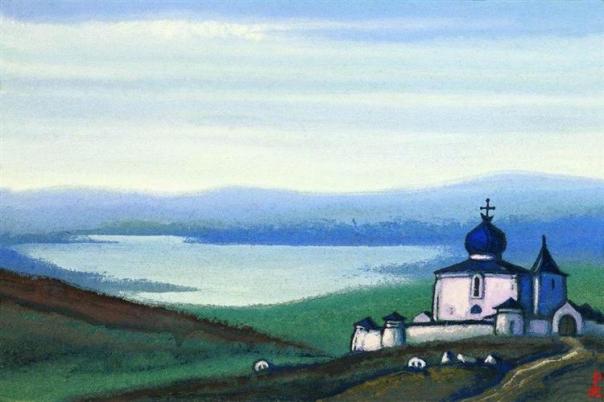
Nicholas Roerich, Novgorod Cemetery

Cherries and new galaxies.

EVERYTHING IS PLUNDERED, BETRAYED, SOLD

Everything is plundered, betrayed, sold,
Death’s great black wing scrapes the air,
Misery gnaws to the bone.
Why then do we not despair?
By day, from the surrounding woods,
Cherries blow summer into town;
At night the deep transparent skies
Glitter with new galaxies.
And the miraculous comes so close
To the ruined, dirty houses—
Something not known to anyone at all,
But wild in our breast for centuries.

-Anna Akhmatova

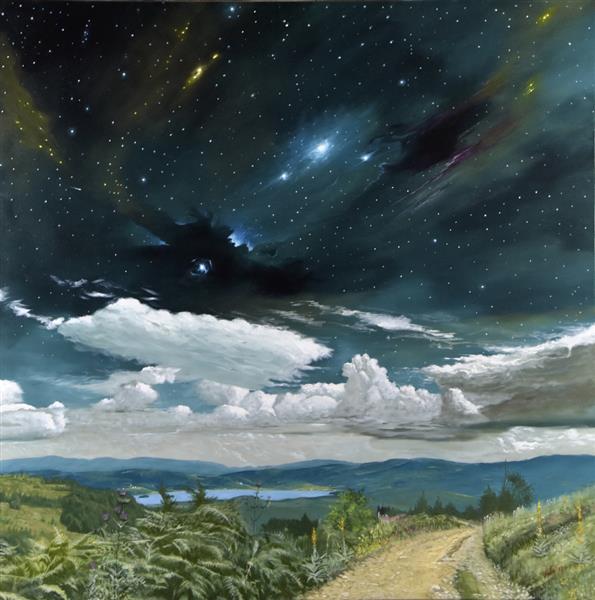
Vlasina Stars, by Goran Vojinovic

Poetry’s argument with doubt.

“Doubt is more intelligent than poetry, insofar as it tells malicious tales about the world, things we’ve long known but struggled to hide from ourselves. But poetry surpasses doubt, pointing to what we cannot know. Doubt is narcissistic; we look at everything critically, including ourselves, and perhaps that comforts us. Poetry, on the other hand, trusts the world, and rips us from the deep-sea diving suits of our ‘I’; it believes in the possibility of beauty and its tragedy.

“Poetry’s argument with doubt has nothing in common with the facile quarrel of optimism and pessimism. The twentieth century’s great drama means that we now deal with two kinds of intellect: the resigned and the seeking, the questing. Doubt is poetry for the resigned. Whereas poetry is searching, endless wandering. Doubt is a tunnel, poetry is a spiral. Doubt prefers to shut, while poetry opens. Poetry laughs and cries, doubt ironizes. Doubt is death’s plenipotentiary, its longest and wittiest shadow; poetry runs toward an unknown goal. Why does one choose poetry while another chooses doubt? We don’t know and we’ll never find out. We don’t know why one is Cioran and the other is Milosz.”

-Adam Zagajewski, 1945-2021
A Defense of Ardor: Essays

Krakow 2011 –  Adam Zagajewski