“Have no anxiety. Sometimes what’s worse than being sick is being afraid of getting sick. Leave it to God. Whatever God gives you is best for you. God never gives you a cross without first weighing and measuring it very carefully to make sure that the cross will result in your spiritual growth.”
Today I’ve been tossing out most of my beloved Touchstone and Gilbert magazines, but not before I glance at notes I’d written to myself on their covers ten or more years ago, suggesting to my mind and pen (and keyboard) topics to muse and write about. I have accumulated several boxes of such periodicals, including cooking and gardening magazines as well, every issue containing provocative information and knowledge that I hoped to incorporate into my daily life, both the active and contemplative aspects.
One of them that drew me in was short enough to reread this morning: “It All Depends: on Randomness and the Providence of God,” by Philip Rempel. Rempel compares the Enlightenment view of the cosmos as orderly clockwork to the postmodern concept of it as random and chaotic. Both end up being “dead and dreary,” especially when contrasted with the reality of the world we see in front of us, and described in the language of Christ and the church.
“For the world we observe if we open our eyes is indeed a universe filled with both structure and freedom, but the structure is never a rigid structure and the freedom is never a lawless freedom. As in a dance, or all art for that matter, where rules and creativity must work in tandem to produce something of meaning, so it is with the universe. In some sense we are part of a cosmic dance, but the dance must be structured if it is to have meaning; a universe of arbitrary motion is just as unsatisfying as a universe without motion.
“The existence of every created thing, and thus its role in the dance, is entirely and continually dependent on God, and so our movement through the cosmos and through time, which is our response to his love, must be continually focused on him and directed towards him. Particles and probabilities, and people and planets, are all twirling through the cosmos in response to God’s loving call.”
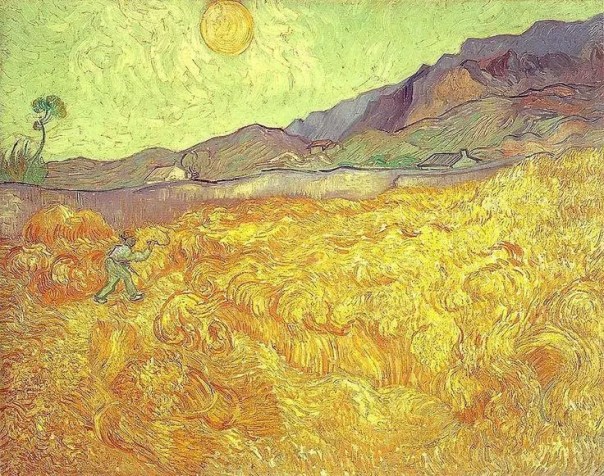
I have always loved this hymn since singing it in the Presbyterian church of my childhood. I included it in a booklet of Thanksgiving hymns I put together some years ago, for our family to sing when we gathered for the feast. Here is John Rutter conducting a choir singing it: We Plough the Fields and Scatter. The lyrics have undergone some adaptation over the decades, which you can read about on Wikipedia where the hymn has its own entry.
Matthias Claudius published this poem in Germany, where it was set to music attributed to Johann A. P. Schulz, in 1800. I also like this bold instrumental version: We Plough the Fields and Scatter.
WE PLOUGH THE FIELDS AND SCATTER
We plough the fields and scatter the good seed on the land, but it is fed and watered by God’s almighty hand; he sends the snow in winter, the warmth to swell the grain, the breezes and the sunshine, and soft refreshing rain.
He only is the Maker of all things near and far; he paints the wayside flower, he lights the evening star; the wind and waves obey him, by him the birds are fed; much more to us, his children, he gives our daily bread.
We thank thee, then, O Father, for all things bright and good, the seed-time and the harvest, our life, our health, our food. Accept the gifts we offer for all your love imparts, with what we know you long for: our humble, thankful hearts.
All good gifts around us are sent from heaven above; then thank the Lord, O thank the Lord for all his love.
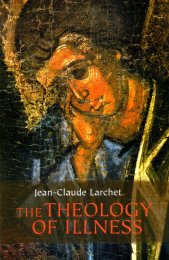
To the brief passage below, taken from The Theology of Illness by Jean-Claude Larchet, the author attaches four footnotes, in which he references St. John Chrysostom, St. Maximus the Confessor, St. Gregory Palamas, Vladimir Lossky and the Book of Job. He is a patristics scholar for sure! And he manages to incorporate many quotes from church fathers and Scripture in the main text as well, without making it hard to read. In fact, it is pure pleasure to follow Larchet’s explanations as he gathers from great minds of the church and reveals the unity of their thought and faith.
“God, who envisions the salvation of man and through man of the entire universe, does not allow the forces of evil to submerge and destroy His creation. Man and nature remain partially protected by His Providence, which imposes certain limits on the negative activity of the Devil and his demons. Thereby God stabilizes the cosmos in its slide toward nothingness, establishing a certain order in the very heart of disorder. Even if man has lost the ‘likeness’ of God which he began to acquire, he nevertheless remains bearer of the divine ‘image,’ even if that image is veiled, obscured, and deformed.
“Thus man is not totally deprived of grace. Even in his weakness he retains sufficient spiritual power to be able, if he wishes, to turn again toward God and to obey the commandments which he continues to receive from Him (Dt 30:11-19). And thereby he is able to maintain, according to God’s own promise, a certain mastery over nature (cf. Gen 9:1-2).
“Nonetheless, this new balance remains fragile. Man and nature have become a battleground where evil and good, death and life, wage a permanent, merciless combat against each other. This combat is made evident by sickness, infirmity and suffering; and until the Incarnation of Christ, its outcome was uncertain.”
 Today I’ve been tossing out most of my beloved Touchstone and Gilbert magazines, but not before I glance at notes I’d written to myself on their covers ten or more years ago, suggesting to my mind and pen (and keyboard) topics to muse and write about. I have accumulated several boxes of such periodicals, including cooking and gardening magazines as well, every issue containing provocative information and knowledge that I hoped to incorporate into my daily life, both the active and contemplative aspects.

 Gladsome Lights