Tag Archives: Psalms

What Athanasius knew.

Psalm 58:8

Thou tellest my wanderings:
put thou my tears into thy bottle:
are they not in thy book?

The more one researches current events, historical accounts, and the tangled web of cultures and civilizations going back to the foundation of the world, the more likely is a fall into worry and even despair. We fear especially for children who have to grow up in a violent era, as many have done. That’s why I take courage from the life of St. Athanasius, and pray that my children, grandchildren, godchildren, and all of us, might learn deep in our souls what he knew. The following is an excerpt from a post I wrote several years ago in a time of sorrow. I have shared the quote from his treatise more recently than that, but I hope you might agree with me that it’s worth rereading:
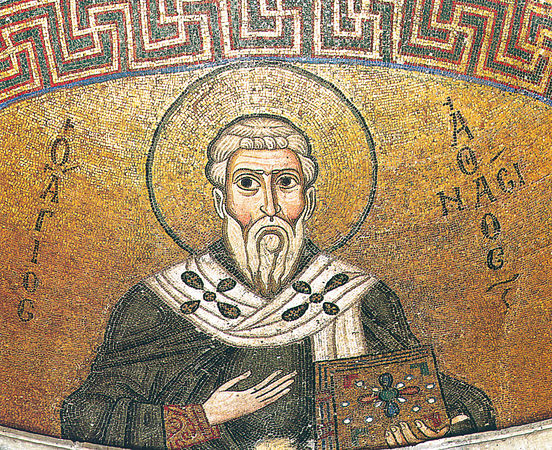

I learned in the short account of the life of Athanasius at the beginning of his On the Incarnation, that the last and worst persecution of Christians ended in Egypt in 311 A.D., when Athanasius was about fourteen. From the age of five he had lived with the constant threat of death, and with the ever-present reality of persecution of his friends and family. The behavior of the ungodly is irrational and inhuman, and tends to cause great pain and suffering, often unto death, not only of the innocent but also of the most Christ-like. As an adult the scenes and events of his childhood seem to be fresh in his mind when he writes:

“A very strong proof of this destruction of death and its conquest by the cross is supplied by the present fact, namely this. All the disciples of Christ despise death; they take the offensive against it and instead of fearing it, by the sign of the cross and by faith in Christ trample on it as on something dead. Before the divine sojourn of the Saviour, even the holiest of men were afraid of death, and mourned the dead as those who perish. But now that the Saviour has raised his body, death is no longer terrible, but all those who believe in Christ tread it underfoot as nothing, knowing full well that when they die they do not perish, but live indeed, and become incorruptible through the resurrection. But that devil who of old wickedly exulted in death, now that the pains of death are loosed, he alone it is who remains truly dead.”
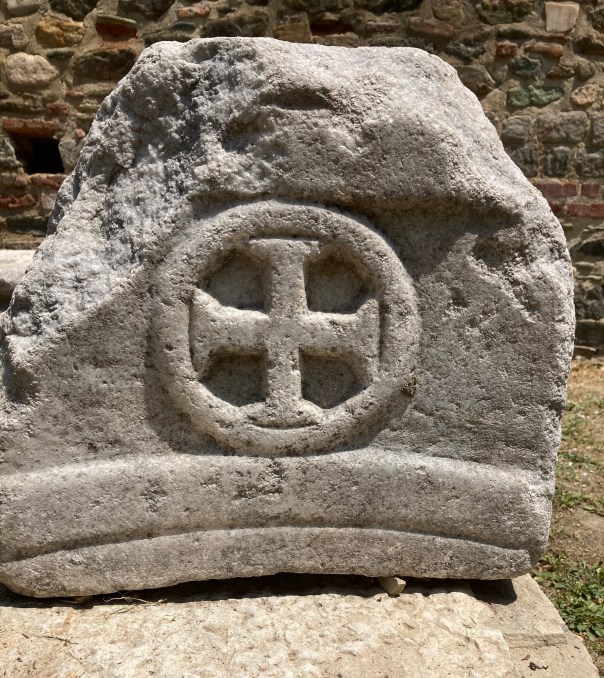
Thessaloniki – Rubble at Church of the Acheiropoietos

The 23rd Psalm

THE 23rd PSALM

The God of love my shepherd is,
And he that doth me feed:
While he is mine, and I am his,
What can I want or need?

He leads me to the tender grass,
Where I both feed and rest;
Then to the streams that gently pass:
In both I have the best.

Or if I stray, he doth convert
And bring my mind in frame:
And all this not for my desert,
But for his holy name.

Yea, in death’s shady black abode
Well may I walk, not fear:
For thou art with me; and thy rod
To guide, thy staff to bear.

Nay, thou dost make me sit and dine,
Ev’n in my enemies’ sight:
My head with oil, my cup with wine
Runs over day and night.

Surely thy sweet and wondrous love
Shall measure all my days;
And as it never shall remove,
So neither shall my praise.

–George Herbert


Eating food that is not dead.

“Prepare yourself, my soul! Be courageous like Abraham, Isaac and Jacob, that acquiring diligence and wisdom you too may meet your God. Through contemplation may you reach the awesome depths in which He dwells and in so doing become a good steward of the Lord.”
-Canon of St. Andrew

For the Orthodox, it is the first week of Great Lent, which is called Clean Week. We began the fast on Monday, after the Vespers of Forgiveness on Sunday. This year in my parish we were thankful for good weather that day, as our long line of people bowing to each other in their masks, and mostly not hugging, stretched in a long loop that went out the side door of the church and wrapped loosely around the front. We were saying, “Forgive me,” to each one, and replying “God forgives.” Many of us had not seen each other in person for months or even the whole year.

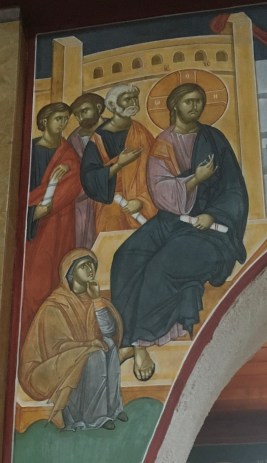
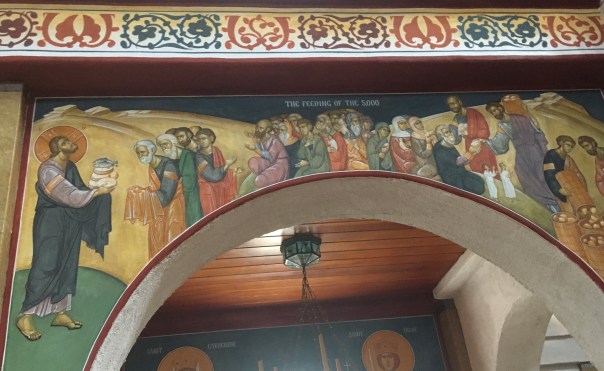
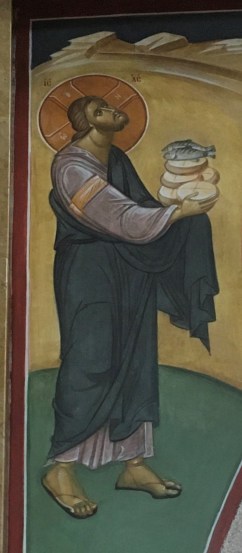
Two new frescoes had been completed just in time to take down the scaffolding and make room for Lenten services. As I took pictures of them on Sunday I realized how each of them draws me into an aspect of the season.

Christ in the House of Mary and Martha in Bethany (on the other side of the arch, not pictured, is Martha scowling) makes me want to imitate Mary and sit at Jesus’s feet. And The Feeding of the Five Thousand reminds me of various levels of meaning in the lines of the Lord’s Prayer, “Give us this day our daily bread.” As we are going without physical food in various ways during this season, that part of our prayer is extra meaningful. The most striking words I ever read on the relation of earthly and heavenly food were in For the Life of the World by Fr. Alexander Schmemann:

“The natural dependence of man upon the world was intended to be transformed constantly into communion with God in whom is all life. …He still loves, he is still hungry. He knows he is dependent on that which is beyond him. But his love and his dependence refer only to the world in itself. He does not know that breathing can be communion with God. He does not realize that to eat can be to receive life from God in more than its physical sense. He forgets that the world, its air or its food cannot by themselves bring life, but only as they are received and accepted for God’s sake, in God and as bearers of the divine gift of life. By themselves they can produce only the appearance of life.

“…Things treated merely as things in themselves destroy themselves because only in God have they any life. The world of nature, cut off from the source of life, is a dying world. For one who thinks food in itself is the source of life, eating is communion with the dying world, it is communion with death. Food itself is dead, it is a life that has died and it must be kept in refrigerators like a corpse.”

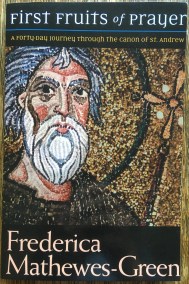
The most prominent reading during the first week of Lent is The Great Canon of St. Andrew of Crete, which is typically divided into four parts sung during services of that week. This year our women’s book group also chose a book on the Canon to read during this season.

I’ve noticed that during the Compline service when the Canon is being read, year by year, there are so many Scripture passages and characters referred to, that I can’t absorb half of it in my mind. Being at the service and participating with my whole body, soul and spirit is the way to do it — we humans are so much more than our thoughts! This week the Compline hymns have been the sweetest part for me, and as usual, a phrase or two from the Canon about a particular sin or person in the Bible will also grab my mind and stick. I seem to have the opportunity for more contemplation generally these days, which is why the lines at top made their impression.

Psalm 69/70 is part of Compline, also, and a few lines from it will help me end this ramble.

“Let all those that seek thee
rejoice and be glad in thee:
and let such as love thy salvation say continually,
Let God be magnified.

“But I am poor and needy:
make haste unto me, O God:
thou art my help and my deliverer;
O Lord, make no tarrying.”

The face of the earth ever renewed.

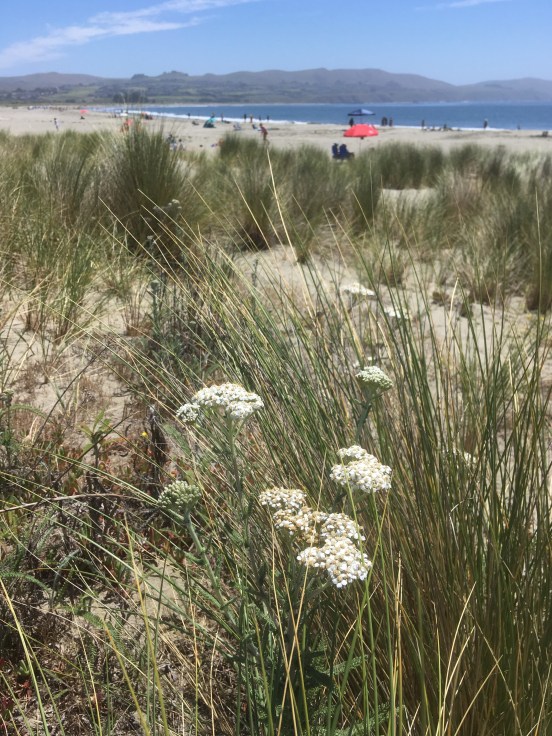
common yarrow

This sunny morning my neighbor Kim and I drove separately to the coast and met for a walk. On my winding way through the hills, I noticed Queen Anne’s Lace swaying in the breeze along the roadway. Trees, grasses and shrubs were painted in the gentlest pastel colors of lavender, green, and yellow-orange. The Psalter played through my speakers, and one of the Psalms I heard was 104, which is part of every Orthodox Saturday Vespers. It begins:

Bless the Lord, O my soul!

O Lord my God, You are very great:
You are clothed with honor and majesty,
Who cover Yourself with light as with a garment,
Who stretch out the heavens like a curtain.

He lays the beams of His upper chambers in the waters,
Who makes the clouds His chariot,
Who walks on the wings of the wind,
Who makes His angels spirits,
His ministers a flame of fire.

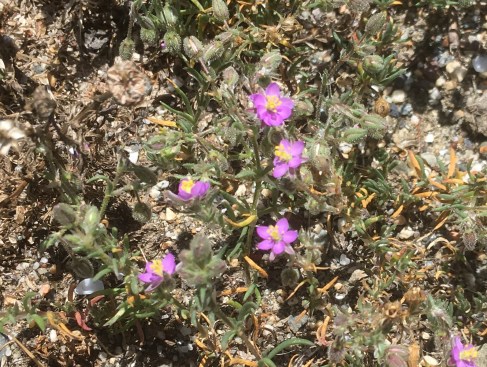
beach suncup

Once we set out at our brisk pace, I was distracted somewhat from my surroundings, except through my bare feet, which kept me tuned to the cool and firm sand under them, or the waves that splashed over. Though lots of people walked close to the surf, the beach in general wasn’t crowded. I had the feeling it must be the healthiest place around, with the quantities of sea air flowing freshly in and around us all.

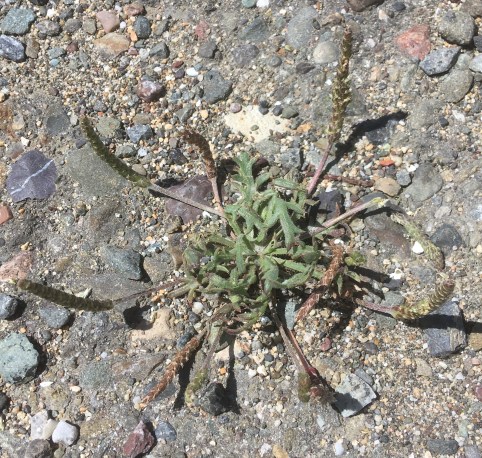
I lost track of time. Eventually we parted in the parking lot, and then I wandered by myself in the dunes for a while looking at flowering plants known and unknown to me. I’ve managed to identify most of them — I think.

Ribwort Plantain
Silver Beachweed
non-native sand spurry
what we call ice plant – native of South Africa
Buck’s-horn Plantain

O Lord, how manifold are Your works!
In wisdom You have made them all.
The earth is full of Your possessions—
This great and wide sea,
In which are innumerable teeming things,
Living things both small and great.
There the ships sail about;
There is that Leviathan
Which You have made to play there.

These all wait for You,
That You may give them their food in due season.
What You give them they gather in;
You open Your hand, they are filled with good.
You hide Your face, they are troubled;
You take away their breath, they die and return to their dust.
You send forth Your Spirit, they are created;
And You renew the face of the earth.

Yellow Bush Lupine

If I hadn’t had another obligation in the afternoon, I think I would have meandered up and down the coast till dusk. I’ve never been more thankful that I live close enough to be in the domain of the sand and the sea and the flowers, on a warm and sweet June day.