Tag Archives: Psalms

Stories of English – Wordstruck

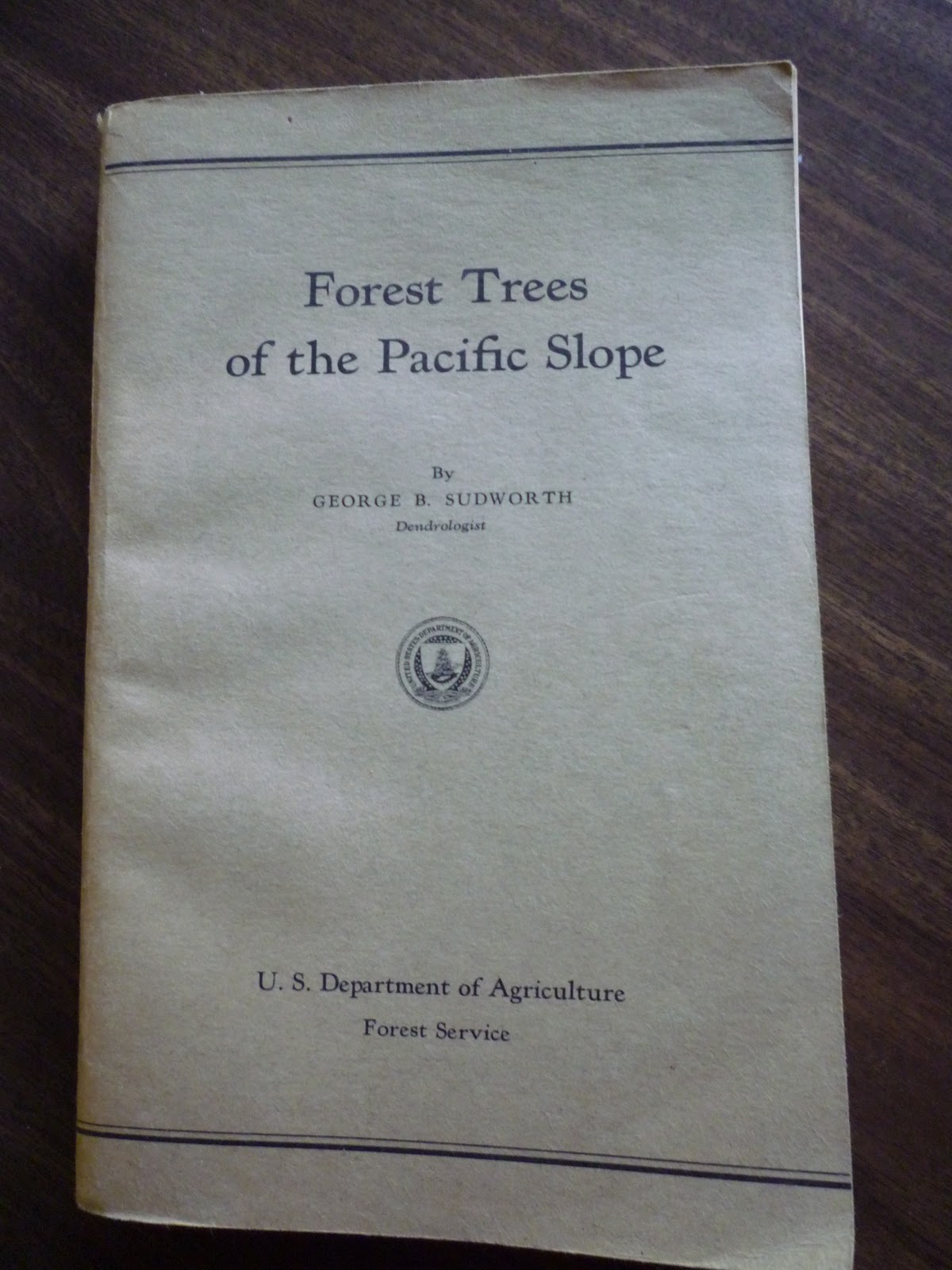
A friend gave me a used paperback copy of Wordstruck, a memoir by Robert MacNeil, of the MacNeil/Lehrer NewsHour that he hosted in different formats from 1975-1995 on TV. I had heard his name during those years, but our family didn’t watch television, so we didn’t pay attention until he co-authored the book The Story of English in 1986. It was quickly made into a TV series that we watched on our video player at home some time later.

I have often thought of renting the films again, because they were so fascinating in our fairly brief viewing. Now I find that Netflix doesn’t have them, and they are out of my price range to buy. There are some excerpts on YouTube.

Wordstruck chronicles MacNeil’s life up until the time he wrote the book in 1989, focusing on his love for the English language, including an account of the early influences that he thinks may have encouraged it. On the first page he describes an evening in chilly Nova Scotia when he was still a little boy, his mother reading to him while he snuggled in his pajamas on the sofa. She is reading the Robert Louis Stevenson poem “Windy Nights” that I read year after year to my own children — so I knew from the beginning that I would enjoy considering the author’s family life.

His parents loved books, and books were the main diversion of their life as “members of the large, scraping middle classes.” Mrs. MacNeil’s voice “was multi-hued, like glass fused of many bottles in a fire, with wisps of Lowland Scots and Highland Gaelic, Irish, Hanoverian German, Acadian French, and the many flavours of English deposited by generations of British soldiers and sailors,” and “She sounded enthralled, as full of wonder and close-rivetted attention as I was.”

And for MacNeil’s father, “Whatever he was doing, his books were a constant; even when he was short of cash for anything else, like paying bills, books appeared. In fact, he used books to hide the bills he couldn’t pay. Occasionally I found little nests of them when I pulled out a book. My mother said scornfully that was Irish–dealing with unpleasant reality by putting it away somewhere, out of mind. She never knew which books to look behind. It made her both furious with him and tender.”

“He always wrote on the flyleaf of each new book the date and where he was, so I can follow him: reading Chesterton just after they were married in November 1929, Scottish poets the following spring, Conrad through the early thirties, and Proust at sea in wartime….” Ah, what a life people lived before television!

MacNeil the Shakespearean actor explains how the words and rhythms and story of a poem like “Windy Nights” were so effective at training his mind to appreciate poetry without him being aware of anything except that he didn’t want his mother to stop reading. His grandmother loved that one, too, and made him memorize it on walks through the public gardens.

Stories of Robinson Crusoe, Gulliver’s Travels, Winnie-the-Pooh and Peter Pan; authors like Kipling and Dickens–they all contributed to a rich mental landscape, as words and word patterns populate the mind:

 “They accumulate in layers, and as the layers thicken they govern all use and appreciation of language thenceforth. Like music, the patterns of melody, rhythm, and quality of voice become templates against which we judge the sweetness and justness of new patterns and rhythms; and the patterns laid down in our memories create expectations and hungers for fulfillment again. It is the same for the bookish person and for the illiterate. Each has a mind programmed with language–from prayers, hymns, verses, jokes, patriotic texts, proverbs, folk sayings, clichés, stories, movies, radio, and television.”

“I picture each of those layers of experience and language gradually accumulating and thickening to form a kind of living matrix, nourishing like a placenta, serving as a mini-thesaurus or dictionary of quotations, yet more retrievable and interactive and richer because it is so one’s own, steeped in emotional colour and personal associations.”

Obviously MacNeil’s mind has a very thick matrix, and the book is full of his sharing various experiences of his life in all its cultural wealth, riches I think are made more valuable by being able to speak and write articulately about them from a broad knowledge background.

So far I’ve just drawn from the introductory chapters, but there are a few incidents later on that I want to mention. During WWII when he was still a boy, MacNeil paid ten cents for a tour of a captured German fighter plane, and while he sat in the cockpit the inspection of the inside “convinced me that Germans were real people, human beings….The few instruments had German labels and the realisation that the man who flew this had to be able to read the words which I could not made him intelligent, alive–a real person with a name. So were the Germans who had designed and built this beautiful machine, even if it was no match for our Spitfires, of course.”

From singing in the choir in the Anglican Church:

“There was poured into the porches of this child’s mind a rich echoing soup of sound which made literal sense only when recollected years later. If scientists could examine my brain, as they do the contents of murder victims’ stomachs, they would find that I had gorged myself when young on plum puddings and fruitcakes of this seventeenth-century prose; each word simple in itself, the combination rich and fruity, loved for the taste on the tongue, through years in the digesting; words for their own sake. That was particularly true of the often-repeated passages from the Book of Common Prayer, paraphrases of biblical verses that constitute English worship since the sixteenth century.”

“All this exposure to the King James Bible, the Book of Common Prayer, and the hymns seasoned me with the words and the forms that had launched British navies and armies into battle and imperial civil servants on their missions; the words that had christened the babies, married the daughters, and buried the dead of the Empire….It was like the tannin of English tea staining our souls for life. You do not lose it ever.”

God willing, His words have not stopped their work on the soul of this man who loves them so dearly as mere words, and not for His meaning that they carry. MacNeil tells us also about many of his favorite non-church words, like reek, and how they came to be and to change over time. He says of Old English: “The words are usually small, like nuts, with strong vowel sounds for flavor and a hard shell of consonants.”

In school the author was good at public speaking and reciting poems, and acting in plays. Then at seventeen, he fell in love–with Shakespeare. “On a winter afternoon in 1948….I didn’t find God but I found William Shakespeare, a piece of God’s work so extraordinary that he comes close to divinity itself.”

“The ironic cast of Shakespeare’s words released me a little from the prison of my self-absorption, and hooked me into a wider, grander scheme of things. They made me larger, freer.”

Of course, it is the language and literature of Shakespeare that MacNeil loves — but he also loves every other variety of English from limericks to slang. Being the author of The Story of English, he’s not afraid to acknowledge that language is always changing, and quotes Otto Jespersen, who wrote in 1905, “The English language would not have been what it is if the English had not been great respecters of the liberties of each individual and if everybody had not been free to strike out new paths for himself.”

There are some changes that do concern MacNeil: he wonders if we are losing our ear for the language because we have consigned good English to the printed page, and also started to depend on computers to choose our syntax and vocabulary. This makes us “more remote from the sound of our language, and therefore from a feeling for the weight of words.”

“There must be some living connection between the weight of words and truth….Today, it seems, words increasingly mean nothing to the person using them….The public words of public men seem to be used increasingly like aerosol room fresheners, to make nice smells.”

It was a very agreeable acquaintance to make, of Robert MacNeil and his love for the English language. I do like him, and spending time with him I was reminded of my own efforts to give my children a rich literary diet in their youth. I certainly did love to read to them; I even made them memorize poetry. But I know I haven’t loved the language as much as this man.

I’m impressed with his writing skill and glad to meet someone who rejoices in so many aspects of his humanity, but it is the Creator of us humans who ultimately deserves our adulation and love. For a fact, Shakespeare and even Robert MacNeil are examples of God’s handiwork and make us know something of the divine, because they are made in God’s image. I can’t revel in the language very long before I start to praise the God who gave us the gift of language and speech.

Just thinking about speech and language brings Psalm 19 to mind. I pray that the literature of the Psalter is a powerful part of the matrix of my own children’s minds and hearts — now I feel that we didn’t read from it enough. Here is part of that particular psalm to help me bring my review to an end:

The heavens declare the glory of God; and the firmament sheweth his handywork.
Day unto day uttereth speech, and night unto night sheweth knowledge.
There is no speech nor language, where their voice is not heard.
Their line is gone out through all the earth, and their words to the end of the world.
….Let the words of my mouth, and the meditation of my heart, be acceptable in thy sight, O LORD, my strength, and my redeemer.
Up and Down the Mountain

Last week was the occasion of a blessed excursion to my family’s mountain cabin, and this time I shared the time with my dear friend Mrs. Bread.

I’ve blogged about the cabin and lake before, here and here. The last two years I went mostly for time alone with God in His Creation. This time I enjoyed plenty of that experience, plus deepening of friendship, and working on improving or maintaining the house and property. Now that my father has passed, I am part owner of this place, and I happily but more intensely feel the responsibility to do my part, though I’m afraid I’ll never match the hardworking devotion of my siblings who live closer; some of them can dash up just for the day if they need to.

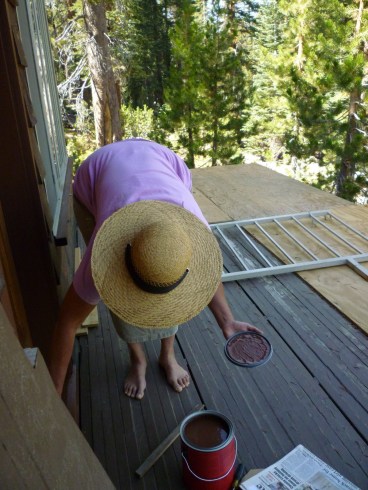
Here I am painting the threshold and doorjamb against the elements of winter. One year–or maybe more than one–the whole cabin was buried in snow, just a lump in the white landscape.

The drive took me ten hours, what with a leisurely detour to pick up Mrs. Bread on the way. So we stayed four nights so as to have three whole days for taking pictures, cooking, reading together, cleaning, admiring giant boulders and listening to the silence of the forest.
How can it be so awe-fully quiet? There are birds flitting and chipmunks scampering, breezes blowing and even the occasional chain saw in the village. But the earth feels peacefully serene up there, weighted with quiet, heavy with a silence that speaks of God’s presence. I seem to soak up contentedness and rest.
I needed the rest, as I had come down with a cough and cold in the two days before. The altitude gave me a headache the first night, and we both suffered from the reduced oxygen, our legs uncooperative and slow when we dragged back up the hill after a walk down to the lake.

It’s the High Sierra, and up there the mornings start out below freezing this time of year, making you want to lie abed and watch the sky lighten out the window. By midday it can be sunburning hot out on the deck, so we sat in the shade of the umbrella to peruse the several tree guides that have found their way to the cabin’s bookshelf.

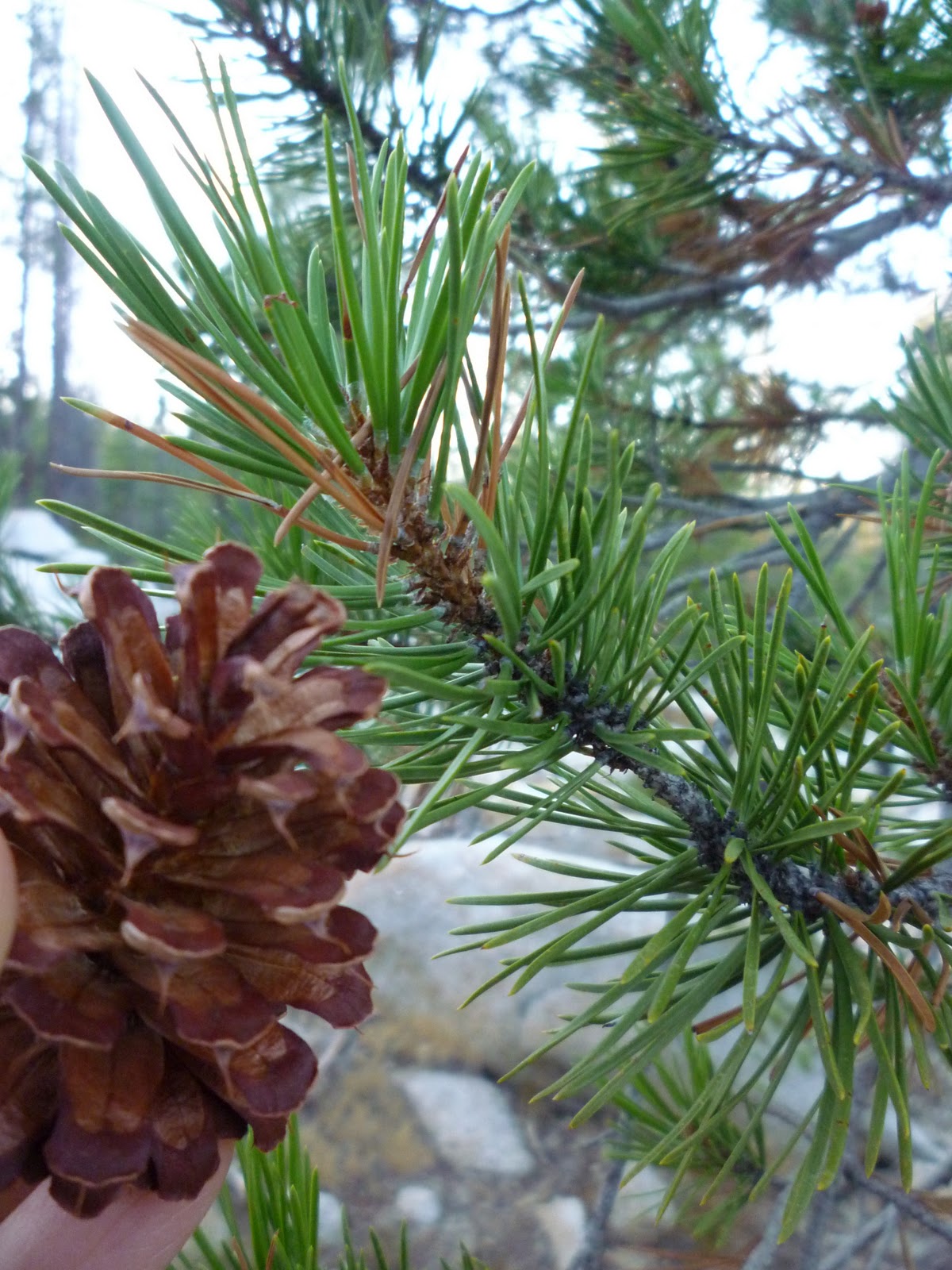
At first we limited ourselves to studying the general shapes and angles of branches, focusing in on the cones with binoculars. Eventually we walked among the trees below the cabin and noticed where cones had fallen underneath their mother trees.

The pines in the neighborhood are mostly Lodgepole, as illustrated by the picture here. But to be truthful, it took Pippin’s later confirmation of that suspicion to make me believe it.

As we walked together marveling at the various beautiful flowers, berries, and stones, Mrs. Bread said, “These little trees grab at my heart!” See why I love her?


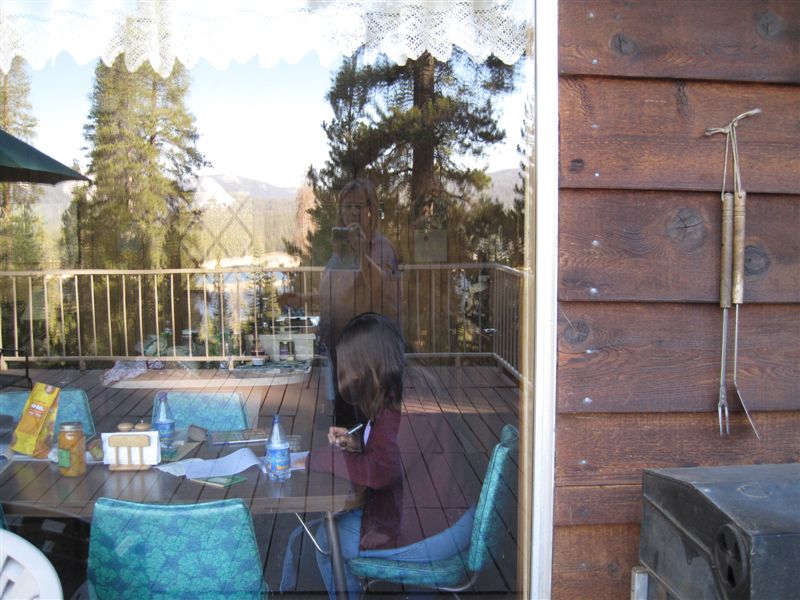
What a lot can be seen in this photograph, taken from outside the picture window, while I was sitting at the table inside writing a letter to a grandson. You can see the kitchen behind me, and the lake reflected behind Mrs. Bread’s reflection.

I like having these pictures of myself at the lake, something besides the ones of my feet that I took last year when solitary. Thanks, my friend!

P1030772

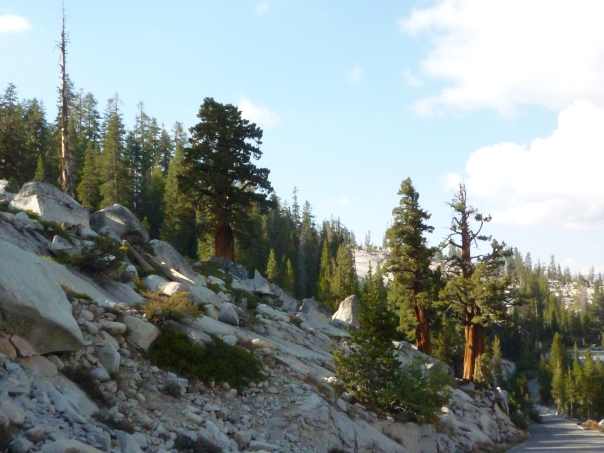
These three trees stood out from the pines with their trunks shown off by the granite slabs.  Mr. Glad thinks they might be red cedars.

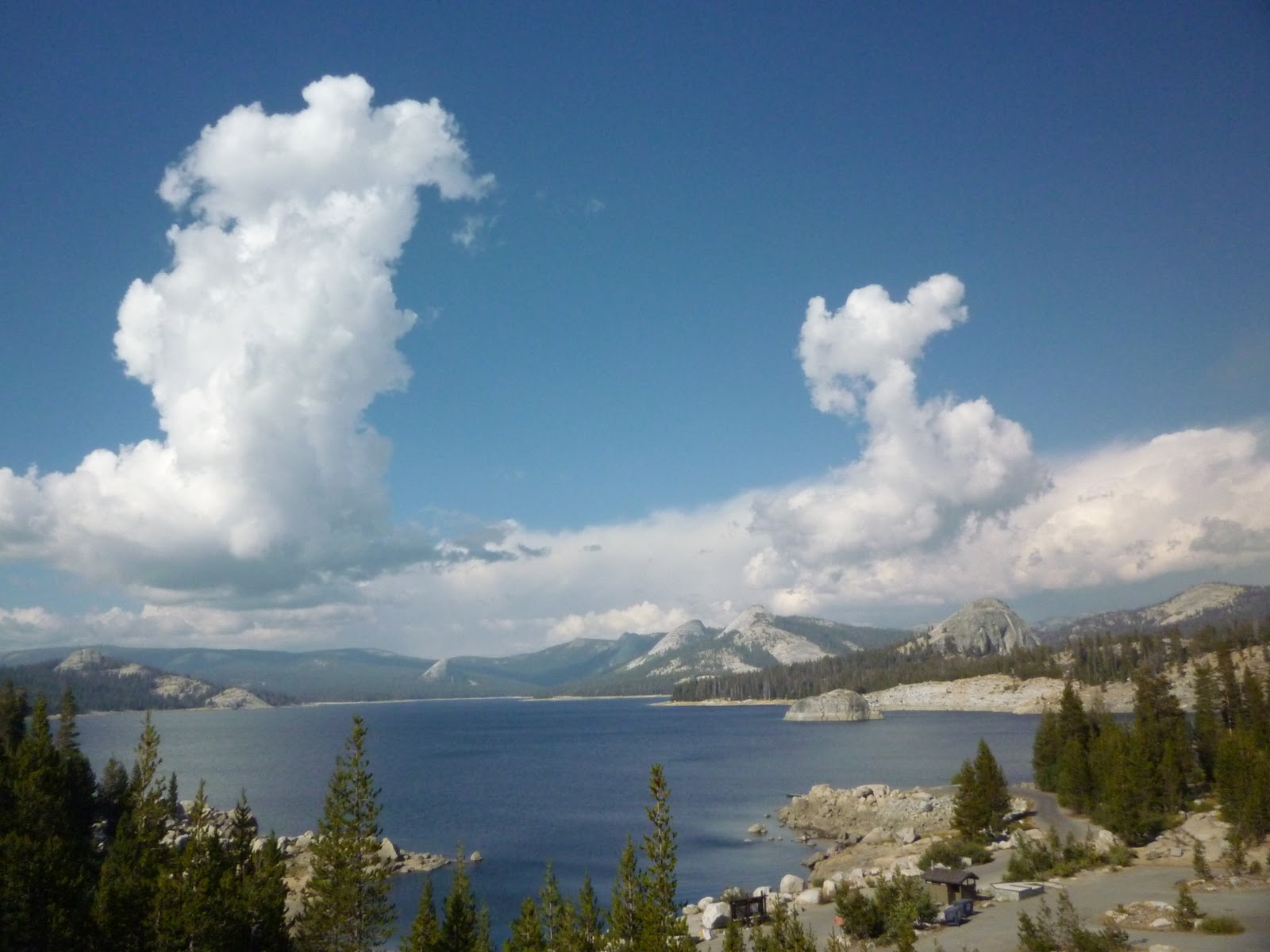
The first morning at the cabin I read in the Psalter, “For Thou hast said: Mercy shall be built up for ever,” (Ps. 88) and was musing about the image that phrase conjured in my mind, of an edifice being constructed. And why not the image of towers of clouds, that often rain down showers of blessing? From now on, when I see cloud skyscrapers rising fast, piling layer upon layer, I will think of the way God’s mercies do the same, every morning.

Someone brought this small remembrance of our father up to put on the bedroom wall. If you click on it a couple of times you can read the labels. I love seeing my father’s handwriting, which didn’t change in all the years since this collection was made when he was in college.

Mrs. Bread helped me firm up my resolve to try really hard to come up to this beloved place more next year. It’s not available for very long, though: This week shutters will be put up, water turned off, chimney covered, to mention only a few of the many tasks to protect the house from blizzards–and if we can get through the snow to open it up before the first of July we’ll be happy.
I’ve never been up more than twice in a summer; I wonder if I really do have the liberty to even dream of spending a week, or visiting twice or three times. I’ll pray for a miracle, and wait to see how the Lord chooses to pile up His mercies next year.

Yosemite Familiness

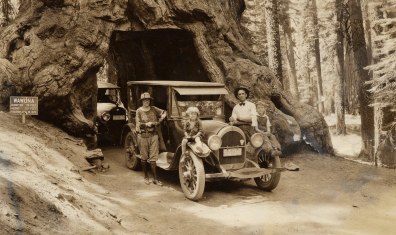
Probably it never happened before this, that we camped in Yosemite two summers in a row. But this year and last, we have been that fortunate. The park is so vast and varied, one could easily stay a month and never get bored; our ancestors often did just that. This old photo from before 1930 shows my mother as a child there.
Farewell-to-Spring


Nowadays there is a one-week limit on camping, and it’s a rare person who can do the phone work and combine it with luck enough to secure a site or a cabin in Yosemite Valley, where whole campgrounds have been eliminated since our little family started camping there in the 70’s. Pippin’s mother-in-law is one of those dedicated and generous people, and this year Mr. Glad and I benefited from her labors and came along as the second set of grandparents, joining Baby Scout and his parents.

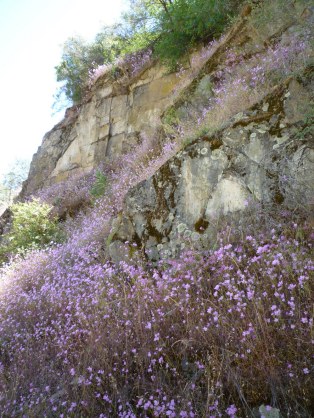
Being there in June meant that we got to see a different batch of wildflowers from those in July. All along the Merced Canyon coming in from Mariposa, the hills and roadsides were covered with these flowers that I am pretty sure are Farewell to Spring, otherwise known as Dudley’s Clarkia, a type of clarkia that reportedly only grows in California. Clarkia is named after William Clark of the Lewis and Clark Expedition, and I wasn’t surprised to learn that it is in the evening primrose family. It reminds me of the Mexican Evening Primrose by my driveway at home.

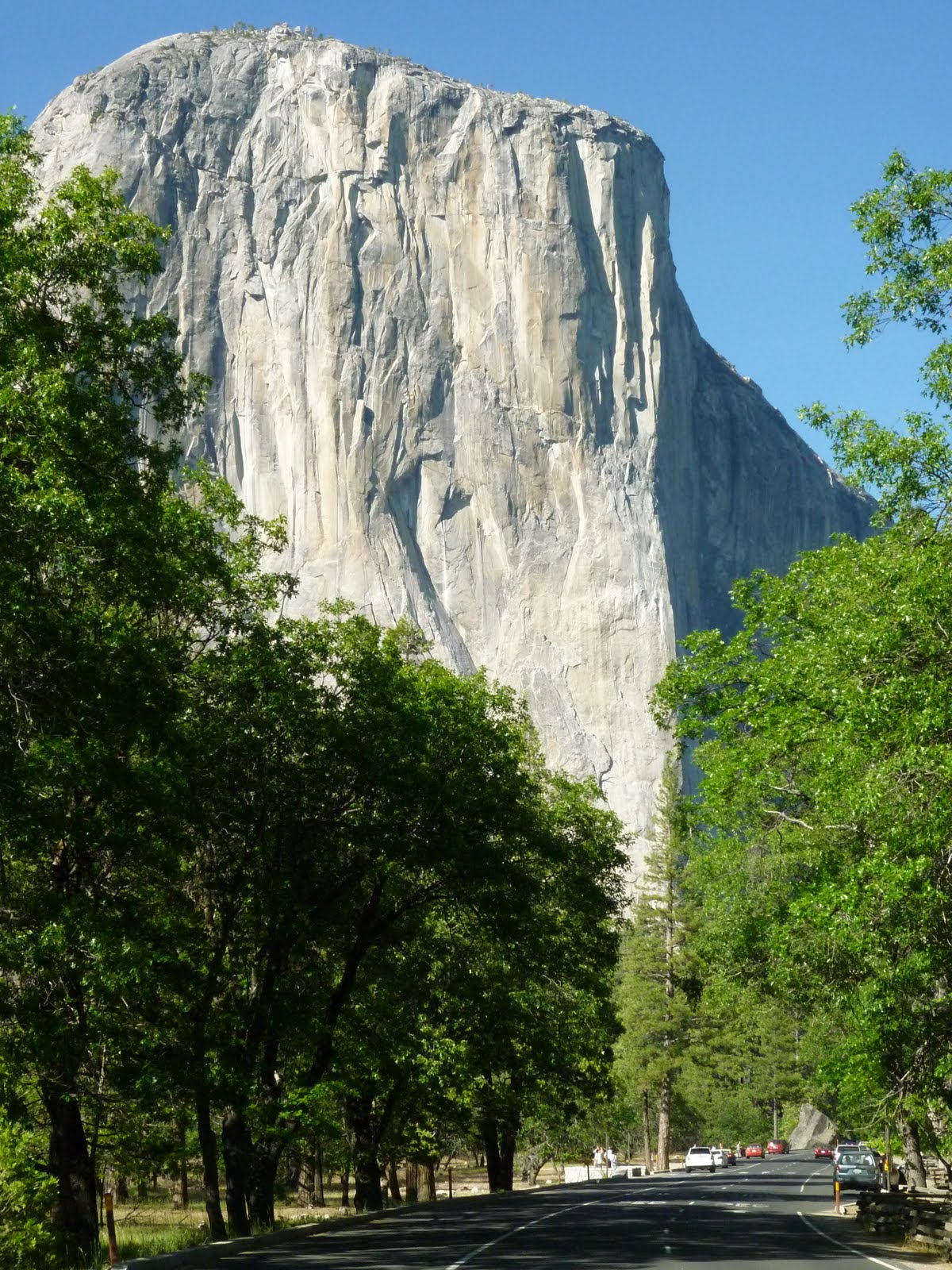
El Capitan
 The massive rock that speaks to me of God took my breath away
as we entered the valley, and this time I took my own photo.

All six adults in our extended family group were veteran campers with hearts thankful to the Creator for lavishing such beauty on us. One grandfather prayed thanks for the “familiness” we were enjoying and when I heard the word I knew it would be in the title of my blog.

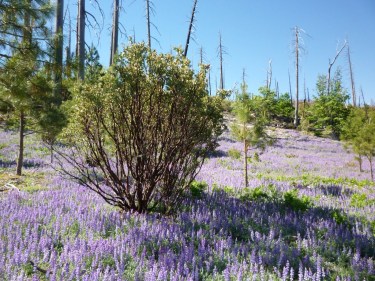
The first day some of us went on an expedition to gather firewood in an area that had been severely burned in 1991.  Pippin took pictures of Scout sitting in the middle of acres of purple lupine, and later we went into the woods and found the colorful Harlequin Lupine as well–two sisters in that family group.

That afternoon the same group of us hiked past Mirror Lake to Hidden Falls. The last time I had seen the lake it was just a swamp full of horsetail and other such stuff. But this year every body or stream or fall of water in Yosemite is at its fullest and highest, and many families with children were playing in the sandy boulder-studded water as we tromped past.

Rattlesnakes! We saw two on the trail– One crossed silently, completely ignoring us. But the second one shook his rattle as he slithered into the leaves. I took his picture, too, but he is well camouflaged.

Hidden Falls wasn’t easy to get to, not with my stiff and unreliable joints and sinews. There was much clambering up steep hunks of granite and even some log-walking, but before long we came to the spot on Tenaya Creek where all my senses were bombarded.

There is little dirt in that place; towering all around are trees with thick trunks, growing out of granite slabs and boulders as big as houses. And water, torrents of it this wet year, pouring off the top of more speckled gray rock in falls that remained hidden somewhat behind huge craggy stones. The water’s roar echoed off all the rocks and made talking nearly impossible, and the brightness of the white foamy water glared somewhere out of every photo frame.

Child Pippin some decades ago

Scout had come along in the backpack. His parents sat him down in a flat place next to the falls and me, while they tried to scramble a little higher, and he started singing and squealing. He liked the excitement in the air, I think, all the fine cold spray and the tempest blast of sound. Clean and fresher than anything.

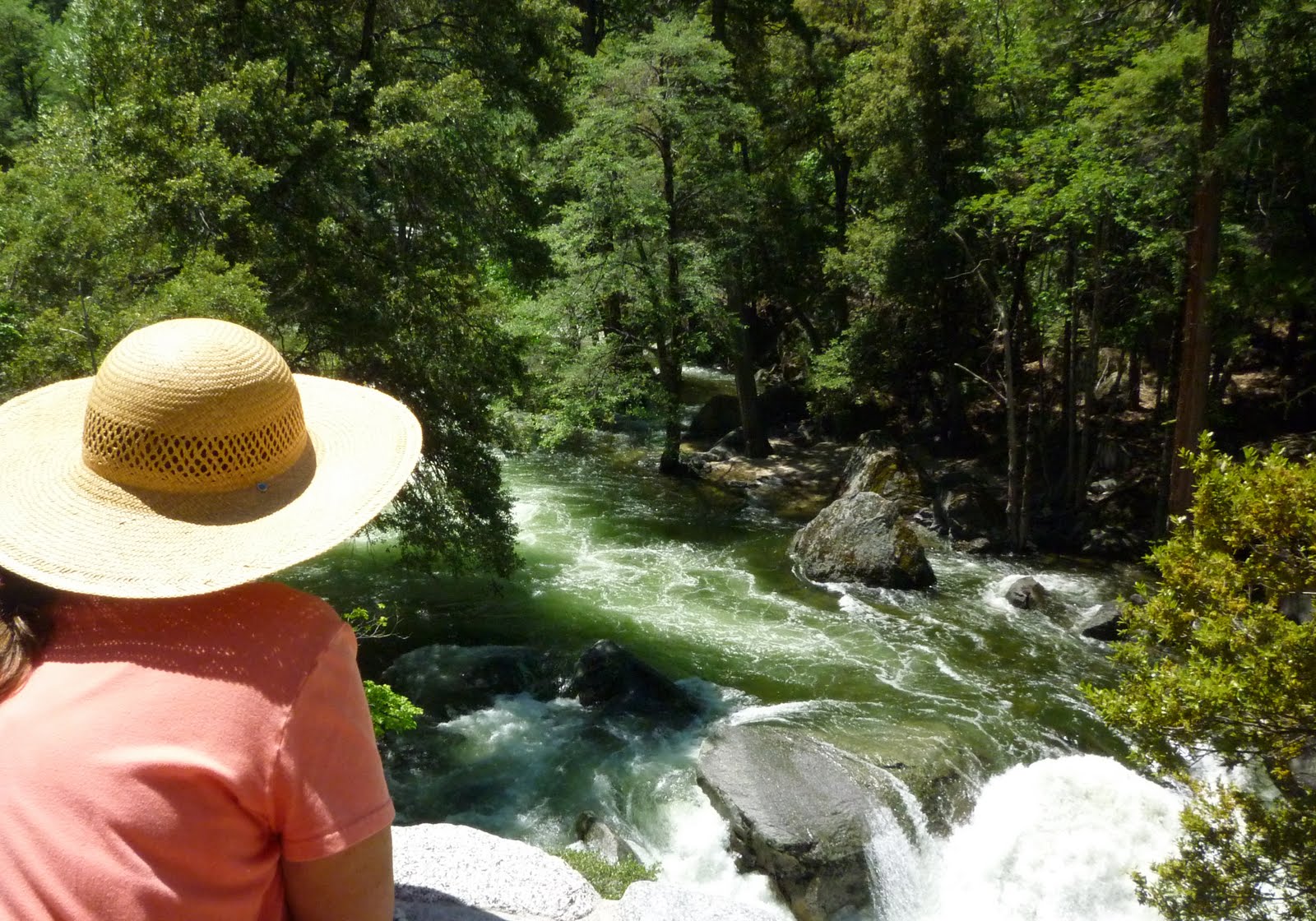
All the waterfalls are exciting this rainy year of 2010.  Mr. Glad and I hiked together part way to Vernal Falls, and I read a book while he completed the ascent to the top of the falls. High steps are cut out of the rock next to the canyon, where spray from the waterfall drenches the hikers on the Mist Trail, some on their way back from the summit of Half Dome.

We have hiked the Mist Trail several times as a family, but this year my knee hurt just thinking about climbing those steps. The photo above right is of Pippin on that trail, aged three, with her papa.
It was a new kind of camping for us, in Housekeeping, where you get three walls surrounding beds with mattresses, canvas roofs over your head, electricity in your cabin and patio area, and hot water in the restrooms nearby. Not like our tent camping at Crane Flat in the past, pictured.
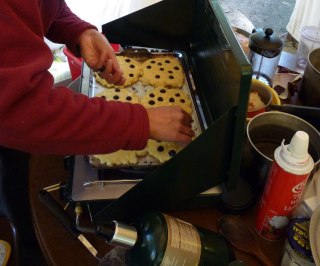
Tent camping in Yosemite in the past

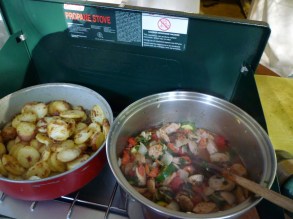
Cooking was fun, shared by the three women. I had a new and hot propane canister stove to replace our old one that was of a kind that we had to pump what seemed to be every few minutes, and even then the burner farthest from the tank never got very hot.

Pippin made a version of Power Pancakes with blueberries. No one had brought a large enough bowl for the batter so we made do with a dishpan.

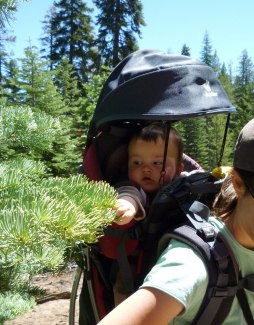
Scout missed his routine, and seemed to get more overtired and cranky day by day. This is a shot of him sleeping early in the week, after being lulled to sleep on a wheeled walk. He often enjoyed his outings in the baby backpack, with its pauses next to trees and rocks where he was given time to feel the textures.

Our last full day in the park Mr. Glad and I went with our daughter to Taft Point. It’s a short hike after you drive up toward Glacier Point for an hour or so. Still, the trail involved a bit of “boulder-hopping” as I heard it described.

The streams are full and the distances between the rocks that stick up sometimes require a leap. It’s not that the water is deep; I could have taken off my shoes and walked across if I wanted to lessen the risk of wet boots or a sprained ankle. I managed without doing that–but on the homeward crossing, it took me about half a minute to coordinate my eyes, legs and courage and figure out how to spring–or lunge.

From Taft Point you look down into Yosemite Valley where the Merced River is snaking along, and across the canyon to perhaps the most thorough view of  Yosemite Falls possible. The day before, we had stood at the bottom of that waterfall; the experience from Taft Point is much quieter and drier.

You can also see down to El Capitan, that mass of rock one often sees from the bottom on entering the valley. It’s in the upper center of this photo, sloping down to the trees.
 

We ate our trail mix and crackers sitting on the rock slabs, and let Scout out of the pack to wiggle his toes in the granite dust.

So many wildflowers up there remain a mystery to me, even though I have prolonged my vacation (Yes, yes, I know, I should finish putting my kitchen back together or prepare for my soon arriving house guests.) researching them online and writing this blog.

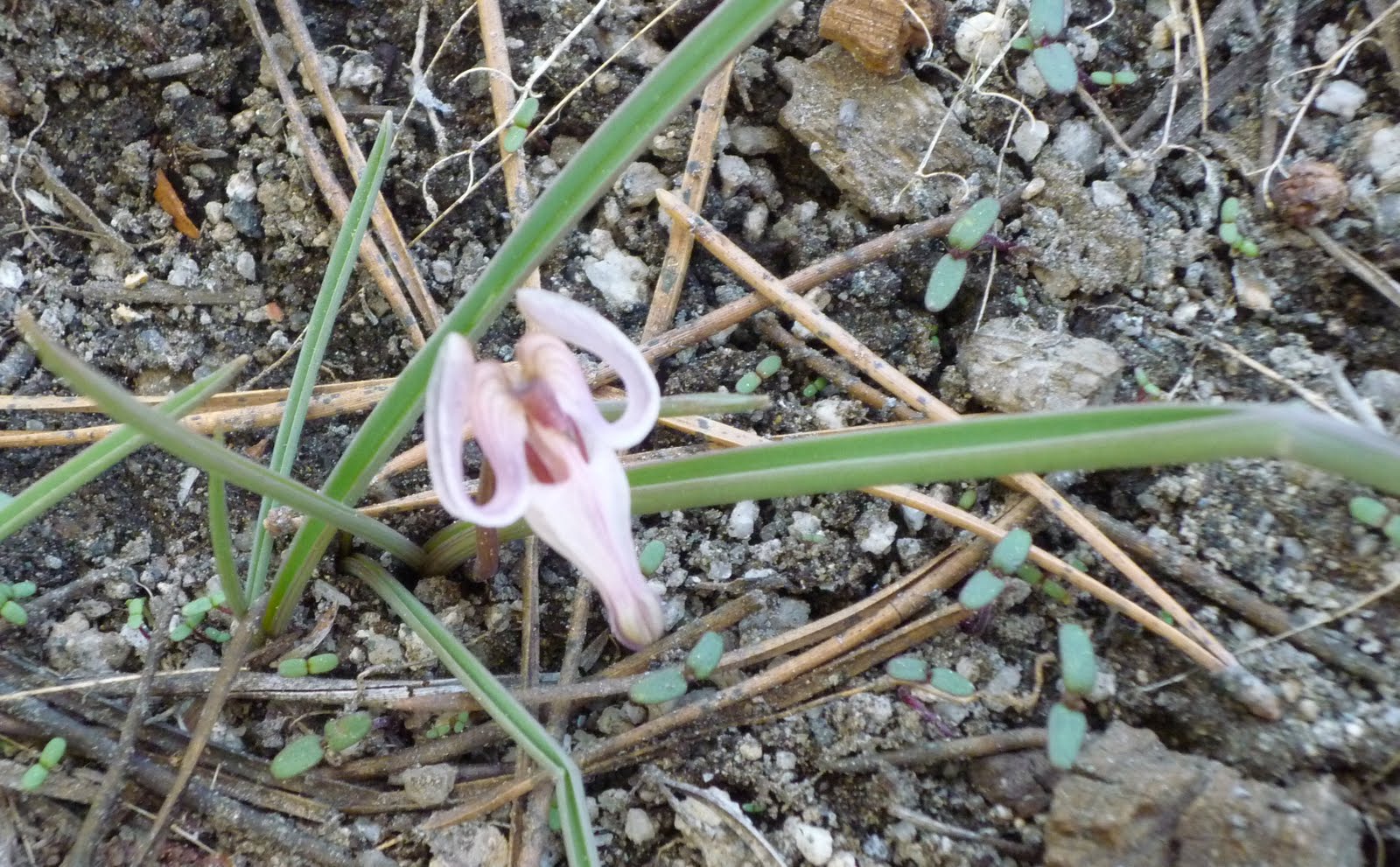
The curious specimen here, for example, has the look of a Longhorn Steershead–the descriptive common name of a flower, Dicentra uniflora–but it doesn’t have the leaves to match that identity, which would be a relation of Bleeding Heart. Is it an imposter steer? How could there be two flowers so similar, that are not at least in the same family? Those blade-like leaves must go to something else…but where are steershead’s leaves? Very odd.

But I can’t let that problem distract me from the main point of this flower: God is amazing!I saw chamomile ready to bloom, and the tiniest alliums: each plant consisted of a single thin stem that I’d have thought was a frail blade of grass sprouting out of the sand up there where there is only wind and rock and sun. But at the tip of a few “blades” were the remains of a half-inch spherical tuft, lying down on the ground at that point because the thin stem couldn’t bear it up.

These leafy plants at left were scattered profusely over the meadows and forests at about 7,000 ft.; when the buds open they will make for a lot of color–we think yellow–and then they will really be attention-getters.


After taking in the views from Taft Point we hiked back to the road and drove on to Glacier Point, the most popular viewing spot in Yosemite National Park. No matter how often I visit the park, I appreciate the broad perspective. You can see where you camped or hiked over the last few days when you were down in the trees.

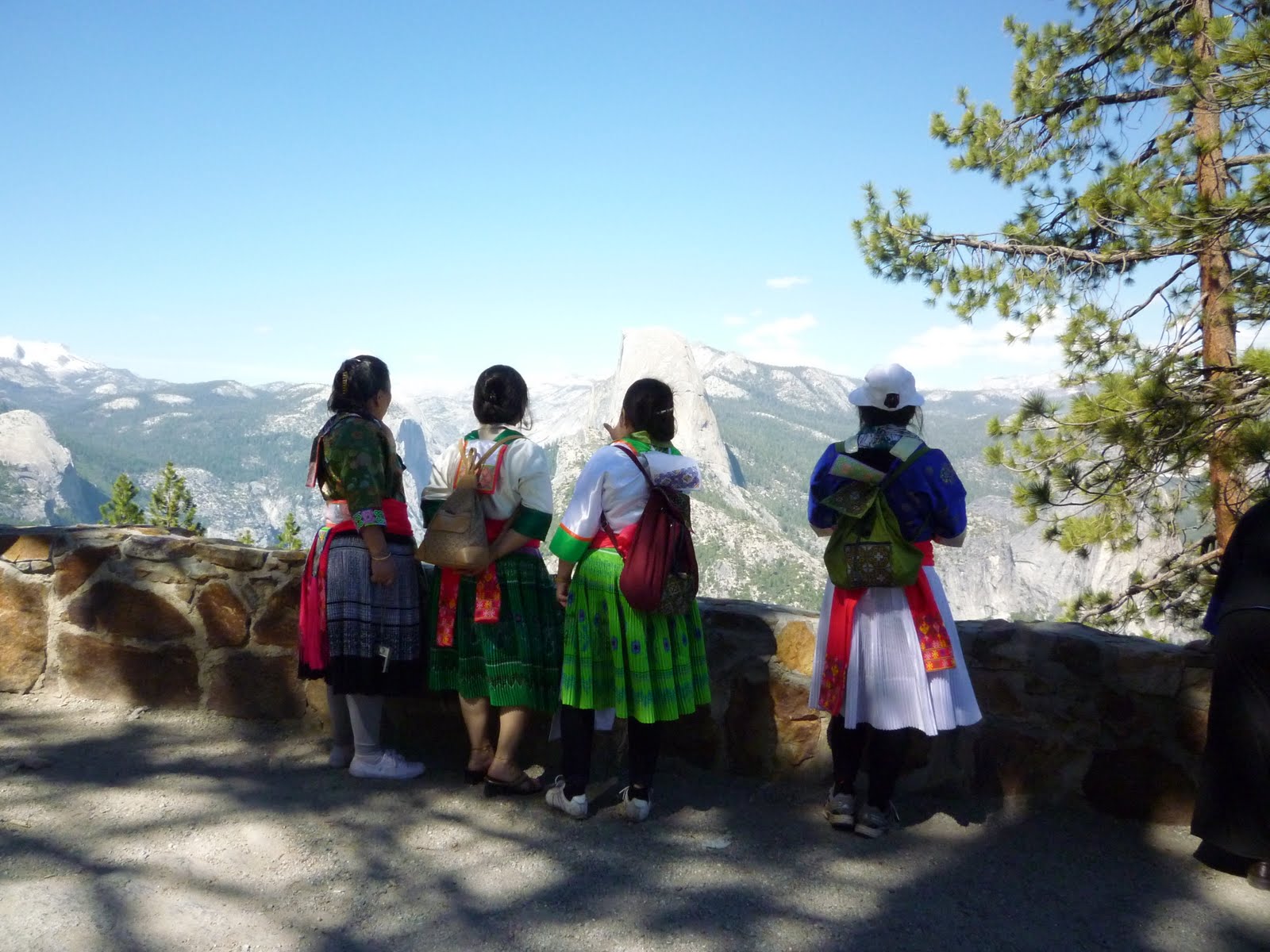
At Glacier Point the people-watching is unbeatable, because the population is international (Yosemite belongs to the world, or the U.N., or something, after all, which doesn’t please anyone I know), and there are so many people. After driving up the mountain all that way they aren’t in any hurry to leave, so everyone can watch everyone else as well as the scenery. We wondered if this pink-and-black woman might be on her honeymoon…anyone have a guess as to the origin of what looks like a traditional costume?
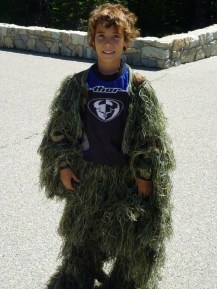
I didn’t know what a ghillie suit was until I asked Moss Boy if I could take his picture, and why he was dressed like that.

Kate as a child

“I love your dress,” I said to the woman with the long yellow costume. It was also quite pretty from the front, as was she.

Kate was dressed in our family’s traditional outdoor clothing when we took this picture of her at Glacier Point nine years ago.

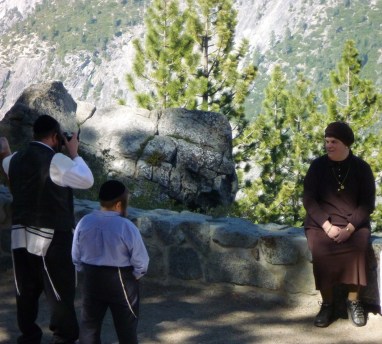
But Glacier Point was not the last view; we always love to see things from Washburn Point as well; it’s just a bend or two of the road back from Glacier Point. Additional exotic members of the Family of Man could be viewed there, like Hasidim taking pictures.

What first caught our ear was a shiny man standing on a prominence and turning to and fro, singing over the treetops an Asian style of chant, a cell phone in one hand and a camera in the other. Two or three other men–one dressed all in black– and four women were singing nearby at the same time, and the women were tapping their feet.

 I asked one of the women, when she was finally walking back to the parking lot, what she was singing about. She was beaming smiles as she said, “Oh, I sing to myself.” I didn’t want to pry, but she didn’t seem in a hurry to get away, so I pressed, “What were you singing about?” She was happy to tell me, “About mountains, high, lonely.”

There is no last word that seems to fit after that, unless it would be Psalm 104, revealing to us our Lord,

Who walketh upon the wings of the winds….The mountains rise up and the plains sink down, unto the place where Thou hast established them….He sendeth forth springs in the valleys; between the mountains will the waters run….He watereth the mountains from His chambers; the earth shall be satisfied with the fruit of Thy works….How magnified are Thy works, O Lord! In wisdom hast Thou made them all; the earth is filled with Thy creation….

Tree Friends on the Way

The trees kept calling to me to stop and take their pictures yesterday, turning what should have been a five-hour drive into six hours. I think it’s just been too long since I took a walk in the forest, and when I saw some old friends, it wasn’t possible just to give a glance and continue on my way.

The buckeye first caught my eye; it’s a tree I dislike at other times. In the late summer, when the world is full of lush greenery and flowers, its leaves turn brown and spoil the landscape. But when humans are saying, “I’m ready for Spring,” and it’s still February, the buckeye, or horse chestnut, puts on its party clothes way ahead of time and is, for a while, the prettiest one.

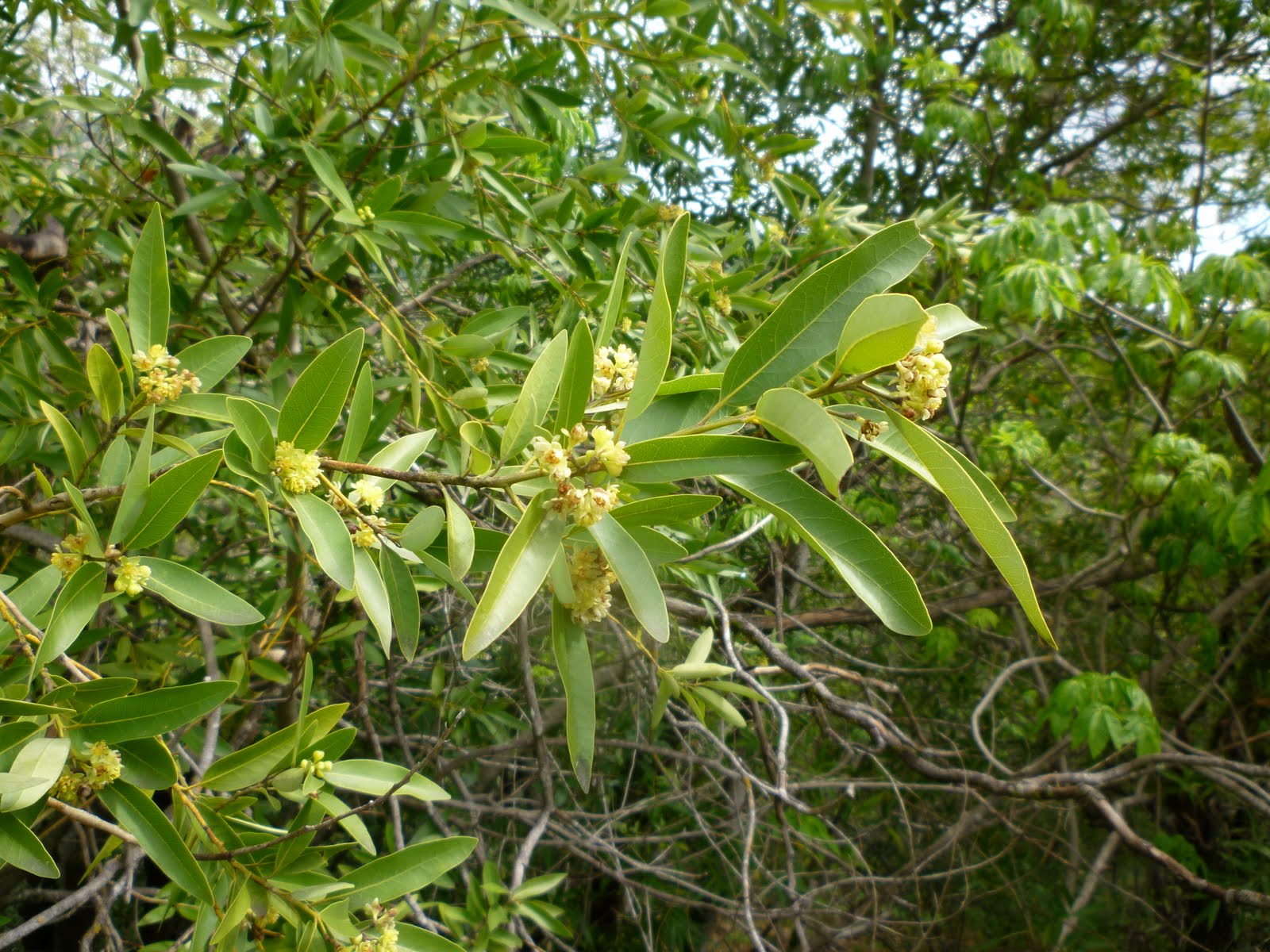
The California Bay Tree is dear to my heart. Until I moved to Northern California I didn’t know anything of it, though I had probably at least heard of bay leaves for cooking. Since then I’ve seen what may be the biggest bay tree on earth, and I’ve stuck many a spray of leaves into my flour buckets to keep out bugs. In Oregon they call this tree the Oregon Myrtle, and some people know it as Pepperwood. The usual leaves you buy in a jar for cooking are milder and come from a different tree altogether–though the California “bay” leaves that I can gather on my walks  have been good enough for this culinary make-doer.

Here’s another picture of the bay with a live oak backdrop. Which live oak? I couldn’t tell you. Once I decided I would learn about all the oak trees in our area so I could know what I was looking at, and I brought home a stack of botanical books from the library. I quickly discovered that if I took on that project I wouldn’t have time to look at any other trees, much less cook meals or do laundry. My daughter told me it was a live oak–otherwise I’d have left out this picture.

This bay tree has full flowers on it…which makes me wonder if some are male and some female; but the Wikipedia article on this species doesn’t say anything about that.
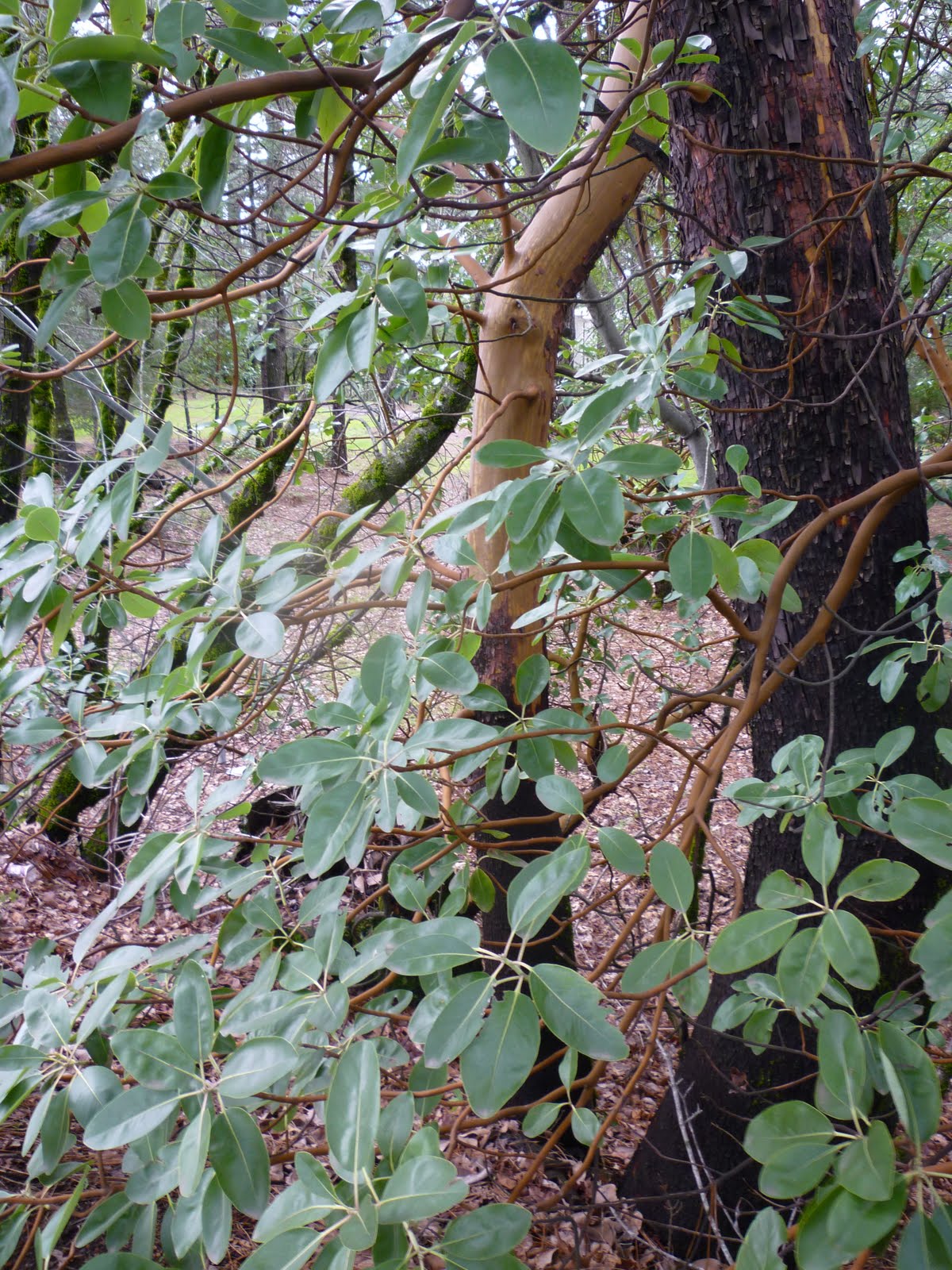
The handsome Pacific Madrone trees, which I’ve always known just as Madrones, it turns out are related to the Strawberry Tree in my own back yard, as they are both arbutus.

I have to give two photos to fully show the beauty of the leaves and smooth orangey branches.


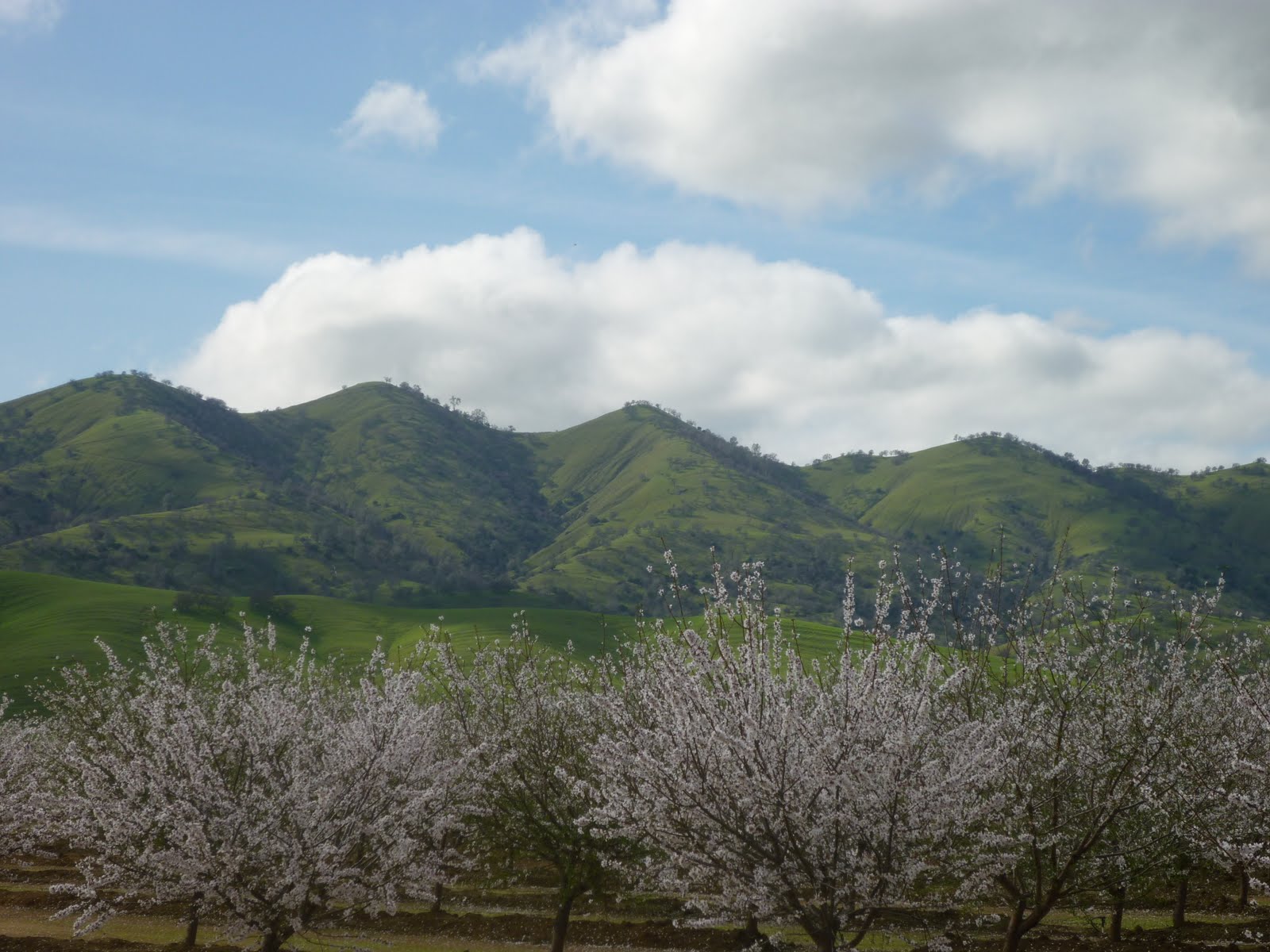
I emerged from the forest into the broad Central Valley of California, to the lovely display of barely pink almond blossoms. These are younger trees than the ones I photographed last month, but in the same neighborhood.

And the clouds, and the blue sky! Going north on the interstate, with the wide flatlands spreading out on either side of me, the ceiling was huge and broad. Dark clouds piled up like stair-stepping plateaus, and then disappeared behind me. I so wanted to catch their drama with my camera, and I’m ashamed to say I’d probably have tried while zooming along the freeway, but by then my windshield was too buggy.

I had to find a likely exit, where there would be a nice view, and a place to park. The first public rest area had a tall chain link fence all around it and not a very good look at the sky, but even the scraggly eucalyptus seemed lovely to me that day.

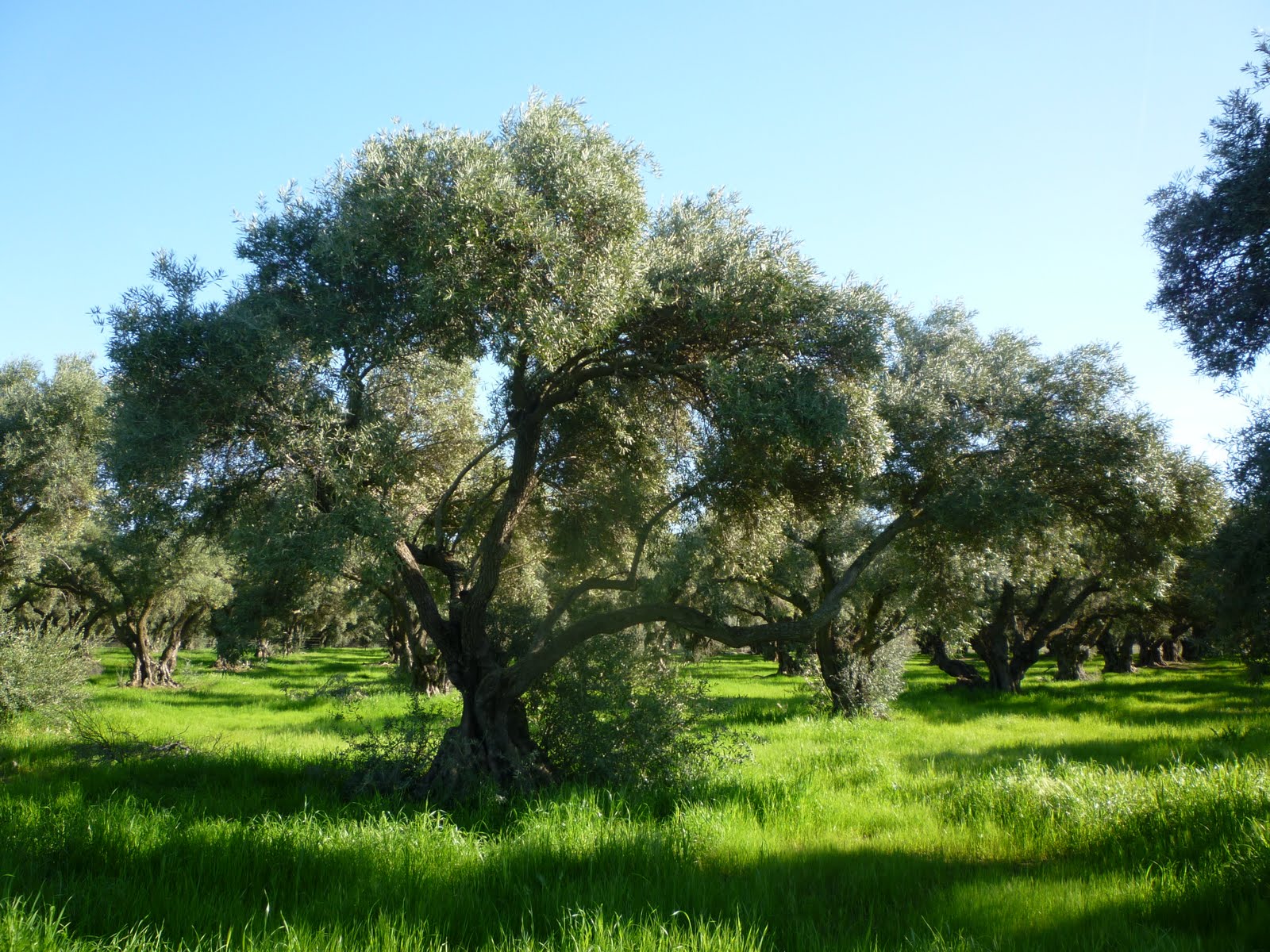
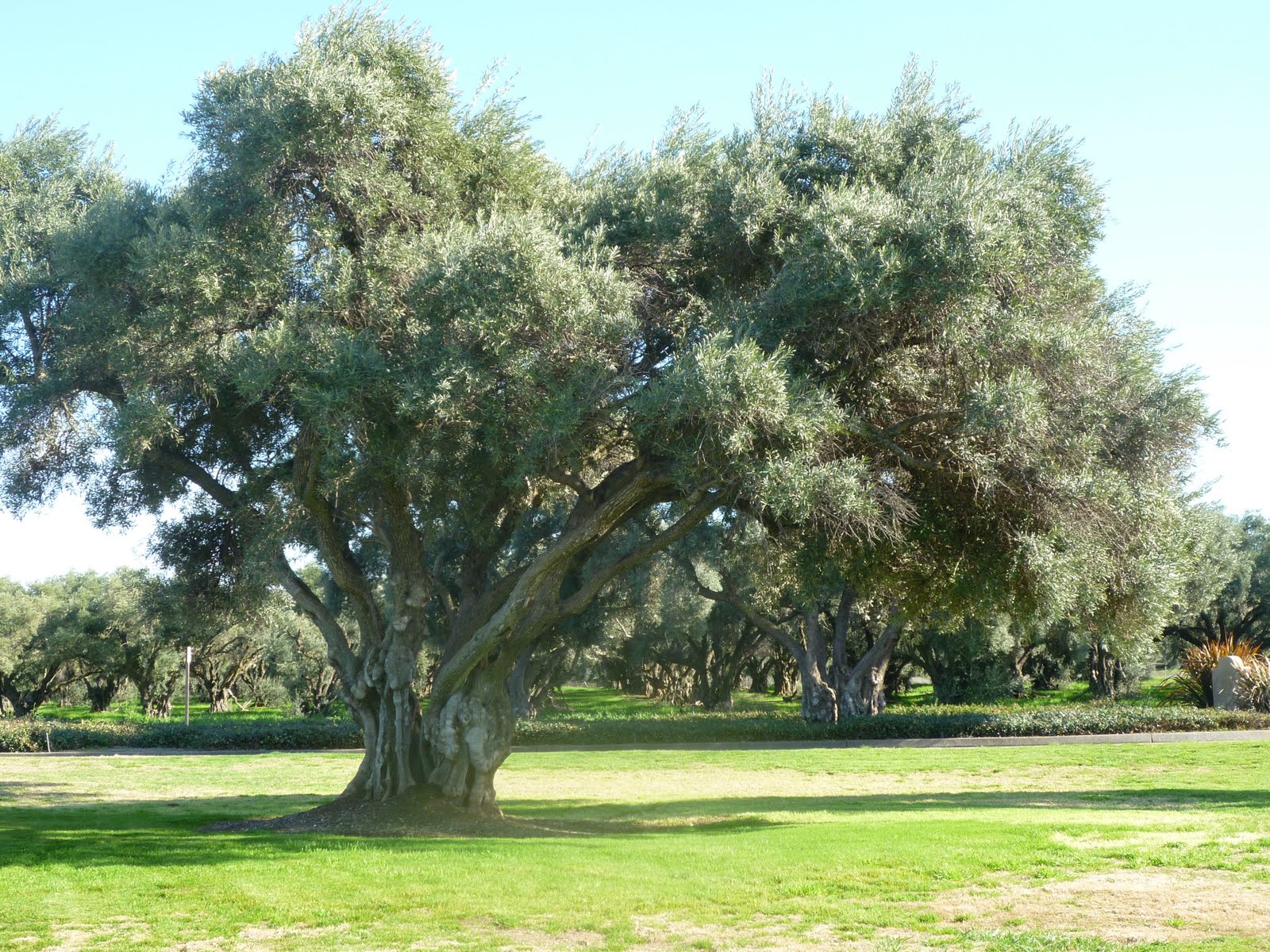
The almond trees gave way to old olive orchards, and I do love olive trees, so I stopped at another rest area that had been plopped into the middle of an orchard. I wandered around for quite a while, admiring these old stalwarts. Olive trees can live thousands of years, but these are probably just over a hundred years old.

There is so much to be said about trees. Right now it’s probably enough to quote Psalm 1, which says of the man who delights in God:

He shall be like a tree
Planted by the rivers of water, 
That brings forth its fruit in its season,
Whose leaf also shall not wither;
And whatever he does shall prosper.

Lord, water me with Your mercy and make me like my tree friends.