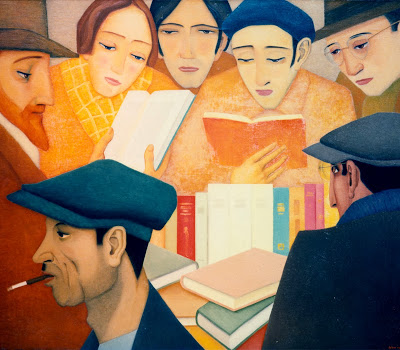
It was a time when wise men Were not silent, but stifled By vast noise. They took refuge In books that were not read. Two counsellors had the ear Of the public. One cried ‘Buy’ Day and night, and the other, More plausibly, ‘Sell your repose.’
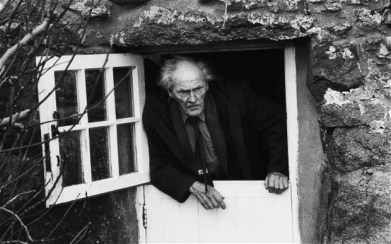
R. S. Thomas, 1913 -2000
With thanks to Stephen Pentz,
who has all the best poems.
Illustration by Johan van Hell.
I stepped just beyond my front door only to put a letter out for the mailman, but I immediately forgot myself and stepped farther, to gaze upon that small part of my kingdom…
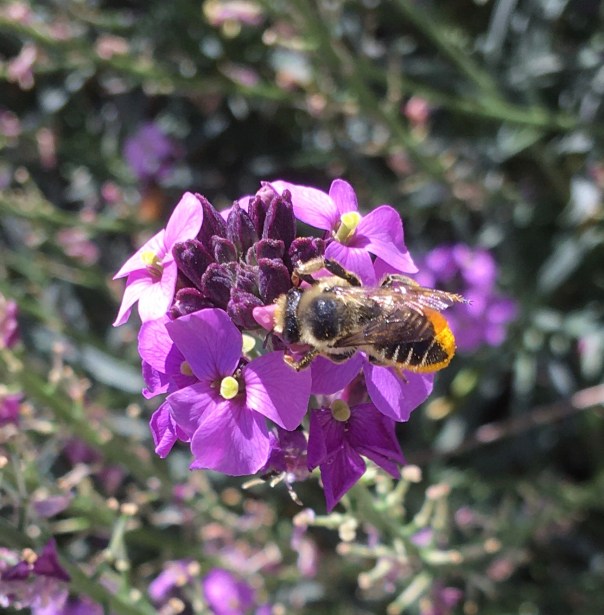
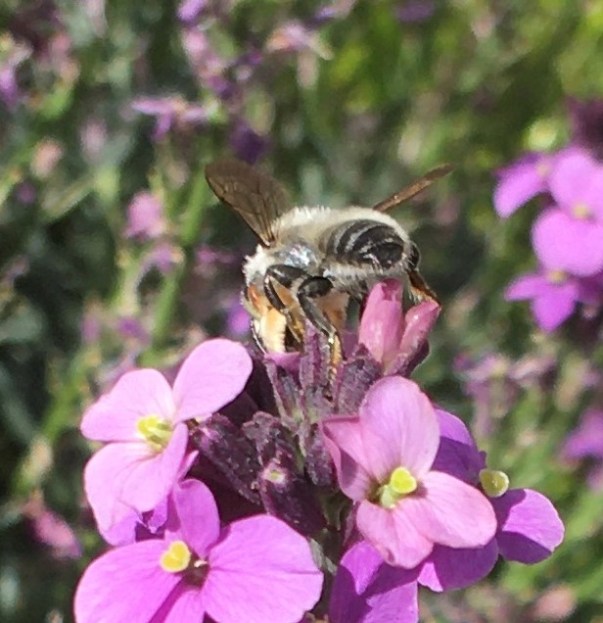
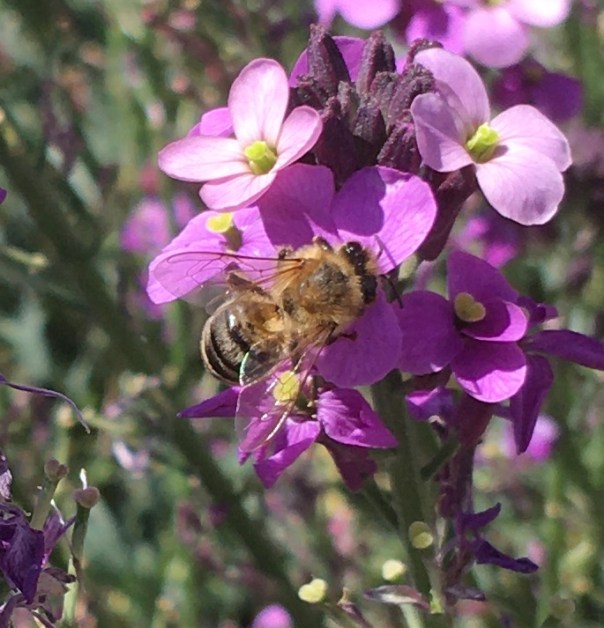
Carpenter bees were working at the white salvia that has filled out so well and become a definite feature of the landscape. Only carpenter bees were there. What about the other flowers? On the wallflower, grown to a prominent bulwark of purple in that area that is squeezed between the street and the driveway, buzzed a half dozen different sorts of pollinators, among them honeybees (I hope), stripey little bumblebees, and a species new to me, with bright yellow abdomens underneath.
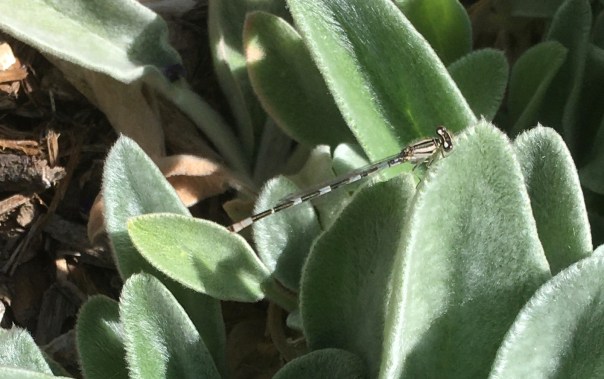
And what a quietly “burning” bush — to follow the metaphor of the poem below — this creature is. I’m amazed that I saw him at all:
I spent a half hour studying them and collecting blurry pictures to help me see them better. I pulled out the orange California poppies that I am trying to keep from taking over my pale yellow plantation of them. After peering into the asparagus beds that are becoming a forest, I spied a few spears that could be cut, and managed to remember them long enough to bring out a knife with which to do that.
The rest of today promises to hold encounters with several bright and human epiphanies. My world is illuminated and shining full of these transitory and eternal treasures. Christ is risen!
THE BRIGHT FIELD
I have seen the sun break through
to illuminate a small field
for a while, and gone my way
and forgotten it. But that was the pearl
of great price, the one field that had
the treasure in it. I realize now
that I must give all that I have
to possess it. Life is not hurrying
on to a receding future, nor hankering after
an imagined past. It is the turning
aside like Moses to the miracle
of the burning bush, to a brightness
that seemed as transitory as your youth
once, but is the eternity that awaits you.
Hers is the clean apron, good for fire
Or lamp to embroider, as we talk slowly
In the long kitchen, while the white dough
Turns to pastry in the great oven,
Sweetly and surely as hay making
In a June meadow; hers are the hands,
Humble with milking, but still now
In her wide lap as though they heard
A quiet music, hers being the voice
That coaxes time back to the shadows
In the room’s corners. O, hers is all
this strong body, the safe island
Where men may come, sons and lovers,
Daring the cold seas of her eyes.
Blessed are the poor in spirit: for theirs is the kingdom of heaven. Matt. 5:3
I liked the first poem I read by R.S. Thomas so well that I borrowed a collection of his poems from the library. It had some water damage already so I don’t worry about leaving it in the bathroom or reading it at the breakfast table, and I’ve been perusing it for a few weeks.
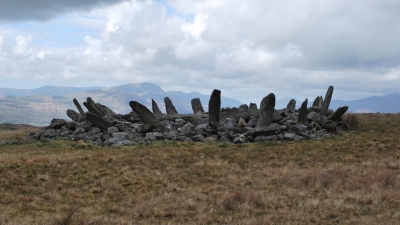
One doesn’t have to explore this book for very long to find that Thomas’s poetry is full of the feeling of coldness between us and God. Themes of harsh landscape and winter reappear, with lots of stone, stone, stone. My husband has been watching a TV detective series set in Wales and he commented that he would not want to live there, it looks so bleak. Maybe Thomas’s perspective is touched by the geography of his homeland.
This poem below is an example of this tone, though it’s not as painful as some of his verse that describes the alienation that is so common to the human experience. The last line relieves me with its hopeful turn and reminds me of what I’ve heard elsewhere: It’s only when we are truly empty of anything to offer God, and present ourselves humbly before Him, that He can speak to us, with His fullness that is silence, His presence that is His Word.
THE ABSENCE
It is this great absence that is like a presence, that compels me to address it without hope of a reply. It is a room I enter
from which someone has just gone, the vestibule for the arrival of one who has not yet come. I modernise the anachronism
of my language, but he is no more here than before. Genes and molecules have no more power to call him up than the incense of the Hebrews
at their altars. My equations fail as my words do. What resource have I other than the emptiness without him of my whole being, a vacuum he may not abhor?