Tag Archives: re-post

Mellowness and kindly wisdom.

This post that is very fallish in more than one way, I am sharing again nine years later. It is about Lin Yutang, whose writings my late husband and I were reading aloud together, during the illness that was to end his earthly life only a few months later. Much of what I read during that period is very foggy in my mind at this point, and many of those and other books from the past keep calling me back, especially when I read my own reviews.

               –  –  –  –  –  –  –  –  –  –  –  –  –  –  –  –  –  –  –  –  –  –  –  –  –  –  –  –  –  –  –

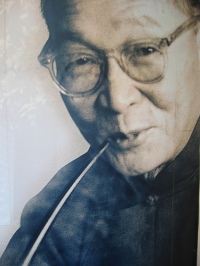
If you like thought-provoking quotes as much as I do, you might sometime run across one by the eloquent Lin Yutang. I find that I did have a quote by him about autumn in my files, so that is probably how he came under my radar recently, long enough for me to decide to borrow his book The Importance of Living from the library. It was in the closed stacks, and looks old and Chinese. But as Samuel Butler said, “The oldest books are only just out to those who have not read them,” and for me, Lin Yutang is definitely a new and exciting discovery.

I expected a small book of proverbs, perhaps, but The Importance of Living is a large conversational and philosophical treatise that I won’t be ableLin Yutang - Living to read in bed. I may have to buy a copy, because in the very first paragraph of the preface I found beautifully written lines that drew me in to his mind and his ruminations:
“Very much contented am I to lie low, to cling to the soil, to be of kin to the sod. My soul squirms comfortably in the soil and sand and is happy. Sometimes when one is drunk with this earth, one’s spirit seems so light that he thinks he is in heaven. But actually he seldom rises six feet above the ground.”

I opened the book randomly in the middle and there, also, his words were worth thinking about as poetry or motivational talk. Did someone very gifted translate the works of this Chinese man? No, he wrote in English in such a graceful way that it is pure joy to read him aloud.

Lin Yutang was born in China in 1895 of Chinese Christian parents. His father was a pastor and a very progressive, forward-thinking man who made sure that Lin learned his Bible stories and went to the schools that produced the best speakers of English. He eventually got a degree from Harvard and another from Leipzig University.

I began to read The Importance of Living aloud with Mr. Glad. I usually do the reading because I enjoy it more than he does, and I immediately noticed the easy flow of Lin’s prose and the equally smooth progression of ideas. Everything he says makes perfect sense given his worldview in 1937, and at that time he was no longer a Christian.

What happened? Mr. Glad and I were very curious, because we had information Lin didn’t have at the time; we knew that later in life he would return to the faith and live to write about it, in his book From Pagan to Christian. So we stopped reading Importance and started in on the book about his spiritual journey that he wrote about 20 years later.

Putting together what he says in the relatively little we have read of him so far, I can tell you this about Lin’s first change of mind: As soon as he came of age to notice, he realized that he had not received the usual Chinese philosophical or literary heritage, much of which was typically learned through the theater; the theater was forbidden to Lin and his siblings who were in some ways raised as Puritans. He hadn’t taken the time to learn to write beautiful calligraphy, either, so he found that he was by Chinese standards completely uncivilized. At this point the one very Chinese thing he did know was intense shame.

He felt he had to go back and learn to be an authentic Chinese man, and having learned as a child the diligence and study habits of a Puritan, he did a very thorough job of learning Chinese philosophy and literature, not to mention a stunningly broad understanding of Western culture. This knowledge base combined with the ability to think and write about all that he has figured out — or is figuring out, as the story evolves — makes him fascinating to me.

We haven’t progressed very far in either of these books, but having this articulate author “friend” to explain Chinese culture and history to me from the inside has given me an interest in that part of the world that I have always lacked. So I hope to read more, and I expect to have more to share. But for now, I’ll close with his quote from My Country and My People about the lin_yutangseasons of the year.
“I like spring, but it is too young. I like summer, but it is too proud. So I like best of all autumn, because its tone is mellower, its colours are richer, and it is tinged with a little sorrow. Its golden richness speaks not of the innocence of spring,nor the power of summer, but of the mellowness and kindly wisdom of approaching age. It knows the limitations of life and is content.”

This meditation seems to me an expression of a perspective that could be both Chinese, as he felt at the time, and truly Christian. I’m looking forward to reading more of the kindly wisdom of Lin Yutang.
Moroccan lamb pie warms and charms.

In the first autumn of Gladsome Lights, I shared this old recipe for a lamb stew served as a shepherd’s pie. I haven’t had occasion to make it for a long time, but this evening when my mind turned to the kind of dishes that warm both body and soul, this one appeared.

Mutton is the meat I love.
On the dresser, see it lie;
Oh, the charming white and red;
Finer meat ne’er met the eye.

Roasting lamb is one of those aromas that reminds me of my grandmother. Combine it with Moroccan spices, and it makes for one of my favorite dishes:

Moroccan Lamb and Sweet Potato Pie

2 tsp. ground cinnamon
4 tsp. ground cumin
3 tsp. ground coriander
2 T. freshly grated ginger
1 T. all-purpose flour (or arrowroot)
1 ½ tsp. salt, plus more to taste
¼ tsp. freshly ground pepper, plus more to taste
2 lb. lean leg of lamb, cut into 1-inch cubes
3 T. olive oil
4 T. unsalted butter
2 large onions, thinly sliced
1 T. sugar
3 large cloves garlic, peeled and minced (about 1 ½ T.)
3 c. beef stock
1 28-oz. can whole Italian plum tomatoes
2 pieces star anise
2 cinnamon sticks, about 3 inches long
2 medium carrots, peeled and cut into ½-inch rounds
2 lb. sweet potatoes, peeled and cubed
12 oz. fresh spinach (optional) washed
½ c. dried tart cherries

½ c. dried pitted prunes, cut in half freshly grated nutmeg, for sprinkling

1. In a medium mixing bowl, combine the ground cinnamon, 2 tsp. cumin, 1 tsp. coriander, flour, ½ tsp. salt, and ¼ tsp. pepper. Toss the lamb pieces with the spice mixture to coat.

2. In a Dutch oven or a large saucepan, heat 2 T. olive oil over medium-high heat. Add the lamb in two to three batches, in a single layer, and sear until dark brown on all sides, about six minutes per batch. Add the remaining T. olive oil during searing if pan becomes dry. Remove the lamb pieces and set aside.

3. Reduce heat to medium; add I T. butter. Add onions and sugar; cook 10 minutes, stirring frequently, scraping up brown bits on bottom of pan while stirring the onion.

4. Reduce heat to medium low, add the minced garlic, and cook until brown and well caramelized, about 15 minutes.

5. Stir in the stock, tomatoes, star anise, cinnamon sticks, carrots, remaining 2 tsp. cumin, 2 tsp. coriander, the fresh ginger, remaining 1 tsp. salt, and reserved lamb. Bring to a boil, reduce heat to medium, and simmer, stirring occasionally, uncovered, for about 1 hour, until lamb is tender and sauce is thick.


6. Meanwhile, place sweet potatoes in a large saucepan; cover with cold water. Bring to a boil, reduce heat to medium, and simmer, uncovered, for 15 minutes, until very tender when pierced with a fork. Drain potatoes, and return to saucepan. Dry potatoes, over medium heat, for 1 minutes. Pass potatoes through a food mill into a medium bowl. Stir in remaining 3 T. butter; add salt to taste. Set aside, loosely covered.

7. Preheat oven to 325 degrees. If using spinach, place in a large skillet over medium-high heat. Season to taste with salt and pepper, cover, and cook until wilted, about 1 ½ minutes. Drain, and rinse under cold water to stop the cooking. Set aside.

8. Remove the star anise and cinnamon sticks from the stew. Stir in the cherries and prunes. Transfer mixture to a deep 2-qt. Casserole, and place a layer of spinach, if using, over the stew. Spoon the sweet potato mixture onto the stew. Place on a baking sheet, and bake for 30 minutes. Sprinkle with freshly grated nutmeg.

Notes: I have always used a whole boneless leg of lamb for this recipe, which usually is about 5 lb., not 2 lb., so I end up with more than 2 times the quantity. You can see  I have two pots of the stew simmering.

This gives me plenty to put in the freezer for another day, which raises the question of how to prepare the yams. If I purée all the yams, they end up getting  mushed up into the stew by the time I have reheated it, especially if it spends time in the freezer.

The stew tastes especially nice if the flavors have blended overnight, so I try to cook it a day ahead. Also this time I baked ahead of time the sort of monster yams, not very sweet, that are in the discount supermarket around Thanksgiving, not knowing yet how I would arrange everything the next day. Sometimes I have baked smaller sweet potatoes and served them to the side of the stew…

…but on this occasion, I ended up slicing them on top, brushed with butter and sprinkled with parsley and cinnamon, to take to a potluck. Sorry, the photo shows the dish before it had its final heating in the oven, and the butter is still solidifying on the cold yams. That evening the yam slices were gone before the stew itself.

In this season of my life, I don’t have a crowd to feed every day, but I think if I made a big pan of this stew I might be able to find enough friends to eat with me, and fortify ourselves against the coming winter. Next I’ll consider what other fallish items would fill out the menu… How about a dessert pie?


Things you have to do today.

THE WORD

Down near the bottom
of the crossed-out list
of things you have to do today,

between “green thread”
and “broccoli,” you find
that you have penciled “sunlight.”

Resting on the page, the word
is beautiful. It touches you
as if you had a friend

and sunlight were a present
he had sent from someplace distant
as this morning—to cheer you up,

and to remind you that,
among your duties, pleasure
is a thing

that also needs accomplishing.
Do you remember?
that time and light are kinds

of love, and love
is no less practical
than a coffee grinder

or a safe spare tire?
Tomorrow you may be utterly
without a clue,

but today you get a telegram
from the heart in exile,
proclaiming that the kingdom

still exists,
the king and queen alive,
still speaking to their children,

—to any one among them
who can find the time
to sit out in the sun and listen.

–Tony Hoagland

In the Wooded Marshes of Giverny, Autumn Light – by Blanche Hoschedé Monet

Maps not of this world.

I wrote the post below before my husband died, and before I had a smart phone and GPS to use when on road trips. This morning when I was getting ready to walk the grandboys over to the playground, which is only around the corner, I felt the need to bring up its location on my phone and look at the layout of the streets for a while (lacking a paper D.C. map), even though Kate was going to show me the way. I still prefer paper maps of any sort to what one can view on a screen, and I hope they’ll continue to be available.

The accompanying poem is not about this practical aspect of maps; you might even say that it is about how maps fail to give us information that might be necessary to our survival. And there is a third aspect of the subject that I dip into. I hope there is something you might enjoy musing on.

……………………

Most people in our family love maps. The previous generations loved them, too, and I treasure the memories and pictures of various father-son or sibling groupings around a map, planning a road trip or a backpacking adventure, or just getting a better idea of the world we live in.

Geography games including maps can also be fun, such as Global Pursuit that was put out by National Geographic in 1987. It was a little challenging for someone like me who isn’t sharp in spatial orientation skills, because the map of the world was all chopped up into pentagons which never fit together all the way.

global pursuit game

It’s easy to lose all track of time when poring over maps. One of my favorite parts of an unusual aviation ground school that was offered at my high school was studying the aviation maps pilots use to plot their course. In those days it was all done on paper, and I was fascinated by the concentric rings around airports, and all the copious information including odd names of towns in Texas, which was the area our school sample was showing. (The one below, I realize, is of Anchorage, Alaska.)aviation map

The whole concept of a map, a simplified form by which we can get a mental handle on a vastly greater reality, became useful for me in a different manner when I was introduced to the way M. Scott Peck uses it in his book, The Road Less Traveled. I have never actually read the book, but the the image of a mental/emotional map has served me well through the years. Some excerpts:

CHOOSING A MAP FOR LIFE – Truth is reality. That which is false is unreal. The more clearly we see the reality of the world, the better equipped we are to deal with the world. The less clearly we see the reality of the world–the more our minds are befuddled by falsehood, misperceptions and illusions–the less able we will be to determine correct courses of action and make wise decisions.

Map of Life – Our view of reality is like a map with which to negotiate the terrain of life. If the map is true and accurate, we will generally know where we are, and if we have decided where we want to go, we will generally know how to get there. If the map is false and inaccurate, we generally will be lost.

-M. Scott Peck

I brought all of my real and metaphorical map history to this poem I read today. The poet is another woman who also likes maps, but her poem shows clearly the ways that they fail to reflect reality. That doesn’t bother her; even in their failure she praises them for the vision they give us, “not of this world.”

Perhaps we also don’t need to worry about whether our heart-maps are all matched to our surroundings. Might they also serve a great-hearted and good-natured purpose, so that instead of giving up on our inner maps we strive to bring the full reality closer to the vision? I’m thinking of our daily prayer, “Thy Kingdom come…” and of “Love hopes all things, love believes all things….” May the Lord write the map of His Kingdom large in our hearts.

MAP

szymborska
Wislawa Szymborska

Flat as the table
it’s placed on.
Nothing moves beneath it
and it seeks no outlet.
Above – my human breath
creates no stirring air
and leaves its total surface
undisturbed.

Its plains, valleys are always green,
uplands, mountains are yellow and brown,
while seas, oceans remain a kindly blue
beside the tattered shores.

Everything here is small, near, accessible,
I can press volcanoes with my fingertip,
stroke the poles without thick mittens,
I can with a single glance
encompass every desert
with the river lying just beside it.

A few trees stand for ancient forests,
you couldn’t lose your way among them.

In the east and west,
above and below the equator –
quiet like pins dropping,
and in every black pinprick
people keep on living.
Mass graves and sudden ruins
are out of the picture.

Nations’ borders are barely visible
as if they wavered – to be or not.

I like maps, because they lie.
Because they give no access to the vicious truth.
Because great-heartedly, good-naturedly
they spread before me a world
not of this world.

–Wislawa Szymborska

Translated from the Polish by Clare Cavanagh
The New Yorker, April 14, 2014

red slate map look
My two sons consulting a topographical map on a peak.