“There was an actress who wore a white dress with a circle cut in it just above her navel so that her skin could be seen, which looked very pink. Against the white, it was as if she had dropped a slice of ham on her lap; but it showed good feeling and willingness to think out new ways of pleasing.”
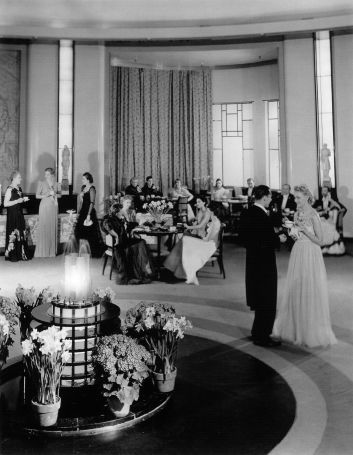
The actress appears at a party in New York, in the last pages of Cousin Rosamund by Rebecca West. At the end of the third novel in the Aubrey Trilogy, Rose is talking about her visit with her sister Mary to the United States during the Great Depression; West herself did visit many times, not as a musician but as a journalist and author. What she does in these books I think of as the best kind of historical fiction, the autobiographical kind; when I do my time travel I like to go about with a friend who knows the places and people well, who is observant, analytical, and attentive to every detail.
“Since the crash in America Mary and I were not offered nearly such good tours… but we could not keep away, and we felt a longing… to be with our friends again. They were so friendly and they were so violently engaged in life; being with them was like getting on a toboggan behind somebody one liked, putting one’s arms round them, and dashing off downhill over the spurting snow.”
“On the boat the American passengers told us stories of ruin, but with an upward, hopeful inflection that made them hard to consider: it was as if we were trying to look into the eyes of someone who wore brightly polished spectacles.”
“…these people spoke always of general ruin, which had not touched them yet but must, of this paralysis, spread further. They spoke too of prescriptions to end it, and showed themselves naked and newborn in their innocence, as unaware that blood ran in their bodies as they were of bandages and tourniquets.
 “’They are like us when Papa went away,’ said Mary, as we drove home. ‘Do you remember how we talked about going into factories, we did not know which, and making enough to keep the house going?’
“’They are like us in other ways,’ I said. ‘They speak of the stock market as something that has an independent existence and sometimes gave them lots of money. It was their father, they are like us, they are gambled children.’”
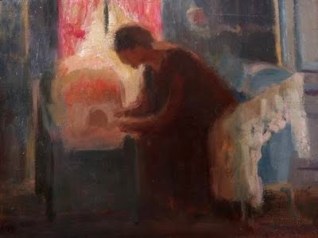
 Cousin Rosamund is a more difficult read than the first two books in the Aubrey Trilogy (also known as The Saga of the Century), in ways I might tell about later. But this passage in which the Aubreys’ friend Nancy shares her expectant-mother thoughts sweetened the mood:
 “I never thought of it before, but it would be more natural if there wasn’t anything at all,” said Aunt Milly.
 The constant revelation of what goes on in her highly analytical mind, her wanting to understand the meaning of things, and her sureness that there is something numinous behind the visible world, all draw me to the stories. (She makes me love just being with the characters — I never want to leave them — which is probably a greater reason, but it deserves its own post.)
 “We were not surprised when the war came, for we had heard our father prophesying it all through our childhood… We had also been warned by our music. Great music is in a sense serene; it is certain of the values it asserts. But it is also in terror, because those values are threatened, and it is not certain whether they will triumph in this world, and of course music is a missionary effort to colonise earth for imperialistic heaven. So we were not so sorely stricken by August, 1914, as many other people. Indeed we had our consolations. It was proved to us that music was not making a fuss about nothing, and that the faces of our parents had been distorted out of common placidity not by madness but by the genuine spirit of prophecy.”

 Gladsome Lights