Tag Archives: repentance

A continuing attitude, to the end of life.

“Correctly understood, repentance is not negative but positive. It means not self-pity or remorse but conversion, the re-centering of our whole life upon the Trinity. It is to look not backward with regret but forward with hope – not downwards at our own shortcomings but upwards at God’s love. It is to see, not what we have failed to be, but what by divine grace we can now become; and it is to act upon what we see. To repent is to open our eyes to the light.

“In this sense, repentance is not just a single act, at initial step, but a continuing state, an attitude of heart and will that needs to be ceaselessly renewed up to the end of life.”

-Metropolitan Kallistos Ware, in The Orthodox Way

Solar Flashback calendula May2016

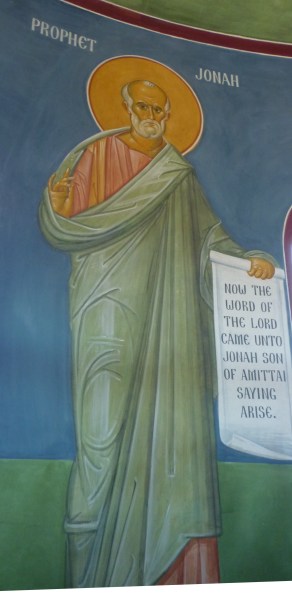
Jonah is glorified forever.

I remember as a Protestant gl-jonah-prophet-dome-edit-crplaughing at the prophet Jonah, because he seems to make himself ridiculous in his pouting conversation with God. Essentially, his emotions are all over the place, which I can relate to. Jonah is unhappy when God spares the people of Nineveh, because that means his prophecy of their destruction doesn’t come to pass, and it makes him look bad. Then he is “exceedingly glad” when God makes a gourd grow up to give him a little shade. When the gourd dies he is very displeased again. And God chastises him for having more pity on a gourd than on a whole city full of humans.

In the Orthodox Church we read the entire book of Jonah in church every Holy Saturday, along with a dozen other Old Testament passages. No one ever chuckles when we get to this part of the story; Jonah has a lot to teach us about our salvation, and we revere him for the fact that God made his life a picture of Christ’s death and Resurrection.

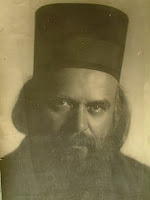
For the Prologue of Ohrid St. Nikolai has written a Hymn of Praise to God for how He worked in and through Jonah’s life, and for His forgiveness. I imagine that much of the poetry got lost in the translation from the Serbian language, but I appreciate the attitude toward the Holy Prophet Jonah, whom we commemorate on this day.

THE HOLY PROPHET JONAH

Nineveh! Nineveh resounds with sin,
And God sends Jonah to heal Nineveh.
Jonah does not want to, and flees from God!
Oh, where will you go, Jonah, to hide from the Most High?
Jonah sleeps; he sleeps and the tempest rises.
God moves slowly, but He will find you in time.
Hurled into the waves, swallowed by the whale,
“From whom did I flee?” Jonah asks himself.
“I fled from Him, from Whom one cannot hide!”
God chastises Jonah and yet delivers him,
And, by His providence, glorifies him forever.
Jonah, you do not want to speak to the Ninevites,
But through your punishment you will prophesy the immortal Christ.
You do not want to by words? Then you must, by deeds,
Prophesy Christ and the death and resurrection of the body!
Your deeds, Jonah, will not fade away,
And Christ the Lord will speak of you to men,
That, through you, the mercy of the Living God might be revealed,
By which you will be saved, as well as Nineveh.
Through you, the power of repentance shall be revealed–
The power of repentance and God’s forgiveness.
You pitied the gourd, and God pitied men.
Help us to repent, O God, and save us from condemnation.

Birthday Reflection

St. Nikolai

Yes, it’s my birthday today! Another day to thank God for all His wonderful gifts.

This spring I’ve been enjoying The Prologue of Ohrid by St.Nikolai Velimirovic. I splurged on this two-volume set of readings for every day of the year when our church bookstore offered it at a discount. I was the one who had to write down information about the book for a list of sale items, and that was the first time I’d actually looked inside. Something about the name along with its size had made me disregard it, but in the Preface I learned that the name Ohrid is “solely to distinguish it from the ancient Slavonic Prologue which — regrettably, because of its language — has become inaccessible to the Slavic people of our time.”

I’d heard and read many of St. Nikolai’s Prayers by the Lake, which are heartfelt and inspiring poems, so it is not surprising that his devotionals of three or four pages are also beneficial. They include stories of two or more saints commemorated that day, a Reflection, a Contemplation, a Homily of a few paragraphs, and often a Hymn of Praise. I’m happy to know that the whole thing is also available online, so I won’t need to carry my book across the continent later this month.

Today’s Reflection is a good one for Lent:

Even in His pain on the Cross, the Lord Jesus did not condemn sinners but offered up pardon for their sins to His Father, saying, They know not what they do (Luke 23:34)! Let us not judge anyone so that we will not be judged. For no one is certain that, before his death, he will not commit the same sin by which he condemns his brother. St. Anastasius of Sinai teaches: “Even if you see someone sinning, do not judge him, for you do not know what the end of his life will be like. The thief who was crucified with Christ was a murderer, while Judas was an apostle of Jesus, but the thief entered into the Kingdom, and the apostle went to perdition. Even if you see someone sinning, bear in mind that you do not know his good works. For many have sinned openly and repented in secret; we see their sins, but we do not know their repentance. Therefore, brethren, let us not judge anyone so that we will not be judged.”

St. Anastasius by Rembrandt

How to Get Light instead of Fog.

St. Isaac of Syria

Thanks to Christ is in our Midst for this posting appropriate to the beginning of Lent. To me it is a helpful elaboration on C.S. Lewis’s statement that “Virtue — even attempted virtue — brings light; indulgence brings fog.”

…If you cannot be still within your heart, then at least make still your tongue. If you cannot give right ordering to your thoughts, at least give right ordering to your senses. If you cannot be solitary in your mind, at least be solitary in body. If you cannot labor with your body, at least be afflicted in mind. If you cannot keep your vigil standing, keep vigil sitting on your pallet, or lying down. If you cannot fast for two days at a time, at least fast till evening. And if you cannot fast until evening, then at least keep yourself from satiety.

If you are not holy in your heart, at least be holy in body. If you do not mourn in your heart, at least cover your face with mourning. If you cannot be merciful, at least speak as though you are a sinner. If you are not a peacemaker, at least do not be a troublemaker. If you cannot be assiduous, at least consider yourself lazy. If you are not victorious, do not exalt yourself over the vanquished. If you cannot close the mouth of a man who disparages his companion, at least refrain from joining him in this.

Know that if fire goes forth from you and consumes other men, God will demand from your hands the souls which your fire has burned. And if you yourself do not put forth the fire, but are in agreement with him who does, and are pleased by it, in the judgment you will be reckoned as his accomplice. If you love gentleness, be peaceful, if you are deemed worthy of peace, you will rejoice at all time. Seek understanding, not gold. Clothe yourself with humility, not fine linen. Gain peace, not a kingdom.

~St. Isaac of Syria