
Kate took me to South Mumbai last week to visit some Must See sites, which I’m sure I could write a book about if I only had enough lives to live. I tell you truly, this exciting life with its realms of experience and knowledge that I can only manage to dip my little toe into is wearing me out. My understanding of many things I present here is slight, and my photos are not as good as you can find other places online. But they are what I’ve seen with my own eyes, and we had good reason for going to these spots, and I was so glad we did.
I’ll start my report with one of the High things, the Gateway of India, which is hard for someone as unskilled as I to photograph, looming as it does so huge at the edge of the sea. The British built this monument to commemorate the visit of King George V and Queen Mary to India in 1911, and it was completed in 1924. When the last British troops departed India, they passed through the arch, ceremoniously relinquishing power.
Kate and I walked all around, and she took my picture in front of this icon of Mumbai, under which one is no longer permitted to walk. We also had our picture taken with various groups of Indian tourists. But then we sped away, because there was so much to see…

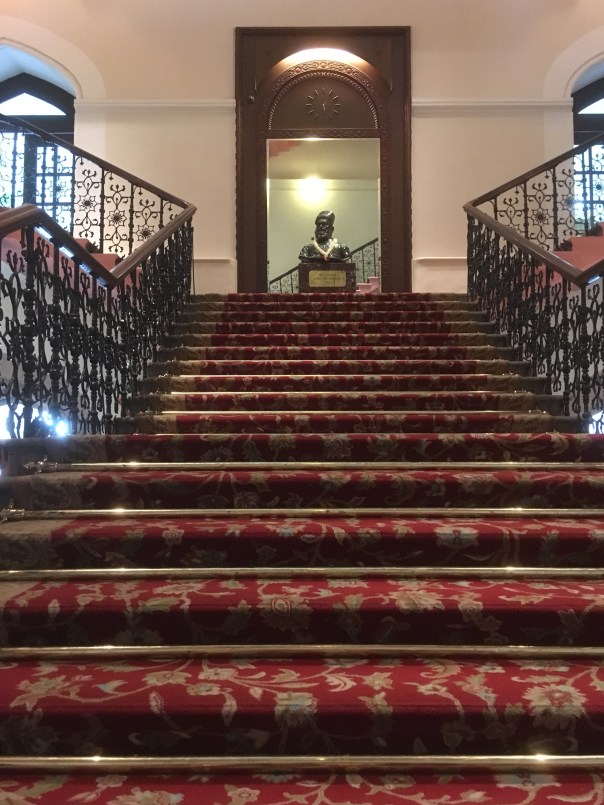
The next High thing on our agenda, which often appears in photos with the Gateway, was the Taj Mahal Palace Hotel. This five-star hotel opened twenty years before the Gateway was completed, having been commissioned by the Tata group, a conglomerate founded in 1868 by the man considered “The Father of Indian Industry,” Jamsetji Tata. A staircase leads up to a bust of this patriarchal figure.
I didn’t notice when I took my picture of the exterior that I was including a row of men posing for someone else, but I was happy to have them come along! That picture shows the original building and the tall addition, which between them have more than 600 rooms and suites. “The Taj” is the place where John Lennon, Oprah, and Queen Elizabeth stay when they are in town.
In 2008 a terrorist attack on Mumbai focused on the Taj, where the attackers holed up for days, and where many staff were killed. This garden, which has a waterfall not in the picture, memorializes those who lost their lives:

We wandered around for a little while, appreciating the artful opulence. In the restroom each patron has a clean and folded cloth napkin with which to dry her hands. Everything was elegant and serene and orderly.


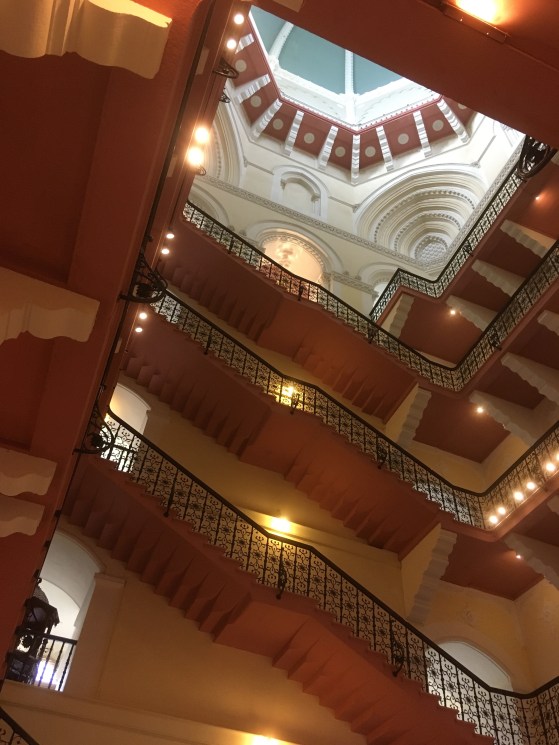


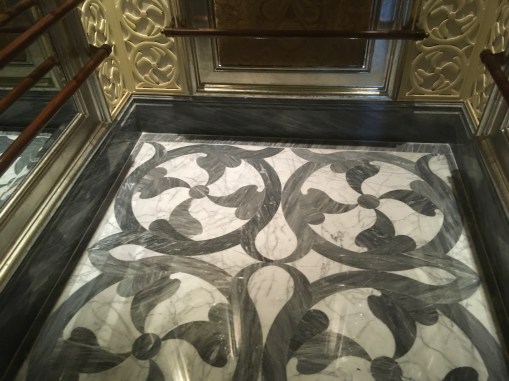
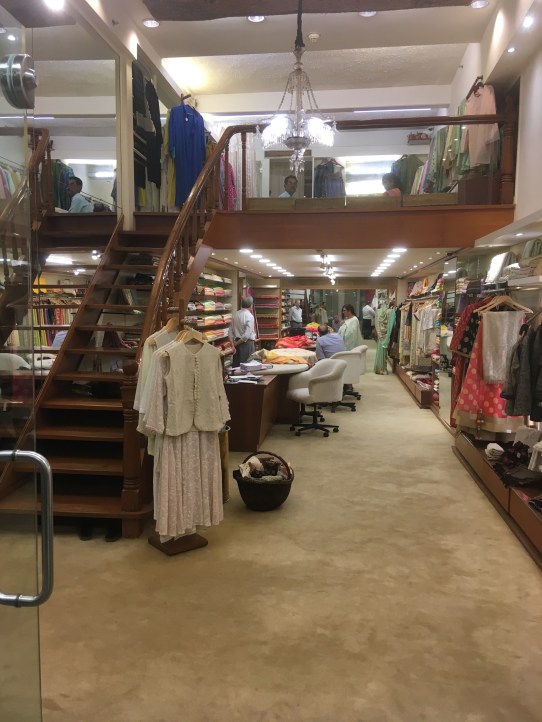
I could imagine the lovely dresses in the clothing shop, but I was concerned that Kate not get worn out, so we left The Taj pretty soon and went to lunch at a famous Parsi café called Britannia & Company. “Parsi” refers to the Zoroastrian Persians who emigrated to India centuries ago to escape persecution. There is a large Parsi community in the Mumbai area, from which the Tatas are descended, by the way, and much good Parsi food available. Pilau is probably the center of a good Parsi lunch:
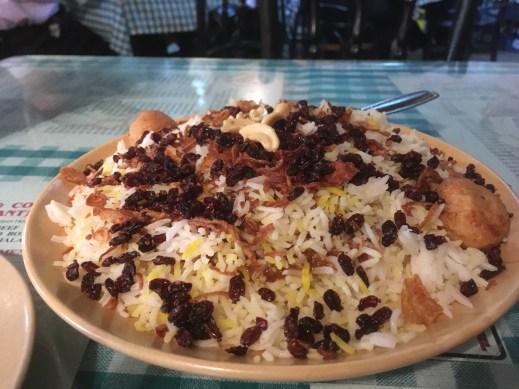
In the rankings of high to low, our lunch was not high cuisine, but it was a high point of the day, and Parsi food ranks high on my list. The next places I’ll tell you about, though, are both low in different ways, which I dare not begin to muse on philosophically. It’s another book to be written.
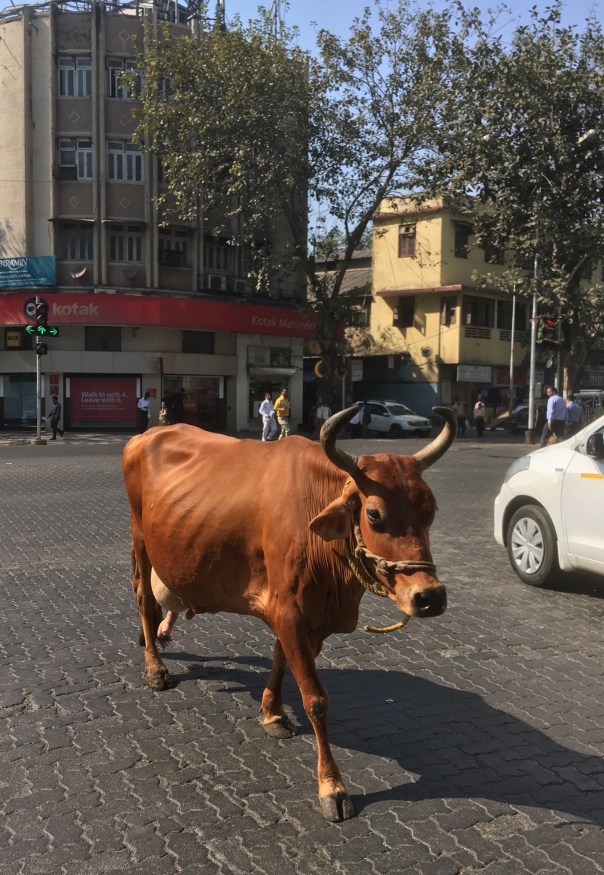
I have to mention that it was in this busiest part of the city that I saw the most cows, three strolling through one intersection alone.

Dhobi Ghat… In Hindi, ghat means “steps leading down to a body of water.” (It also means “mountain,” as in my last post.) Dhobi is the name of a caste of washermen. Dhobi ghat can refer to any laundromat, but in Mumbai, Dhobi Ghat is the giant open-air laundry that Kate and I visited. My first picture above was part of the view as seen from the road on one side; after, we walked down into the area of washing pens and flogging stones, where drying laundry hung in close rows above us.
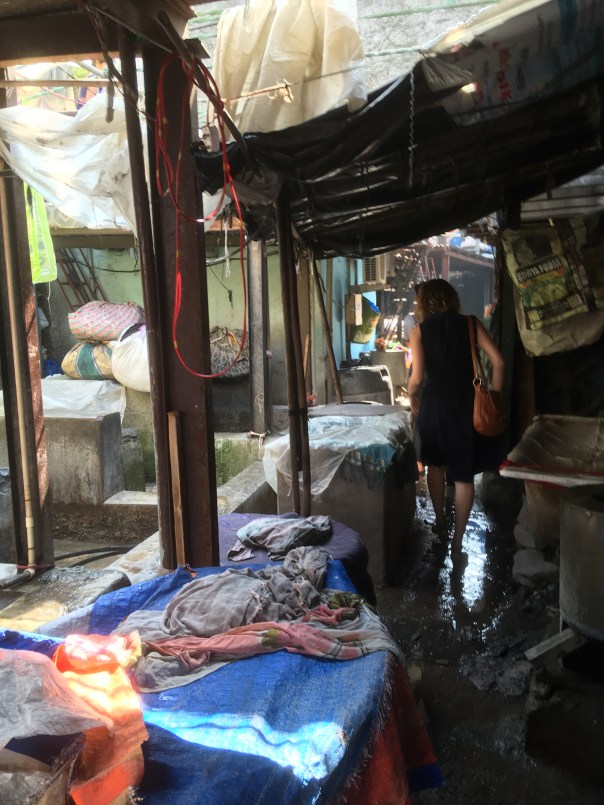
Our tour was very informal: we entered what in essence is a little village, started looking around, and a young man asked if we wanted a tour for 200 rupees, about $3, each. We said okay, and paid, and then he walked us through very fast and told us some things about the laundry. I missed much of what he said because I was hanging behind taking pictures, and just generally being overwhelmed and spacey from barely believing that I was in this place. I love doing laundry, but it seems ludicrous for me to say that in the context of Dhobi Ghat. These people take the task of washing clothes to a level that is outer space. But the whole affair lies so low as to be hardly noticeable as your gaze is carried upward by the skyscrapers all around.

Our guide told us that 400-500 people live here, and that he had been born at the “laundromat” himself. Internet articles say that their clients are “neighborhood laundries, wedding decorators, garment dealers, mid-sized hotels, clubs, and caterers.” I believe those things. But so much else that you can read, or even hear residents of Dhobi Ghat say in YouTube interviews, is contradictory or contrary to recorded history, so my questions only multiply and are unlikely to be answered to my satisfaction.
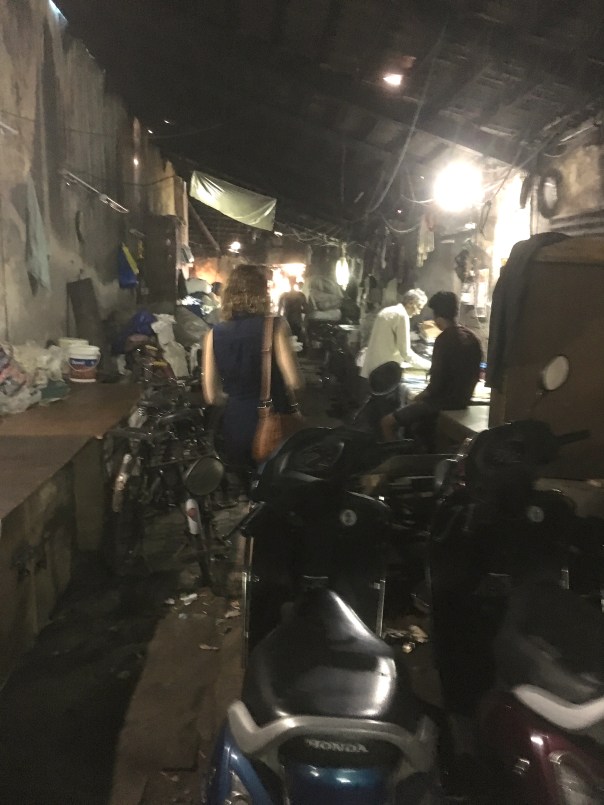
Some of my pictures are dark, because it was dark, especially in a passageway under tarps or some kind of roof, where in the space of five yards motorcycles and a bicycle were parked, a young man was cooking a big pan of potatoes, and an old man was pressing jeans with a vintage iron.


I came upon a man flogging a large wet item on a stone, his back to me, and when he lifted it each time to slap it down again, washwater fell in a shower behind him and on my path. So I timed my crossing, and managed to scoot past between slaps. In places there were little puddles or ditches to hop over, but we got through the busy laundry without getting wet.
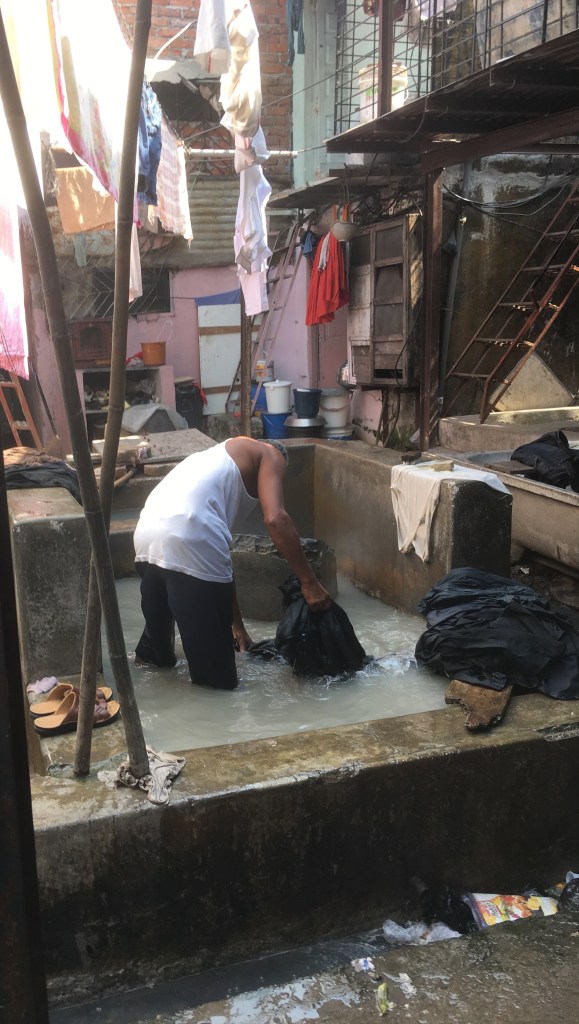


It was noon, a clock in my photos tells me, and this man with one hand on the door of a big washer has a small glass of masala chai in the other hand. As we walked the lanes and streets we saw little apartments where the workers and their families live; some of them had a curtain pulled across, but in one doorway a woman was sitting on the floor preparing a salad. In the work area we walked past the occasional man stretched out sleeping on a wide shelf.

Dhobi Ghat was built by the British in 1890. Washermen own their wash pens and hand them down through the generations; some of them have installed modern washing machines and dryers. How they manage to keep track of the 10,000 items they collectively process every day is completely beyond me.
I thought the little girls I saw headed to school must be going off-site, but I learned in my research that the residents started their own school after one of their children was in an accident traveling to school elsewhere, and now they also have families from neighboring areas sending their children to the Dhobi Ghat school.
I count it a privilege to have had fifteen minutes in the presence of these hard-working people. When I am home again where I can hang my garments on the clothesline after letting my machines do almost all of the hard work, I will continue to think of them with admiration.
The last stop on our touristy outing was the lowest of all relative to sea level, because it was sea level, Girgaum Chowpatty or Chaupati Beach, a famous beach in Mumbai, but not for swimming. Festivities surrounding the favorite Hindu god Ganesh are held here, and at the end of the yearly celebrations effigies of Ganesh are plunged into the Arabian Sea, unfortunately adding to the trash problem. I found this photo online showing the event:

If I didn’t have a growing sand collection, I would not have taken the time to go to a beach in Mumbai, because a beach where the water is toxic is so disheartening. It’s not just trash, but sewage that pollutes these waters. And did I even want to collect sand from it? We had been trying to fit in a trip to an Indian beach ever since I arrived, and I was grateful to Kate that she insisted I not miss the opportunity.
We didn’t go on to the wet area of the wide beach. I theorized that the dry sand far away from the shore would have been washed by the last monsoons and not be the dirtiest. Nonetheless, when I got a sample home I washed and disinfected the sand with bleach, and then baked and dried it in the oven before filling my little bottle. 🙂

When you read here or elsewhere about all of the air pollution, water pollution, trash, you might think, “Why doesn’t someone do something?” The problems are complex, but sometimes simple baby steps can improve the situation.
We were only on the beach for a few minutes, during which time we were surprised to see big coppery urns — what could they be for? Kate asked a young man nearby, and he said they were waste bins! Many of the trash cans that have been installed all over the city are bright blue plastic barrels, but these elegant receptacles were both functional and beautiful. I did think of how a child would not be able to use them — oops! I guess that’s a design flaw.
While the government and environmentalists keep working on the source of the problems that humiliate the water and the sand, it makes me happy that someone has honored the beach with these trash urns. When I showed Tom my picture of Kate below he said, “Cute wife looking into the greatest trash can in India!”





 Orthodox Lent is almost here! And there is plenty for me to focus on, of the sort of things that help us on our Journey to Pascha. A few of the speakers at the conference gave us their unique short list of “action points,” for going forward in our personal lives on the theme of the event. That theme was Reclaiming the Cosmic Image, which right there seems a very Lenten goal. Maybe I will share about it in future posts.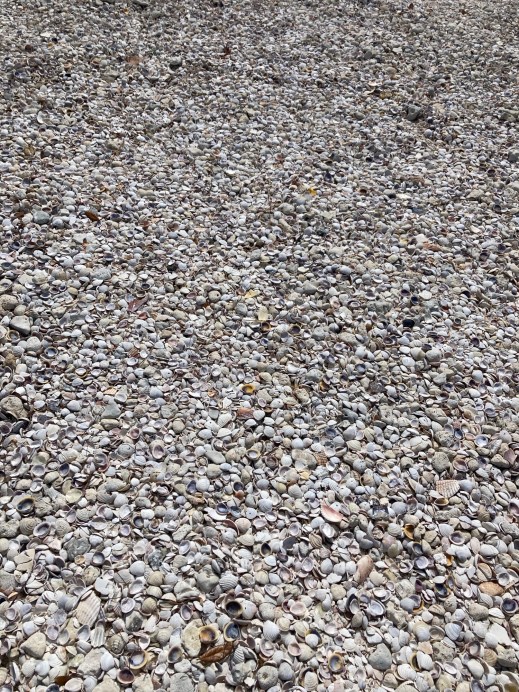


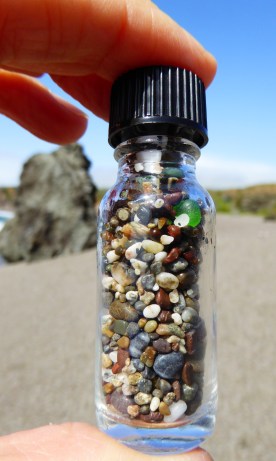
 You might notice in that photo above the blue sky in the background. For much of the afternoon we were under a clear and blue ceiling, though we could see fog banks and clouds moving in on three sides of us.


 Gladsome Lights