Tag Archives: Santa Lucia

Brave and faithful servants.

Over the years I’ve often written about St. Herman of Alaska and Father Alexander Schmemann, two important people in my life whom we remember on this day. This year I want to add St. Lucia of Syracuse, whose day it also is; we are blessed to have four Lucys in our parish, one of whom is my dear goddaughter.

This morning we had a glorious Divine Liturgy in honor of the saints, with our rector testifying to the power of Fr. Alexander as well, saying that if it weren’t for his influence, teaching and prayers, he would not be our priest today. We sang “Memory Eternal” for Fr. Alexander and for Leonid Ouspensky, whose legacy as an iconographer continues to enrich our parish year after year.

St. Herman and Fr. Alexander have both contributed hugely to the presence of true and living Orthodox faith in America, that Church in which I’ve found the fullness of Him Who fills all in all. Every year that we come to this date finds me more thankful.

Saint Herman of Alaska arrived in Alaska in 1794 and died there in 1837. On the occasion of his canonization in 1969 Bishop Dimitri spoke:

The Church on earth lives in a loving fellowship with the saints who have already run their race, who have fought the good fight, and have received their crowns (2 Timothy 4:7) (James 1:12). This is what the Apostle means when he says that we are compassed about or surrounded by the witness-martyrs or saints. We are assured both of their presence and their interest in us. In fact, they are concerned about the whole world and its salvation, for “there is joy in heaven over the repentance of one sinner” (Luke 15:7).

Father Schmemann was born in 1921 into a family of Russian emigres, and came to the United States in 1951 to join the faculty of St. Vladimir’s Seminary, where two of my own parish priests sat under his teaching. He reposed in the Lord in 1983. Not only has my life been enriched broadly by his contributions to the whole of Orthodoxy in America, but by my reading directly what he wrote, especially For the Life of the World, and his journals. Most recently I read his The Eucharist, which was a treasury of living truth, so vast, I haven’t known how to begin to say anything about it here.

It seems fitting that we commemorate St. Herman of Alaska on this date, when winter is making itself felt. I’ve written before (and yes, before that) about how he spurned the cold, befriended the animals, and interceded between the Aleuts and the powerful people who would exploit them. His is a good example in the Advent season, of how to keep our hearts and activities focused on the Kingdom of God in the face of distractions. 

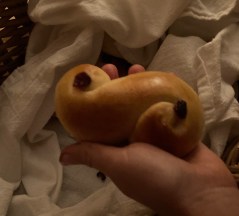
Santa Lucia buns from a previous year.

The mother of the youngest Lucia in the parish brought darling Santa Lucia buns as she always does, and a few of us stayed to drink coffee in the parish hall. But now I am home, with hospitality on my mind and heart: I have been welcomed into the household of God and fed at His table, and will go in that strength throughout the day and on to the Feast of the Nativity of Christ.

May we all prepare ourselves for the celebration by entering into the spirit of St. Herman, who advised us:

“…let us make a vow to ourselves, that from this day, from this hour, from this very moment, we shall strive above all else to love God and to fulfill His Holy Will.”


In-between December days.

The first half of the week was a flurry of activity: First a Santa Lucia Eve procession that I was invited to, with a few families I have been getting to know because of my involvement in a homeschool group. With the eldest girl wearing a wreath studded with candles, we processed through the neighborhood singing “Santa Lucia” in Italian — I admit I was only humming the tune because I haven’t become that involved to have learned the words in Italian or even English. Then back at the house, we added “Stille Nacht” (Silent Night) in the original German. Tea and Santa Lucia buns in their delicious quintessential selves finished out the evening’s simple program. I took the picture three days later so the greenery is a bit dried out.

The next night our women’s book group at church got together. Originally that meeting was to be a soup dinner for 10 at my house, but the time and place got changed because of a funeral; it was a big relief for me, because as soon as December arrived, I couldn’t imagine getting ready for a party at the same time I was getting ready for a trip, which this year is the case: I’m headed to Soldier and Joy’s for Christmas.

At the first part of the funeral, in the evening.

I made split pea soup, and we had a very festive group and evening, eating fish chowder, pumpkin soup and lentil tomato soups as well — plus accompaniments. Of course, cookies and vegan brownies, too! I don’t think I mentioned before what books we have been reading this time. They were Strength in Weakness by Archbishop Irenei Steenberg, and The Secret Garden by Frances Hodgson Burnett. I’d been wanting to gather my thoughts on The Secret Garden for about five years, so this was the impetus I needed to buckle down. I’ll share more about my resulting amateur analysis in the new year.

By Julia Morgan

Thursday I attended a tea party of about a dozen ladies and girls, several of whom I was meeting for the first time. Many of them are very accomplished, cultured and educated, and there was lots of fascinating conversation about our personal histories, world events, information about our local towns and the architecture of particular houses that were built by a relation of the woman sitting next to me. She was the only one there who is older than I, and she has been involved in our town’s history from way back, and continuing.

It was while this talk was flowing around me that the name of Julia Morgan, architect, made me pay closer attention; a bit more information about the time frame in which she worked, and I began to wonder if my grandfather was one of the contractors that she worked with in the San Francisco Bay Area; she designed more than 700 houses in California. I will be doing more research on that, but in the meantime I show you these photos of the Berkeley City Women’s Club building, in which my grandmother (on the other side of the family) was very active, and where she took us swimming when we visited her. That building has been called a “little Hearst Castle,” referring to the real (huge) Hearst Castle in San Simeon, California, the estate that Morgan designed with William Randolph Hearst.

Since the tea party I have switched gears and stayed home, slowly working on wrapping presents, packing bags and organizing my thoughts in preparation for my departure. One by one little things that need to be done come to mind and I do them, or write them down. It is not very systematic, and the whole process seems to require frequent attention to everyday tasks like building the fire and tending the frozen fountain. I guess it’s because I’m not systematic that I require banks of time for the creative flow to happen. As I am fond of quoting G.K. Chesterton:

“I am not absentminded. It is the presence of mind
that makes me unaware of everything else.”

Even things I’ve been procrastinating on for months must be put off no longer, whether or not they have anything to do with the trip — like making a phone call. My daughter Kate says everyone does the same at the end of the year, finally sending in reports or contacting loved ones, I guess because they don’t want to come back from Christmas break with “old business,” whether it’s work or family related, dutiful or joyful.

Now that I’ve procrastinated enough to get another unnecessary thing done, the writing of this post, I will have to hustle a little bit and fold the clothes I laundered, to figure out what to take with me. Before I know it, these in-between days will have ended and I’ll be boarding an airplane and on my way to a happy reunion with several of my dear family. I hope that on Christmas Eve we will sing “Stille Nacht.”