Maria Horvath (blog now inactive) posted this song, scripture and video together many years ago:
We begin this month’s look at the different forms of love with one of the most thought-provoking statements ever made about love.
In the Sermon on the Mount, Christ tells his followers, “You have heard that it was said, ‘You shall love your neighbor and hate your enemy.’ But I say to you, Love your enemies and pray for those who persecute you, so that you may be sons of your Father who is in heaven; for he makes his sun rise on the evil and on the good, and send rain on the just and on the unjust. For if you love those who love you, what reward have you? Do not even the tax collectors do the same? And if you salute only your brethren, what more are you doing than others? Do not even the Gentiles do the same? You, therefore, must be perfect, as your heavenly Father is perfect.” ~ Matthew 5:43-48

The lyrics below tell the true story of a truce between British and German soldiers on the Western Front in 1914. It is told from the perspective of a fictional British soldier.
CHRISTMAS IN THE TRENCHES
Oh, my name is Francis Tolliver, I come from Liverpool,
Two years ago the war was waiting for me after school.
From Belgium and to Flanders, Germany to here,
I have fought for King and country I love dear.
’Twas Christmas in the trenches and the frost so bitter hung,
The frozen fields of France where still no songs of peace were sung.
Our families back in England were toasting us that day
Their brave and glorious lads so far away.
I was lying with me mess mates on the cold and rocky ground
When across the lines of battle came a most peculiar sound.
Says I, Now listen up me boys, each soldier strained to hear
As one young German voice sang out so clear.
He’s singing bloody well, you know, my partner says to me.
Soon one by one each German voice joined in in harmony.
The cannons rested silent and the gas cloud rolled no more,
As Christmas brought us respite from the war.
As soon as they were finished and a reverent pause was spent,
“God Rest Ye Merry Gentlemen” struck up some lads from Kent.
The next they sang was “Stille Nacht.” ’Tis “Silent Night,” says I,
And in two tongues one song filled up that sky.
There’s someone coming towards us now, the front line sentry cried.
All sights were fixed on one lone figure trudging from their side.
His truce flag like a Christmas Star shone on the plain so bright
As he bravely trudged unarmed into the night.
Then one by one on either side walked in to No Man’s Land
But neither gun nor bayonet, we met there hand to hand.
We shared some secret brandy and we wished each other well,
And in a flare-lit football game we gave ’em hell.
We traded chocolates and cigarettes and photographs from home,
These sons and fathers far away from families of their own.
Tom Sanders played the squeeze box and they had a violin,
This curious and unlikely band of men.
Soon daylight stole upon us and France was France once more.
With sad farewells we each began to settle back to war.
But the question haunted every heart that lived that wondrous night,
Whose family have I fixed within my sights?
’Twas Christmas in the trenches and the frost so bitter hung.
The frozen fields of France were warmed, the songs of peace were sung.
For the walls they’d kept between us to exact the work of war
Had been crumbled and were gone forever more.
Oh, my name is Francis Tolliver, in Liverpool I dwell.
Each Christmas come since World War I, I’ve learned its lessons well,
For the one who calls the shots won’t be among the dead and lame,
And on each end of the rifle we’re the same.
~ John McCutcheon, born 1952, American singer, musician, and composer
 After Myriah had gone home, she wrote to thank me, and to apologize for what she thought was her own “noise” as she “tried to make sense of everything.” She said, “I came home and planned to curl up and read the Bible.” But family demands prevented her. I realized that I had robbed her of what should have been a respite from confusion, talking as I had as though raging and clanging could be truly rational. Probably we should have spent some part of our two-day visit reading the Gospel together. (The garden did rescue us several times.)

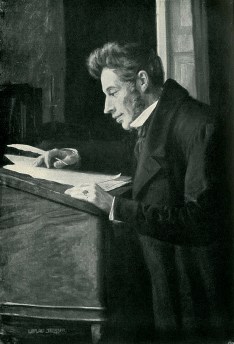 Søren Kierkegaard published the first edition of this work in 1849, but he continued to think about the subject and to write about it in his journals. The translator Bruce H. Krimmse tells us this in the introduction, and quotes from the journals, reflections that I rather wish I hadn’t read, because what’s in the first half of the book itself is quite adequate for stripping away any sentimentality I might have about birds and flowers. As Krimmse says, “[Kierkegaard] never permits the reader to ease up on the oars and drift in an intellectual, ethical, or spiritual sense.” Also, these further explanations were confusing to me, whereas most of the first discourse was more accessible. Maybe this was one of the introductions one should read after.

 Gladsome Lights