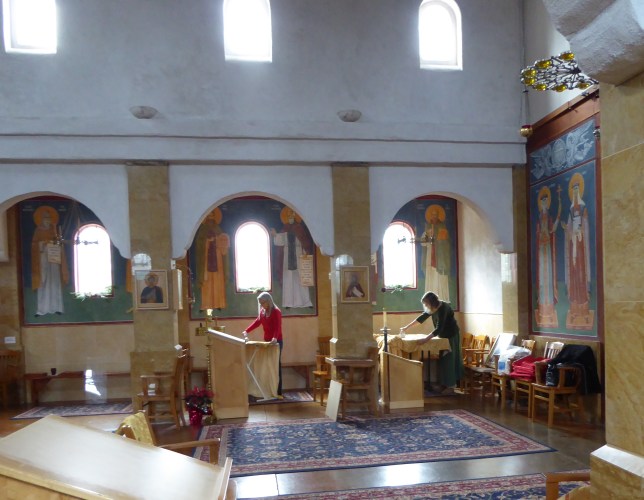
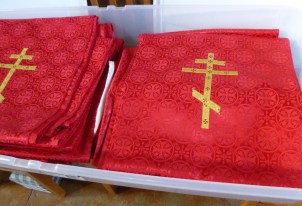
After the Feast of the Nativity of our Lord, we change from red to gold altar cloths. Earlier in the week I helped to iron the gold ones that had gotten creases being in storage bins, a task that is done right there in the temple.
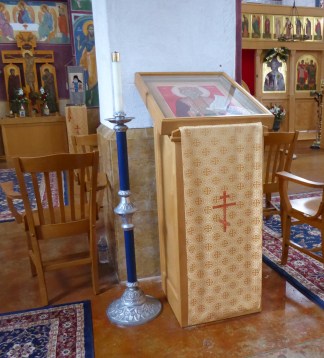
Three of us ironed, and draped the smoothed gold cloths over chairs. The fourth walked around the church making the exchange on icon stands and tables.
The cloths that belong in the altar itself were laid over the choir stands temporarily, where our rector could later switch them out for the red ones in the altar at his convenience, sometime before the next service.
The red ones were put away in bins, where they will stay at least until next September, if I read the rubrics correctly.
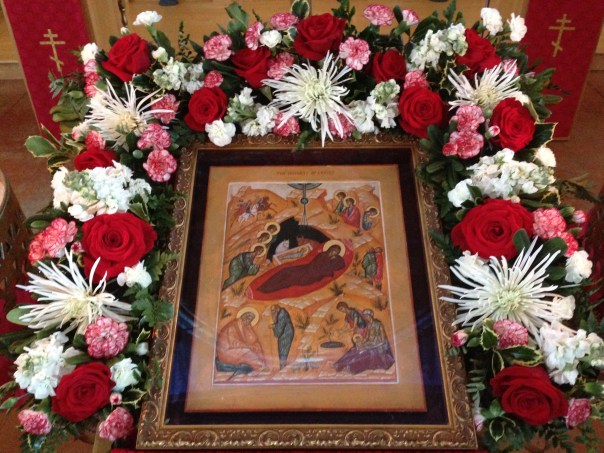
Leavetaking of Nativity was yesterday, so this icon of the Christmas feast has been removed; today was another great feast, The Circumcision of Christ. Born a Jew, our Lord was circumcised eight days after birth according to the law.
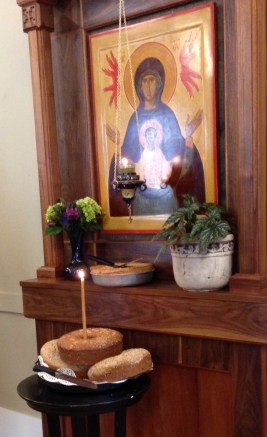 In addition to being one of the twelve great feasts of the church year, today is the day we remember St. Basil the Great, and after Liturgy this morning we gathered in the fellowship hall to eat some St. Basil bread, of which we had four loaves, including one gluten-free. The Greek word for this is Vasilopita, and many traditions have grown up around it over the centuries. I like this telling of the story linking it to St. Basil: Vasilopita.
We sang and ate the blessed bread after it had been cut in several symbolic ways, first into quarters by the sign of the cross made with the knife. Various chunks were swiftly and ceremonially removed for Christ, for the poor, and I can’t remember who all, because I was too focused on taking pictures!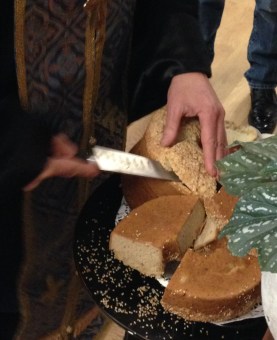
A coin was baked into each loaf, as is the custom, so we were warned to bite our cake gently. Our parishioner who bears the name of Basil was blessed to find the first coin in his slice.
I stood around drinking coffee, eating the sweet bread, and chatting for a good while before I came home and changed into walking clothes so that I could get out in the sunshine with friend Elsie for the better part of an hour. We timed our walk to be in the warmest part of the day, and it was almost 50° by then.
I’ve been burning a lot of wood, and the stack that was “temporarily” in my driveway for five months has been whittled down to almost nothing. Now my new utility yard is ready to receive the firewood again, but I’m not going to bother moving this little bit of old wood back there. I’ll stack the new supply of wood I’ve ordered there next week.
Tomorrow is the first day of winter that we have been forbidden to burn wood, because of the deteriorating air quality. It often happens like this: when you most want a good fire is when the inversion layer keeps the cold and the pollutants close to the earth. I’m glad I have a good furnace but it’s disturbing to hear it coming on all day and night when we don’t have a fire in the stove. Next week we are expecting the El Niño system to bring us rain, so that will clear up and warm up the air.
This week between Christmas and New Year’s has been a struggle for me, trying to accept my new life that is evolving, or that I am creating; I’ll be glad to be slightly less cold next week and to lay in some fresh fuel-wood. Since I can’t have a fire tomorrow I am thinking of baking bread, which would help to warm up the house and make it homey. Theophany is just around the corner, and for about ten days now the days have been getting longer — have you noticed? Here comes the sun!
Happy New Year to all my dear blogging friends and readers!
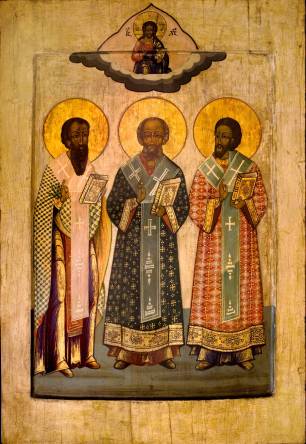 Our Orthodox commemoration of the Three Holy Hierarchs and Ecumenical Teachers was instituted as a result of 11th-century debates about which of them was the greatest. They themselves had to intervene by means of a vision given to St. John Bishop of Euchaita, who chose January 30 for their feast.
 Gladsome Lights