Tag Archives: St. Nikolai Velimirovich

Jonah is glorified forever.

I remember as a Protestant gl-jonah-prophet-dome-edit-crplaughing at the prophet Jonah, because he seems to make himself ridiculous in his pouting conversation with God. Essentially, his emotions are all over the place, which I can relate to. Jonah is unhappy when God spares the people of Nineveh, because that means his prophecy of their destruction doesn’t come to pass, and it makes him look bad. Then he is “exceedingly glad” when God makes a gourd grow up to give him a little shade. When the gourd dies he is very displeased again. And God chastises him for having more pity on a gourd than on a whole city full of humans.
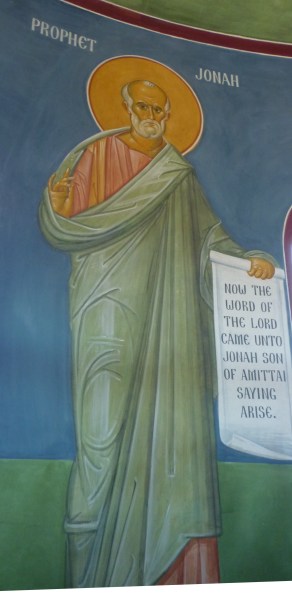
In the Orthodox Church we read the entire book of Jonah in church every Holy Saturday, along with a dozen other Old Testament passages. No one ever chuckles when we get to this part of the story; Jonah has a lot to teach us about our salvation, and we revere him for the fact that God made his life a picture of Christ’s death and Resurrection.

For the Prologue of Ohrid St. Nikolai has written a Hymn of Praise to God for how He worked in and through Jonah’s life, and for His forgiveness. I imagine that much of the poetry got lost in the translation from the Serbian language, but I appreciate the attitude toward the Holy Prophet Jonah, whom we commemorate on this day.

THE HOLY PROPHET JONAH

Nineveh! Nineveh resounds with sin,
And God sends Jonah to heal Nineveh.
Jonah does not want to, and flees from God!
Oh, where will you go, Jonah, to hide from the Most High?
Jonah sleeps; he sleeps and the tempest rises.
God moves slowly, but He will find you in time.
Hurled into the waves, swallowed by the whale,
“From whom did I flee?” Jonah asks himself.
“I fled from Him, from Whom one cannot hide!”
God chastises Jonah and yet delivers him,
And, by His providence, glorifies him forever.
Jonah, you do not want to speak to the Ninevites,
But through your punishment you will prophesy the immortal Christ.
You do not want to by words? Then you must, by deeds,
Prophesy Christ and the death and resurrection of the body!
Your deeds, Jonah, will not fade away,
And Christ the Lord will speak of you to men,
That, through you, the mercy of the Living God might be revealed,
By which you will be saved, as well as Nineveh.
Through you, the power of repentance shall be revealed–
The power of repentance and God’s forgiveness.
You pitied the gourd, and God pitied men.
Help us to repent, O God, and save us from condemnation.
Zoë

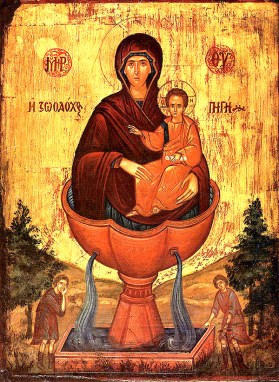
On Bright Friday, that is, the Friday after Pascha, the Orthodox Church commemorates The Life-Giving Spring of the Most Holy Theotokos. Though I had heard of the monastery by that name, it seems I had never paid attention on Bright Friday before to get the backstory; this year I heard about it twice. The story of a miraculous pool of water and how it was rediscovered is well told here.

I also learned that women with the name Zoë might have been named for this feast of the Theotokos. Zoë means life in Greek. In his Prologue of Ohrid St. Nikolai Velimirovich relates the story of a St. Zoë and her family, who were slaves in the second century. On the same day’s entry St. Nikolai’s homily is on this pertinent scripture from Jeremiah:

Be amazed at this, O heavens, and shudder with sheer horror, says the Lord. Two evils have my people done: they have forsaken Me, the source of living waters. They have dug themselves cisterns, broken cisterns that hold no water.

From the homily:

The Source of living water is the Lord Himself: inexhaustible, copious and sweet. The cistern is every man’s work which is performed in opposition to God and God’s law, and from which men expect progress, happiness and satisfaction for their hungeTheotokos lifegivingfountr and thirst….

….O Lord, Immortal Source of every good that the heart of man can desire and the mind of man can imagine, have mercy on us sinners and unworthy ones. With Thy powerful right hand, turn us away from our godless and vain works and quench our thirst with Thy sweet and living water.

Whether in her womb, or in a pool of healing waters, or in her example and exhortation to “Do whatever He tells you,” it is the life of the Lord Himself that His mother offers us.

This concludes my alphabetical posts. As in the first I acknowledged that Christ is Alpha and Omega, the first and last — according to the Greek alphabet — so here at “Z”, the last letter of our alphabet, we find that He is Zoë, Life itself.


Then he took him up in his arms…

P1120397 altar w beamsLight, joy, glory… If you don’t know the story of what happened when Jesus was presented in the temple at 40 days old, skip to the bottom of this post and read the account from Luke before going on.
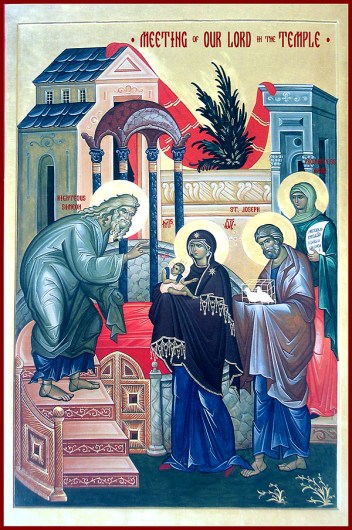
It’s been a few days now since we celebrated the feast of The Meeting of the Lord. It’s interesting that the Orthodox usually know it from the perspective of Simeon and Anna, but it is also called The Presentation of Christ, from the point of view of Jesus’s parents.

As I’ve mentioned more than once, it is one of my favorite feasts (I’ve written about it before), so I was expectant and so glad that I was able to be at Divine Liturgy on what can be an inconvenient day — this year February 2nd was a Monday. But I had missed church the day before and was feeling very needy.meeting-Lord-temple0001 oca

We began with Matins, and every element of the service beginning with the refrain, “Let every breath praise the Lord!” seemed to be calculated to straighten up my bent soul. By means of the most aromatic incense, the chandeliers swinging, the Six Psalms, and many more gifts known and unknown, many kinks in the conduit were at least temporarily untwisted so I could receive the light and the joy.

I got the usual goosebumps when the gospel for this feast was read. Oh, dear Simeon! What must it have been like for you to hold The Christ in your old arms?… knowing not just as information but in your very heart and flesh that this infant was your own God and Redeemer? To help us meditate on this, the words of a hymn ascribe to Christ the words, “I am not held by the Elder; it is I Who hold him, for he asks Me for forgiveness.”

simeon-god-receiverThat hymn was part of yesterday’s remembrance of Saint Simeon the God-Receiver and also St. Anna the Prophetess. We remember them especially the day following the event in which they figured. But it’s still not time to leave the nourishment of this feast behind: The Leavetaking of The Meeting of Our Lord is not until next Monday, and by then we won’t be too sad to say good-bye because we will be well into the pre-Lent period, the Sunday of the Prodigal Son being the day before.
In the Church calendar we have these layers of history and sacrament and celebration constantly orienting us to the deepest realities of life. The light and truth that we draw from the lives of the saints and from the events of our salvation history are not random ideas in our individual heads, but are shared experience with the whole Church family as we worship together by means of all the graces and sacraments pertaining to each season.

St. Nikolai on this day encourages us to contemplate joy, and his homily elaborates: “Just as the bleak forest clothes itself in greenery and flowers through the breath of spring, so every man – regardless of how arid and darkened he is by sin – becomes fresh and youthful from the nearness of Christ. For the nearness of Christ is like the closeness of some life-giving and fragrant balsam that restores health, increases life, and gives fragrance to the soul, to the thoughts and to the words of man.”

I came home from church with a candle from among the stack that had been blessed, as this feast is also Candlemas. Candlelight is reminding me to hold on to the joy that has been given to me, and to be renewed in it every morning. Let every breath praise the Lord!

P1120401crp dome w beams

21 And when eight days were accomplished for the circumcising of the child, his name was called Jesus, which was so named of the angel before he was conceived in the womb.

22 And when the days of her purification according to the law of Moses were accomplished, they brought him to Jerusalem, to present him to the Lord;

23 (As it is written in the law of the Lord, Every male that openeth the womb shall be called holy to the Lord;)

24 And to offer a sacrifice according to that which is said in the law of the Lord, A pair of turtledoves, or two young pigeons.

25 And, behold, there was a man in Jerusalem, whose name was Simeon; and the same man was just and devout, waiting for the consolation of Israel: and the Holy Ghost was upon him.

26 And it was revealed unto him by the Holy Ghost, that he should not see death, before he had seen the Lord’s Christ.

27 And he came by the Spirit into the temple: and when the parents brought in the child Jesus, to do for him after the custom of the law,

28 Then took he him up in his arms, and blessed God, and said,

29 Lord, now lettest thou thy servant depart in peace, according to thy word:

30 For mine eyes have seen thy salvation,

31 Which thou hast prepared before the face of all people;

32 A light to lighten the Gentiles, and the glory of thy people Israel.

How to become fresh and youthful.

“The Paschal season of the Church is preceded by the season of Great Lent, which is also preceded by its own liturgical preparation. The first sign of the approach of Great Lent comes five Sundays before its beginning. On this Sunday the Gospel reading is about Zacchaeus the tax-collector. It tells how Christ brought salvation to the sinful man, and how his life was changed simply because he “sought to see who Jesus was” (Luke 19:3). The desire and effort to see Jesus begins the entire movement through Lent towards Pascha. It is the first movement of salvation.”

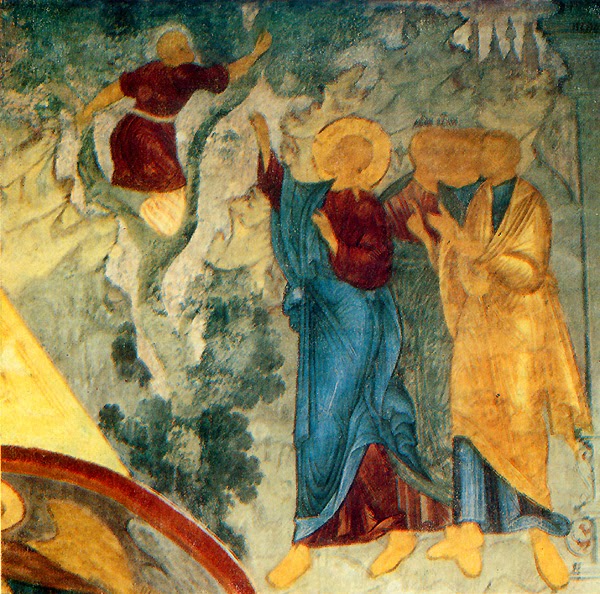
This excerpt from our church bulletin explains why this date on the church calendar is a good one for someone to become a catechumen, as two people did on Sunday in my parish, and as I did seven years ago. It was not my first introduction to life in Christ, but it was definitely the time when I climbed up to the best vantage point to see Christ and His Church in all its fullness.

When I was a little child in Sunday School I learned some details of the story by way of a song:

“Zacchaeus was a wee little man, a wee little man was he.
He climbed up in a sycamore tree for the Lord he wanted to see.
And when the Savior passed that way He looked up in the tree;
And He said, ‘Zacchaeus, you come down, for I’m going to your house today.'”

In his Gospel homily Sunday our rector pointed out that the Lord also said, “Make haste.” In other words, “Get down here, man! Don’t be dilly-dallying about, but begin right now to mean business with God.” And this week St. Nikolai explains how this man and his experience are meaningful to each of us:

“Today, salvation has come to this house.”
(St. Luke 19:9).

“Thus it was spoken by the One Whose word is life and joy and restoration of the righteous. Just as the bleak forest clothes itself into greenery and flowers from the breath of spring, so does every man, regardless of how arid and darkened by sin, become fresh and youthful from the nearness of Christ. For the nearness of Christ is as the nearness of some life-giving and fragrant balsam which restores health, increases life, give fragrance to the soul, to the thoughts and to the words of man. In other words, distance from Christ means decay and death and His nearness means salvation and life.”
….
“Draw near to us O Lord, draw near and bring to us Your eternal salvation.”