Tag Archives: St. Paul

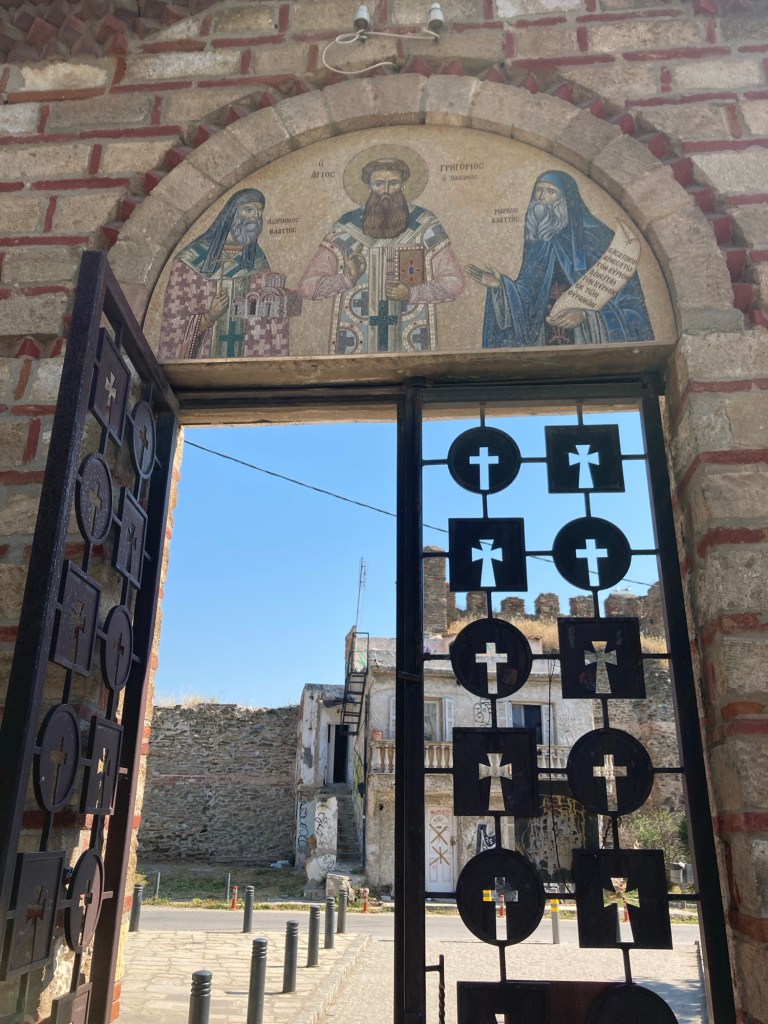
St. Paul preached here.

The Apostle Paul visited Thessaloniki on his second missionary journey, when it was called Thessalonica. He stayed in the city teaching in the synagogue and encouraging the Christians for at least three Saturdays/Sabbaths.

Maria and I visited the place where tradition has it that he preached, on which site Vlatadon Monastery was founded in the 14th century. Of all the monasteries in the city, is the only one still active, though there are many newer ones in surrounding more rural areas.

When Thessaloniki fell to the Ottomans in 1430, and the majority of churches were turned into mosques, the wall frescoes were punctured to facilitate plastering over them.
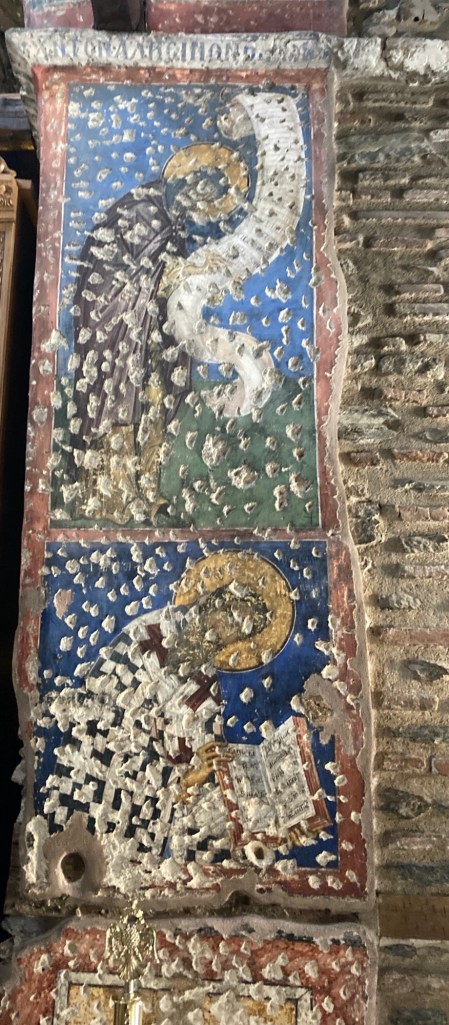
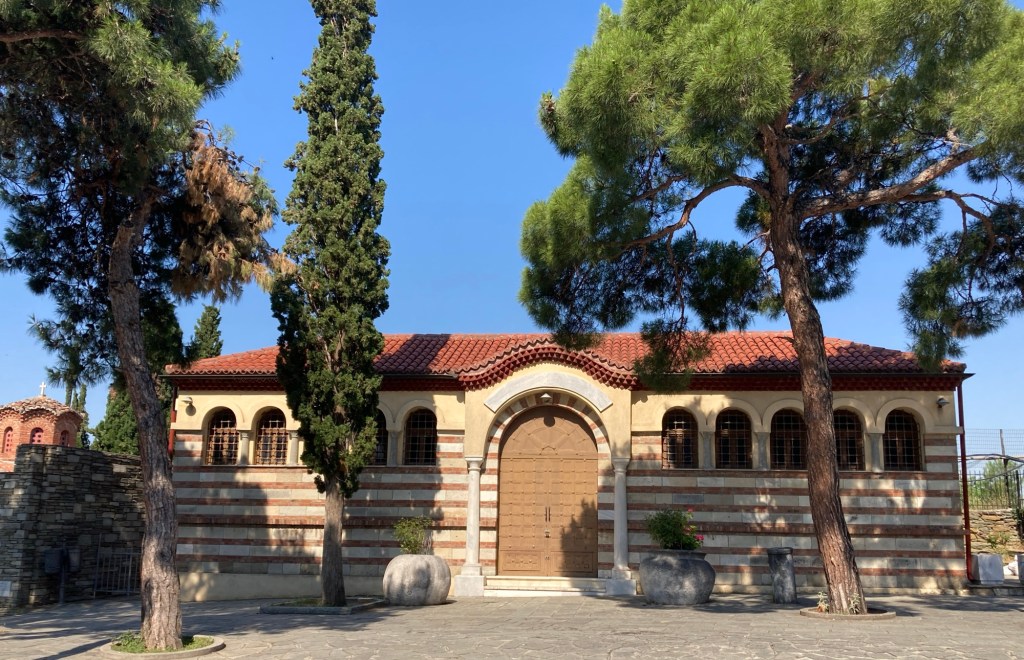
After we toured the monastery church and shady, peaceful gardens, Maria suggested we sit on a bench and read from one of St. Paul’s letters. It was not one he’d written to the Thessalonians, but the famous Love Chapter, I Corinthians 13:

Love’s triad confronts modern man.

This very meditative homily on the words of St. Paul, when he wrote about faith, hope and love, I found to be truly rich and encouraging. Father Patrick Reardon points out in his sermon the strange reductions of St. Paul’s teachings that came from various Christians writing many centuries after the apostle’s letters were circulating among the churches.

In fact, it can only be theoretical to separate love from hope and faith, as St. Paul does in I Corinthians 13, for the purpose of making clear that love is preeminent; true love is not manifested without faith and hope. We also learn in this Bible lesson of another fruit of the Spirit that makes up a second triad of virtues, further fleshing out the reality of what it means to live in love. The interrelated meanings of the several words and their contexts lift one’s mind right up to the throne of God where the Three Persons live eternally in Love, a Love in which we are invited to partake.

If you are interested in further contemplation about this Love that originates in the Holy Trinity, and how it contrasts with Faust, or is described by Dante, you will want to listen to the 16-minute talk on the Ancient Faith site here:  “The Supremacy of Love,”  or by means of the direct MP3 file linked at top.

Happy Valentine’s Day!

The victory hovers over our world.

It’s New Year’s Day according to our liturgical calendar, and special prayers for God’s blessing were included in our service this morning. What better time could there be for thinking about progress… or would devolution and even defeat be more realistic? I happened to read this passage today (I didn’t hear it in church) and just realized how it is connected, sort of. From a letter written by the Apostle Paul to his coworker Timothy:
“But know this, that in the last days perilous times will come: For men will be lovers of themselves, lovers of money, boasters, proud, blasphemers, disobedient to parents, unthankful, unholy, unloving, unforgiving, slanderers, without self-control, brutal, despisers of good, traitors, headstrong, haughty, lovers of pleasure rather than lovers of God, having a form of godliness but denying its power.

…Now as Jannes and Jambres resisted Moses, so do these also resist the truth: men of corrupt minds, disapproved concerning the faith; but they will progress no further, for their folly will be manifest to all, as theirs also was. But you have carefully followed my doctrine, manner of life, purpose, faith, longsuffering, love, perseverance, persecutions, afflictions, which happened to me at Antioch, at Iconium, at Lystra– what persecutions I endured. And out of them all the Lord delivered me. Yes, and all who desire to live godly in Christ Jesus will suffer persecution. But evil men and impostors will grow worse and worse, deceiving and being deceived.” (2 Timothy 3:1-13)

Father Stephen Freeman has written over the years about how this passage is in agreement with what J.R.R. Tolkien wrote in a letter many centuries later:
“Actually I am a Christian, and indeed a Roman Catholic, so that I do not expect ‘history’ to be anything but a ‘long defeat’— though it contains (and in legend may contain more clearly and movingly) some samples or glimpses of final victory” (Letters 255).

This narrative of a long defeat was assumed among ancient peoples, Fr. Stephen tells us, and only changed to one of progress in recent centuries, especially during the 19th century. But the defeat of history is not really pessimistic. It is part of the greater story of Christ’s Kingdom that has come, and is coming:

“I would go further and say that the final victory already “tabernacles” among us. It hovers within and over our world, shaping it and forming it, even within its defeat. For the nature of our salvation is a Defeat. Therefore the defeat within the world itself is not a tragic deviation from the end, but an End that was always foreseen and present within the Cross itself.” 

The whole article is here: “Tolkien’s Long Defeat and the Path of History.”

The liturgical calendar doesn’t have much to do with that long defeat. You can go to any timeline of history to see the kingdoms that have risen and fallen, and the many wars and tribulations, the violence and suffering that have filled the earth since the beginning. Taken as a whole it’s hard to see any true progress there, unless you are talking about Wonder Bread or flush toilets.

No, the liturgical New Year begins the commemorations of Great Feasts of the Orthodox Church, following the sequence of events in what is sometimes called our Salvation History. The birth of Christ’s mother, the birth of Christ, the Presentation of Christ in the Temple, and so on. The death and resurrection of Christ are the peak season on that calendar. Christ’s defeat, and death — swallowed up in victory. That is cause to say “Christ is risen!” and “Happy New Year!” God is with us.

Slave, servant, son: St. Onesimus

“Although in Christ I could be bold and order you to do what you ought to do, yet I prefer to appeal to you on the basis of love. It is as none other than Paul—an old man and now also a prisoner of Christ Jesus— that I appeal to you for my son Onesimus, who became my son while I was in chains. Formerly he was useless to you, but now he has become useful both to you and to me.”

This is a middle portion of the Letter to Philemon that St. Paul wrote to his friend about a runaway slave. It’s an unusually short and focused epistle in the New Testament, dealing mainly with this issue of the freedom of Onesimus, who had been converted while he and the apostle were in prison together.

The article, “Holy Apostle Onesimus as a Model for our Lives,” contrasts the former life of Onesimus as a “worthless slave” to his new life as a brother in Christ, and a valuable servant, as St. Paul describes him so movingly:

“I am sending him—who is my very heart—back to you. I would have liked to keep him with me so that he could take your place in helping me while I am in chains for the gospel. But I did not want to do anything without your consent, so that any favor you do would not seem forced but would be voluntary. Perhaps the reason he was separated from you for a little while was that you might have him back forever— no longer as a slave, but better than a slave, as a dear brother. He is very dear to me but even dearer to you, both as a fellow man and as a brother in the Lord.”

St. Philemon did forgive Onesimus, and sent him back to Paul as requested. Philemon was later made bishop of Gaza, and Onesimus continued to serve the apostles and was also consecrated as bishop.

This article on the Life of Onesimus gives more details about his bishopric and preaching, and ends with his death in this fashion:

“During the reign of the emperor Trajan (89-117), Saint Onesimus was arrested and brought to trial before the eparch Tertillus. He held the saint in prison for eighteen days, and then sent him to prison in the city of Puteoli. After a certain while, the eparch sent for the prisoner and, convincing himself that Saint Onesimus maintained his faith in Christ, had him stoned, after which they beheaded the saint with a sword. A certain illustrious woman took the body of the martyr and placed it in a silver coffin. This took place in the year 109.”

At this season of the year the Orthodox Church remembers both St. Philemon and St. Onesimus, which is why I was prompted to revisit this story, which I find I love more than ever. It prompts the author of the first article linked above to this thought:

“Let us pray that God shows us true spiritual fathers, even in our days,
who can help people be reborn, so as to acquire perfect love,
and from useless servants to become useful and free.”

-Fr. George Papavarnavas