Tag Archives: teaching

Goldilocks and Jim

Goldilocks is the nickname I am giving to the little girl who had her first sewing lesson from me yesterday. I was very nervous leading up to the appointed time. She’s only six years old, for one thing, but she’s been using a needle and thread (and even Scotch tape) to construct clothes for her stuffed gorilla toy and a naked doll she inherited. I hadn’t had a look at her stitches until our first class, by which time I had come up with a few ideas we might pursue. It seemed wise to have a few projects in case her attention span was as short as I imagined from what I know of her from church.

I picked Goldilocks up at school and brought her here, so we needed to have a snack before beginning our work. Offering a child cake and milk sounds like something a woman in a storybook would do, so I felt very romantic about it, and I didn’t mind changing the liquid offer to hot cocoa, it being a rainy day and all. This yummy marzipan cake came in a heavy foil wrapper all the way from Germany so that our Czech friend Jerry could give it to us for Christmas. I had stowed it in the freezer for such a time as this.

As it turned out, my student didn’t yet begin any of the projects I had in mind, which included a 9-patch potholder, a hat for her, a blanket for her gorilla, and embroidering a dish towel. She seemed to want to get some clothes on that doll (poor doll doesn’t even have a name), so we started on a skirt. I showed her how to plan for the right amount of fabric based on measuring the doll, and she took home a rectangle of flowered cloth which she had started basting along one edge. I will show her how to pull up the gathers and sew it to a waistband.

Earlier in the day it was raining when I first came downstairs and found “my” feral cat Jim sitting outside the sliding door with his fur getting sprinkled as he waited for me to feed him. I thought perhaps he would be willing to stick his head in out of the wet this time, so I set the bowl just inside the door, and went away a space. After some deliberation he did partly enter the house, so I took his picture.

I hadn’t put quite the usual amount in the bowl, though, so he waited outside again after finishing it.  I added more food and set the bowl even farther into the kitchen. The temperatures have been higher lately and I hadn’t turned on the heat yet, so I didn’t mind leaving the door open for Jim for a little while. He came in again, and I busied myself building a fire on the other side of the room.
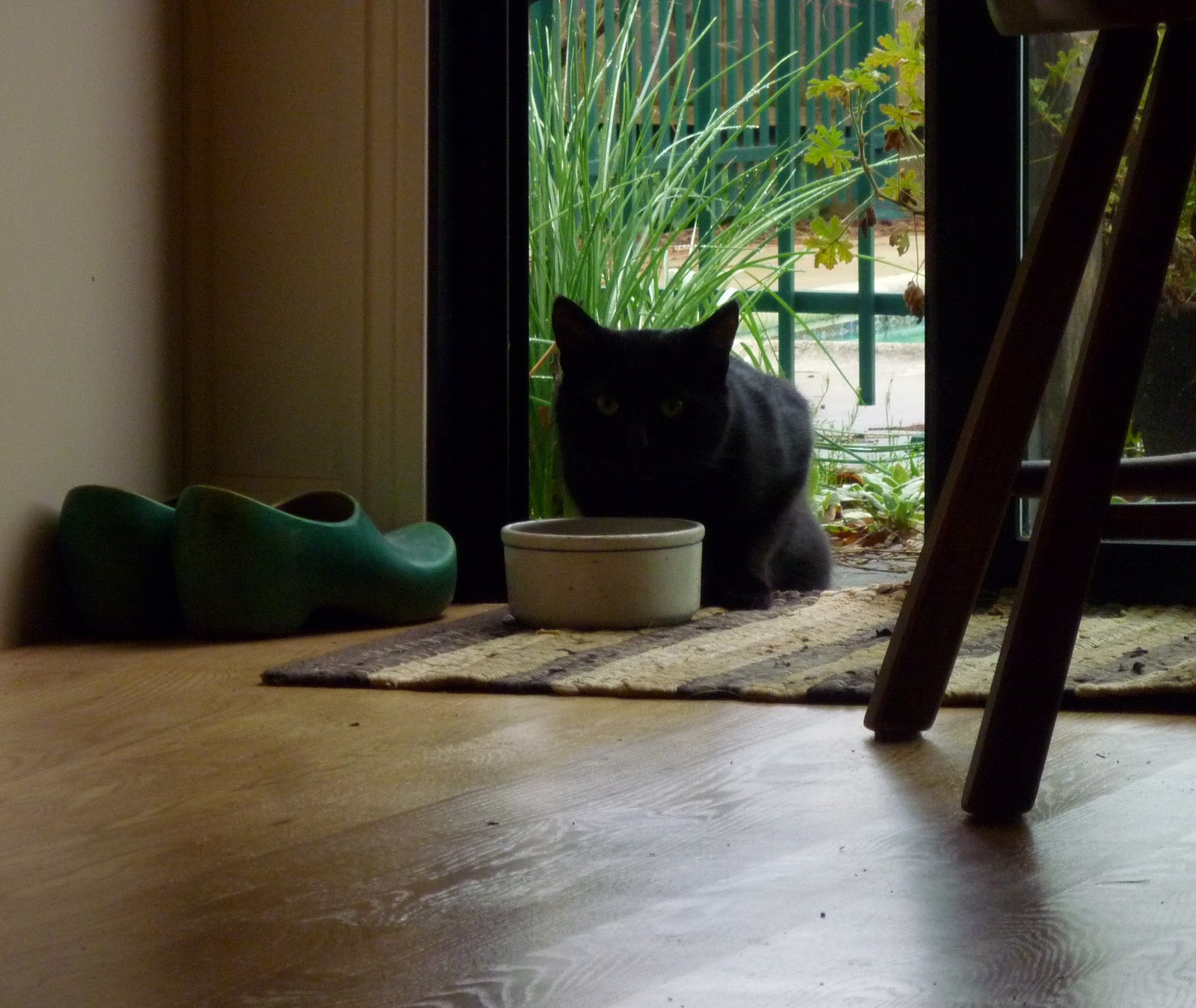
When I turned back around, he was sitting all the way inside on the rug, while he ate. But when he saw that I saw, he was greatly embarrassed, grabbed one more bite of food and ran out the door with it.

The sun is shining today, but again, the air wasn’t too cold, so I put the bowl inside, and once again he came part way in and ate it. When he had finished and was walking around the corner through the gate, I looked out the door, he looked back at me, and I told him to have a good day. He switched his tail. So we have leaped a great hurdle, Jim and I.

This morning I’ve been researching flights to take me across the continent in about two months to visit Pearl and family. It seems that the two airports I want to use have almost no direct flights connecting them. I had thought that if I paid enough money or reward miles I could make the trip less exhausting. Now I find out that not much can be done to make traveling easier, and I’m suffering a temporary setback in my excitement. I will have to focus on taking healthy snacks, and on the wonderful reading I can do. But for now I’ll just be glad I don’t have to go anywhere today.

Grousing About Grammar – Bad Sentence

One thing I didn’t tell you in my recent review of Wordstruck by Robert MacNeil is how he gave an admonition that made me wonder if I am the right kind of influence on people:

“If you love the language, the greatest thing you can do to ensure its survival is not to complain about bad usage but to pass your enthusiasm to a child. Find a child and read to it often the things you admire, not being afraid to read the classics.”

MacNeil quotes a man named Hugh Kenner, who said of some people that they “took note of language only when it annoyed them.” In the days when I frequently read to my children, especially when they were older, I must say in my defense that I do remember stopping at least occasionally to point out particularly well-written sentences. But when the bad sentences force you to stumble or pause or halt completely as you try to figure out what is going on, you can’t help but be annoyed and take note of them, too.

This happened to me just today, and once again I will reveal myself in full nitpickerliness. The sentence that held me up fails in more than one way, so it’s very useful. I’m not going to tell you where it came from, but the author has a (recent) doctoral degree in Intellectual History. I’m not sure why I think that should mean something pertinent to my complaint…but let’s just get on with the beginning of his article:

F.M. [abbreviation mine] lived his life as a poet, a playwright, a novelist, a journalist, and a Roman Catholic. Born in Bordeaux during the year 1885 to a bourgeois family, M.’s mother tenaciously held to her religiosity. His father’s side of the family, on the other hand, sported Voltairean, republican, and anticlerical sentiments.

You can probably guess what happened to me as I was reading briskly along in the first sentence, then cruising through the stop sign period and on to the comma in the second sentence, fulling expecting that M. would be there after the pause — Oh! M’s mother is here, how odd…that must mean the author was talking about the mother’s birth in Bordeaux…strange that he would start out telling us about M., and then in the very next sentence start in on the mother…and there is his father in the following sentence…hmm…I don’t know much about M., but I don’t actually think he is recent enough that his mother could have been born that late…the author must be talking about M.’s birth, then. Too bad, now I have stopped thinking about M. and his mother and am all focused on this writer, poor boy, who spent so much effort in school and can’t get his lovely article off to a decent start.

Before moving on to find out more about M., I had to skip to the end and read the blurb on the author… next I began a rewrite of his problematic beginning in my head — so many times I have done this for myself and five children, trying out different arrangements of words and clauses so that you say what you mean and your reader can read you as effortlessly as possible.

What happened here is called a dangling participle or dangling participial clause. The “Born in Bordeaux” clause actually has no subject (it’s dangling there unattached), but we naturally expect the subject to be close by, so we try to attach the clause to M.’s mother, but it doesn’t really belong to her. The Wikipedia article to which I linked tells it all very clearly, along with other examples that are often funny.

One way that this particular beginning could have been rescued would be to make it slightly longer. Sometimes it just gets awkward, trying to pack too much into a sentence, and the best thing is to make one or two more sentence so you don’t muddle things. To put his birth and his mother’s religious attitude into one sentence seems to be hurrying along too fast, as though the author were just stringing his notes together.

And don’t try to be too clever in switching the order of your clauses and phrases. That’s partly how this writer got into trouble. It’s only the second sentence of your whole article, so certainly you can afford another sentence with the direct and simple subject-verb order.

To say that M. was born “during the year 1885″….It must just be a careless wordiness, because “in 1885” would do nicely, and during gives the impression of an ongoing activity. The time of birth is a date, not a duration.

How about this re-do of the second and third sentences, putting the mother into the father’s sentence, and we don’t even have to add lines. Taking out some commas makes it a  little cleaner, too:

He was born to a bourgeois family in Bordeaux in 1885. M.’s mother tenaciously held to her religiosity, while his father’s side of the family sported Voltairean, republican, and anticlerical sentiments.

Now that I’ve got that settled, I can go to bed. I’ll take the article along and hope I can keep my mind on M. this time.