Tag Archives: the body

A prayer for my friend.

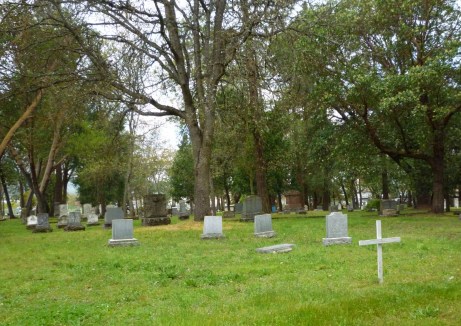
A dear, almost lifelong friend of mine passed from earthly life last night, on the feast of St. Brendan the Navigator. I found comfort in praying for him the Akathist to Jesus Christ for a Loved One Who has Fallen Asleep. Every phrase of the prayer is full of meaning, but something about the following section made me want to share it.

It makes reference to the “soul stripped bare.” This image follows from the fact that the soul and the body are aspects of a whole person, made in God’s image and designed to be a unity; and when you think about how the soul and the body have never had to be fully separated before death, it seems natural that the soul, no matter how pure, should grieve at this loss.

We don’t think of the body as a shell from which our soul ultimately emerges — our bodies are us, and they are temples of God at the same time, in which we worship. If at the end of our lives our Lord takes our spirits from our bodies, it is not because they aren’t precious. They will be resurrected at the end of time.

O Thou Who wast crucified for us and Who for us wast tormented: Stretch forth Thy hand from Thy Cross and with the drops of Thy poured-forth blood wipe away his sins without a trace; and with Thy beautiful nakedness warm his soul, now stripped bare and orphaned:

Jesus, Thou didst know his life from birth and didst love him.
Jesus, Thou didst see him from afar from the height of Thy Cross.
Jesus, suffering painfully on the Cross, Thou didst stretch forth to embrace him as he came from afar.
Jesus, Thou didst cry out for his forgiveness on blood-stained Golgotha.
Jesus, Thou didst in grievous torments meekly die for him.
Jesus, Who didst suffer to be laid in the tomb, sanctify his repose in the grave.
Jesus, Risen, raise up to the Father his soul which was embittered by the world and saved by Thee.
Jesus, All-merciful Judge, vouchsafe Thy servant the sweetness of Paradise.

From The Akathist to Jesus Christ for a Loved One who has Fallen Asleep
The ultimate human experience.

From a church bulletin:

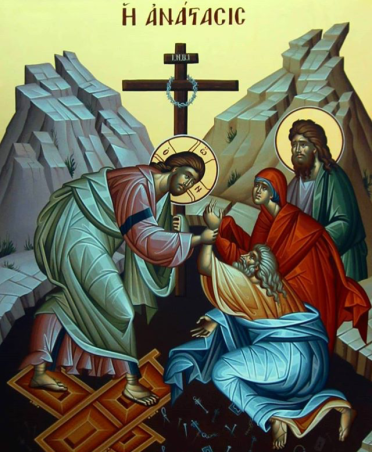
The Resurrection of Jesus… was the ultimate human experience. For the first time, a human brain and a human nervous system were suffused from within by the energies of the Resurrection. The whole, material universe begins to be transformed from that moment to what Paul will call “the fullness of Christ.” For the first time, a human heart pulsed with a life beyond the power of death, the pulsation of a heart which will never stop. For all eternity that heart will beat.

Jesus was thereby manifest as the “firstborn from the dead” as he is called in the book of Revelation. His experience of rising from the dead, the first man to do so, is the secure promise of the glory that awaits all those who are joined to him in faith and Divine Grace. This will be the final stage of Salvation. The final stage of Salvation will come only at the end of the world. You see, even dying and going to heaven is not the last stage. It’s a rather important one, but it’s not the last stage. True Soteria—True Salvation—is found when our bodies will rise in glory.

—Father Patrick Henry Reardon


The body is a nave.

Jean-Claude Larchet is a contemporary French patristics scholar and theologian who has written on diverse subjects such as the Theology of Illness, life after death, and mental disorders. (I’m currently reading his The New Media Epidemic.) Several years ago our parish did a study of his book, Theology of the Body, and last week when I was thinking on that topic I was glad to find it still on my shelf.
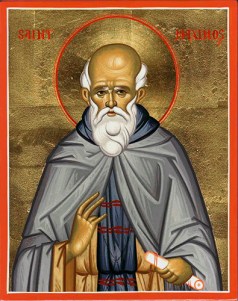
In the chapter on “The Body in Spiritual Life,” Larchet discusses the physical aspects of our worship, beginning with the tradition of standing in church, “… a posture that symbolizes the resurrection, that key point of the Christian faith and hope.”

“In addition, mention may also be made of the ‘passive’ liturgical participation of the body in the setting that is so characteristic of the Orthodox Church, where the splendor of the celebration, so often misunderstood by those who have no experience of its meaning, has an important spiritual role to play – the beauty of the architecture and the ‘decoration’ of the churches whose walls are covered with frescoes and icons; the solemn character of the services; the richness of the celebrants’ vestments; the magnificence of the chants; the incense; the lights of the lamps and candles; and so on. All these things – which never cease to awaken a sense of wonder in the faithful – have a fourfold meaning.”

Two of those “folds” are 1)symbolizing the kingdom of heaven, and 2) giving the faithful, in a symbolic way, a taste of the riches and glory of the kingdom of heaven, and also of the new conditions of existence there, when the body is transfigured along with all the senses….”

The next and last paragraph I will share here struck me as alluding to realities so holistic and fundamental that they must constitute the very business of our life. The story we can read in the specific details tells who we are and what we are made for, and includes many mystical, or hidden, elements, no less real for their hiddenness. It is the true story of humanity:

“The very interior of an Orthodox church introduces the body into a space that is different from the ordinary; it is a space transfigured and sacred, whose profound symbolism is superbly analyzed by St. Maximus the Confessor in his Mystagogia. He stresses in particular that the church’s spatial structure symbolizes the human being: the altar representing the spirit, the sanctuary the soul, and the nave the body. Conversely, the human being symbolizes the church: his spirit is, as it were, an altar; his soul, a sanctuary; and his body, a nave. And this is not simply by their nature but by their own specific functions in spiritual life: the body represents in particular the practical or ethical dimensions; the soul stands for the contemplative dimension; and the spirit its pinnacle, theologia, in which the believer receives from the Holy Spirit supernatural knowledge of the divine mysteries.”

To have a body burdened.

“Virtually everything in our lives is gifted to us, and there are many ‘gifts’ that we would prefer never to have received. It is part of our incarnational existence. We are the offspring of others. To have an embodied existence in space and time is to have a body burdened with the DNA of eons and a family and culture that is both the product and carrier of history.”

Soldier and Brodie 7-5-16

Read the whole article by Father Stephen Freeman: The Sins of a Nation