I’ve shared four poems by W.S. Merwin on my blog over the years. He is a poet who doesn’t use punctuation in his poems. I recently read an interview with him, given five years ago. Here I’m posting a short excerpt in which he talks about his eschewing punctuation, and about the uses and challenges of poetry generally.
If you stop using punctuation, that’s a kind of formality. I mean you have to be very conscious of the grammar and the syntax and how the sentence is put together; otherwise it’ll be just so ambiguous and confusing you just won’t be able to read it. The other thing I think it does is to make the separation between poetry and prose. I thought, punctuation is very convenient, but it was really invented in the seventeenth century for prose. Not for poetry at all. The punctuation of Shakespeare texts is whatever seemed convenient. There weren’t any particular rules that he was following that I can see. I mean it changed in the course of the plays. But above all, I thought that having no punctuation made you listen to the poem. That’s the important thing.
….
Poetry, like the imagination itself, must be limitless. And there must be other ways of expressing the inexpressible, which is what—poetry is just that. Prose is about what can be said and what is known and so on. Poetry is about what cannot be expressed. I mean, terrible grief, or intense erotic feeling, or even unspeakable anger are all inexpressible. You can’t put them in words and that’s why you try to put them in words. Because that’s all you’ve got. That’s another reason why I think that poetry is as ancient as language itself, because I think language must come out of an urge for which there was no expression, no way of doing it. I mean grief or fear or rage or whatever it was. It goes from one roar or one scream or one terrible sound of pain to starting to articulate it. It’s the articulating that becomes poetry. But it doesn’t become information at that point. It’s closer to translation. It’s translating something that’s there, that is only to a degree expressible.
-W.S. Merwin in Guernica magazine interview
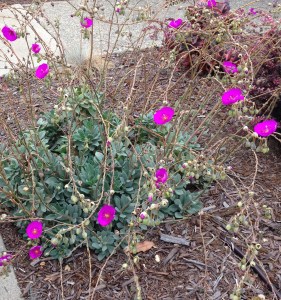 This morning I took Liam (4) and Laddie (2) for a walk in their new neighborhood in Monterey, on California’s Central Coast. It was foggy and cool — it never gets summery hot here — and we enjoyed the flowers in the gardens we passed. This succulent with wild magenta flowers is one I am not familiar with.
 Gladsome Lights