Tag Archives: words

A breath leaves the sentences.

LOSING A LANGUAGE

A breath leaves the sentences and does not come back
yet the old still remember something that they could say

but they know now that such things are no longer believed
and the young have fewer words

many of the things the words were about
no longer exist

the noun for standing in mist by a haunted tree
the verb for I

the children will not repeat
the phrases their parents speak

somebody has persuaded them
that it is better to say everything differently

so that they can be admired somewhere
farther and farther away

where nothing that is here is known
we have little to say to each other

we are wrong and dark
in the eyes of the new owners

the radio is incomprehensible
the day is glass

when there is a voice at the door it is foreign
everywhere instead of a name there is a lie

nobody has seen it happening
nobody remembers

this is what the words were made
to prophesy

here are the extinct feathers
here is the rain we saw

-W.S. Merwin, from The Rain in the Trees, 1988

Royal Hawaiian feather work

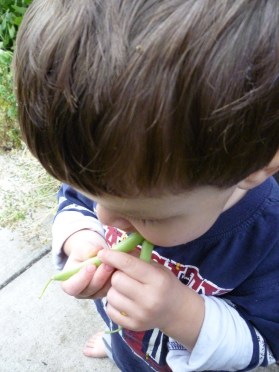
The life of the bean or porcupine.

“The reality of the pole bean or of the porcupine is never their momentary presence. It is the sense of the cycle which is the life of the bean, from planting to bearing, or of the porcupine through all the stages of his life. Words do not merely mirror — they reach beneath the transient surface to grasp the enduring reality it manifests. So, too, with the sense of a human life. Words are the way in which the sense, the very reality of that life, emerges through the manifold doings of the seasons.”

-Erazim Kohák

All the airy words we summon.

Following on the theme of language, I’m re-posting this poem from Dana Gioia. As my situation is different from seven years ago when I first put it up here, so is my response to the poem. Then, I was often with my late husband, and we would tell each other the names of things, and amplify our knowledge and appreciation of the world together. Or, we would simply be together in silence, in those moments of happy existence in the world that does not need words.

Nowadays, I still have the impulse to tell all these things, or attempt to bring my readers into the wordless experiences I have — by means of words! Of course, I can’t even attempt to describe more than a fraction of the moments, the stones and sunlight and shadows. So I am learning — a little — to just sit with the things, “no less real for lying uncatalogued and uncounted.” There is Someone with me, after all, who doesn’t tell me the names of things, but Who is the Reality from which they came into being. He also needs no praise, so we praise Him always.

WORDS

The world does not need words. It articulates itself
in sunlight, leaves, and shadows. The stones on the path
are no less real for lying uncatalogued and uncounted.
The fluent leaves speak only the dialect of pure being.
The kiss is still fully itself though no words were spoken.

And one word transforms it into something less or other –
illicit, chaste, perfunctory, conjugal, covert.
Even calling it a kiss betrays the fluster of hands
glancing the skin or gripping a shoulder, the slow
arching of neck or knee, the silent touching of tongues.

Yet the stones remain less real to those who cannot
name them, or read the mute syllables graven in silica.
To see a red stone is less than seeing it as jasper –
metamorphic quartz, cousin to the flint the Kiowa
carved as arrowheads. To name is to know and remember.

The sunlight needs no praise piercing the rainclouds,
painting the rocks and leaves with light, then dissolving
each lucent droplet back into the clouds that engendered it.
The daylight needs no praise, and so we praise it always –
greater than ourselves and all the airy words we summon.

— Dana Gioia
 

Your language is the world’s richest.

IN YOUR LANGUAGE

In your language every line begins from an opposite end.
The pronunciation of its words changes from day to night
and their orthography changes with the change of seasons.
A new word enters it on some special day
and on some days a familiar word is made obsolete.
The shape of its letters changes with your change of clothes.
You make no effort to put together words
that are crushed under feet from your carelessness,
because your language is the world’s richest.
The first kiss, the second kiss and any count of kisses
are all identified in your language with separate words.
If anything ever causes you to become tearful,
all the books in the whole world written in your language become drenched.

-Afzal Ahmed Syed 
Translated from the Urdu by Musharraf Ali Farooqi

Book of Psalms in Urdu