Monthly Archives: July 2009

A Psalm of the Forest


Alan Paton wrote Cry, The Beloved Country in about 1947. He hadn’t been planning to write a book when he went on a world tour visiting reformatories, but in Norway his heart was full and he started what became a whole novel before he returned to South Africa after his sabbatical.

A few years later he found himself again in California, where the last words of Cry had been set down, and this time he was supposed to be working on a second novel, staying in a cabin alone under and among the towering redwoods, when he wrote this modern psalm. I hope I can write more about it later, but I can’t wait to share the poem itself with you and tell you that it is one more thing that endears me to this man. I will let him introduce it as he does in Journey Continued, which is the second volume of his autobiography:

“…It is called ‘A Psalm of the Forest,’ the forest being that of Lane’s Flat, but the actual trees of the poem, and the monkeys that played in them, being imported from Africa.”

A Psalm of the Forest

By Alan Paton

I have seen my Lord in the forest, He goes from tree to tree laying His hands upon them.

The yellowwoods stand upright and proud that He comes amongst them, the chestnut throws down blooms at His feet.

The thorns withdraw their branches before Him, they will not again be used shamefully against Him.

The wild fig makes a shade for Him, and no more denies Him.

The monkeys chatter and skip about in the branches, they peer at Him from behind their fingers,

They shower Him with berries and fruits, they shade the owls from their hiding places,

They stir the whole forest, they screw up their faces,

They say to each other unceasingly, It is the Lord.

The mothers cuff their children, and elder brothers the younger,

But they jump from tree to tree before Him, they bring down the leaves like rain,

Nothing can bring them to order, they are excited to see the Lord.

And the winds move in the upper branches, they dash them like cymbals together,

They gather from all the four corners, and the waterfalls shout and thunder,

The whole forest is filled with roaring, with an acknowledgement, an exaltation.

New Words

During my convalescence after very minor surgery, I have been reading a lot, and using the dictionary, and reveling in words. I can’t take long to write about all my fun discoveries, but one new-to-me word came up in two very different books, within the week: faience.

Rosemary Sutcliff used it in Mark of the Horse Lord in describing a Pictish pendant hanging from a warrior’s neck. And M.F.K. Fisher used it in Long Ago in France to describe mustard pots she knew in Dijon in the 1930’s. I found a photo of a French mustard pot to show here, and one explanation more helpful than the basic dictionary one: “Majolica, delft, and faience are really names for similar ceramic products. An earthenware body is covered with an opaque enameled glaze, usually colorfully decorated.”

I wonder if this one I found online is anything like what Mary Frances saw.

Stay tuned for more word findings!

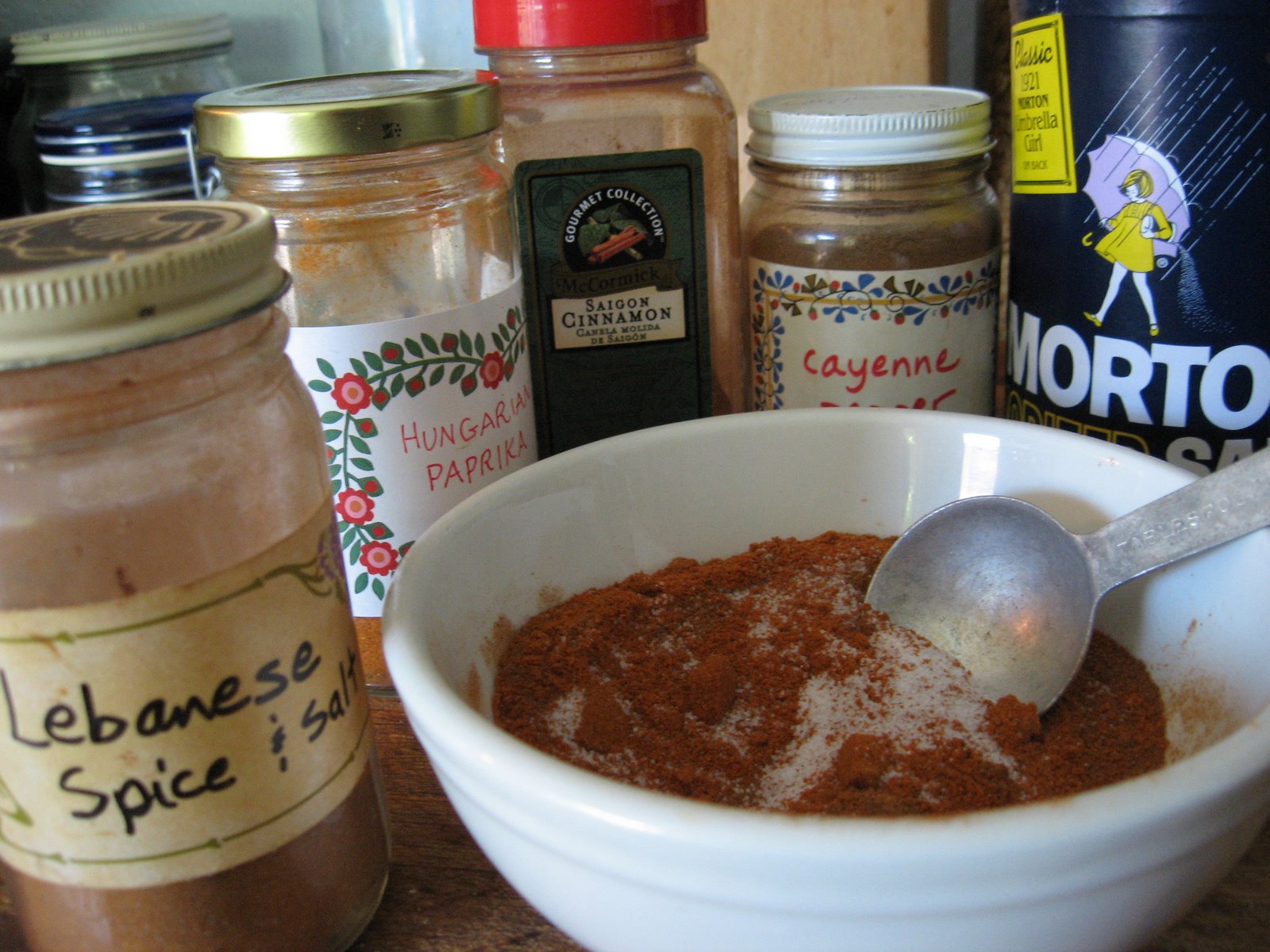
Lebanese Spice

This week I’m not able to spend much time here at the computer, but I don’t want you to think I disappeared, so I’ll just share with you a favorite staple recipe I like to keep on hand.

I have been using this combination of spices and salt for decades. It did come from an authentic Lebanese cook, perhaps via Sunset Magazine. My adaptation is lower in salt and cayenne pepper than the original. You can tweak the proportions to suit your own taste.

Typically it is used to flavor ground beef or lamb; the suggestion was to add 2 teaspoons to one pound of meat. I’ve used it in stews as well. I love that little bit of cinnamon surprise.

Combine the following, mix well, and store at room temperature in your spice cupboard:
3 tsp each cinnamon and paprika
2 tsp salt
1/2 tsp cayenne pepper

Fort Ross Fourth

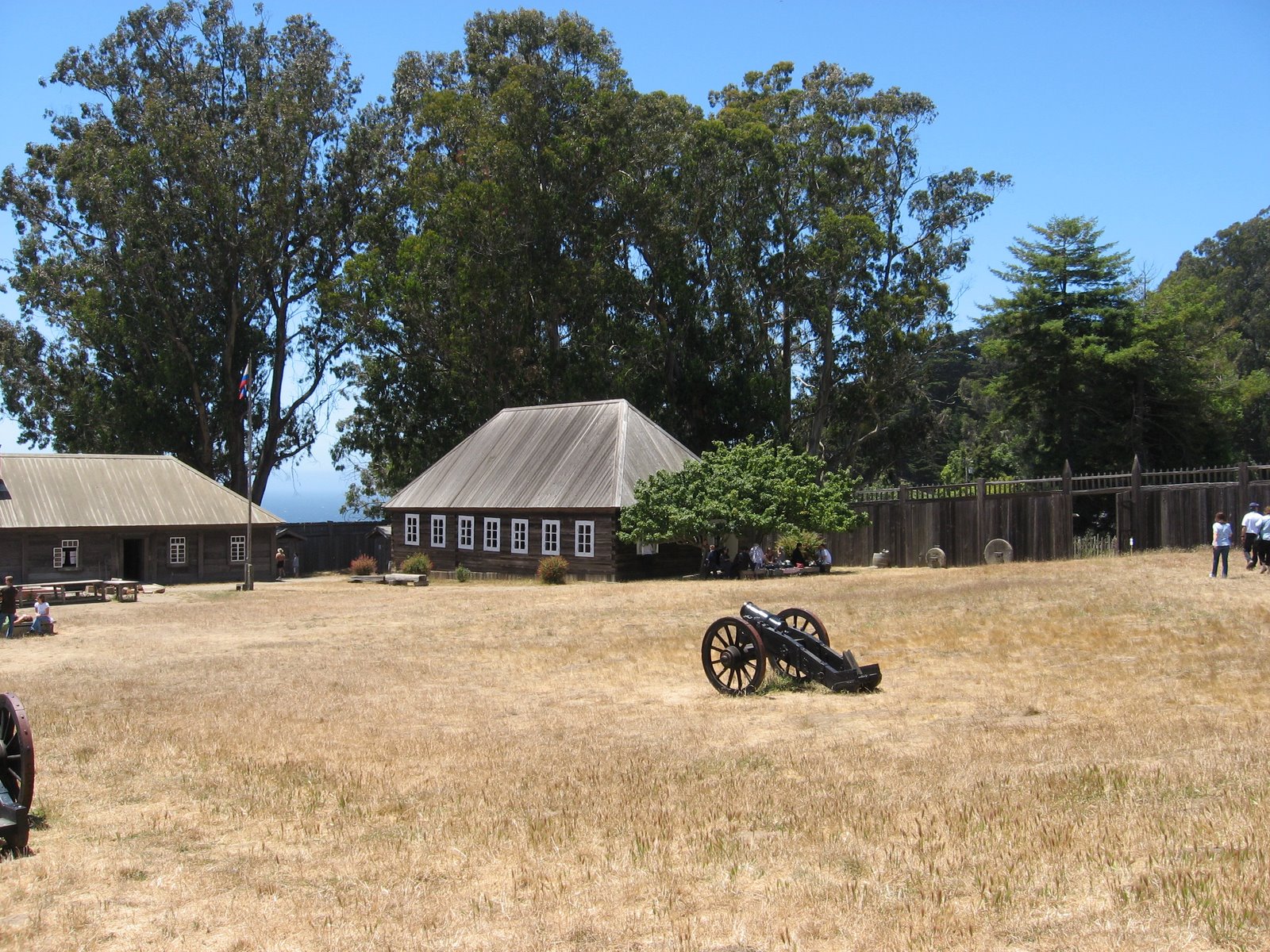
Fort Ross State Historic Park has been a favorite destination of our family for decades. It is a restored fort from the early 1800’s, when California was not yet a state in the Union, and for a while the Russians had an outpost in Northern California for fishing and trapping and growing food. You can see lots more photos and read about the history of Fort Ross online.

I loved the place from our first discovery of it when the children were small. A historic association holds yearly re-enactment days that are great fun, but just visiting on our own was relaxing and renewing, at least in the summer, when the sun would break through the fog and you could smell the ocean and the baking grasses at the same time, and imagine the people of long ago.

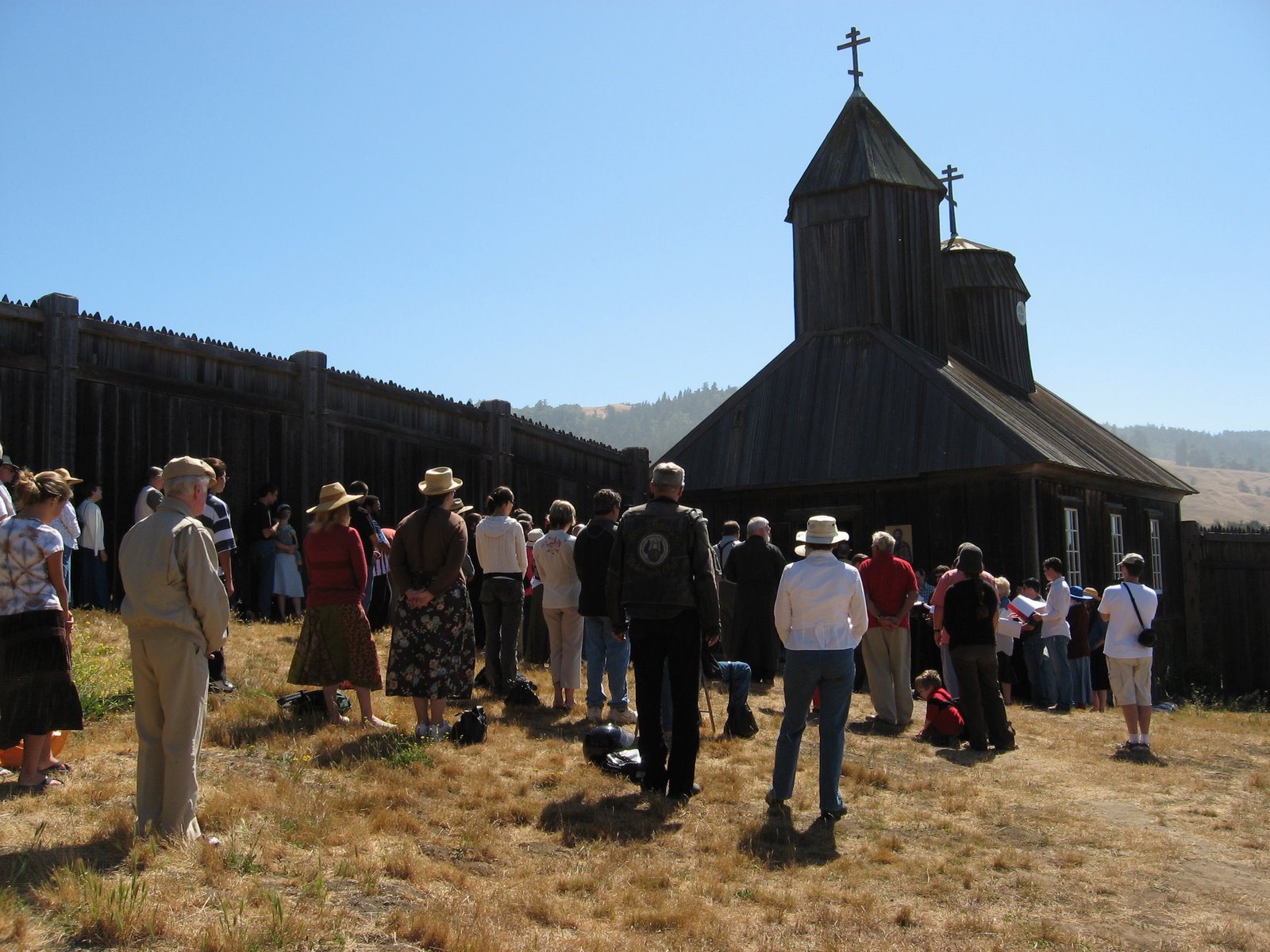
After I joined the Orthodox Church, I was delighted to learn that our diocese has permission to use the chapel at the fort twice a year, including on the 4th of July. We worship in the morning and have a picnic afterward when the sun usually comes out. There is plenty of time to get back home in the evening for Vespers and maybe fireworks later on. I’ve made the pilgrimage three times now, and my pictures here are collected from all the visits.


It’s a short walk from the parking lot to the actual fort enclosure. The photo at right is looking across the field from the chapel.

The church building as restored is small, and sometimes we let the whole of it serve as the altar, with the congregation and the choir standing outside and the priests and deacons coming in and out frequently as they pray and serve Communion.

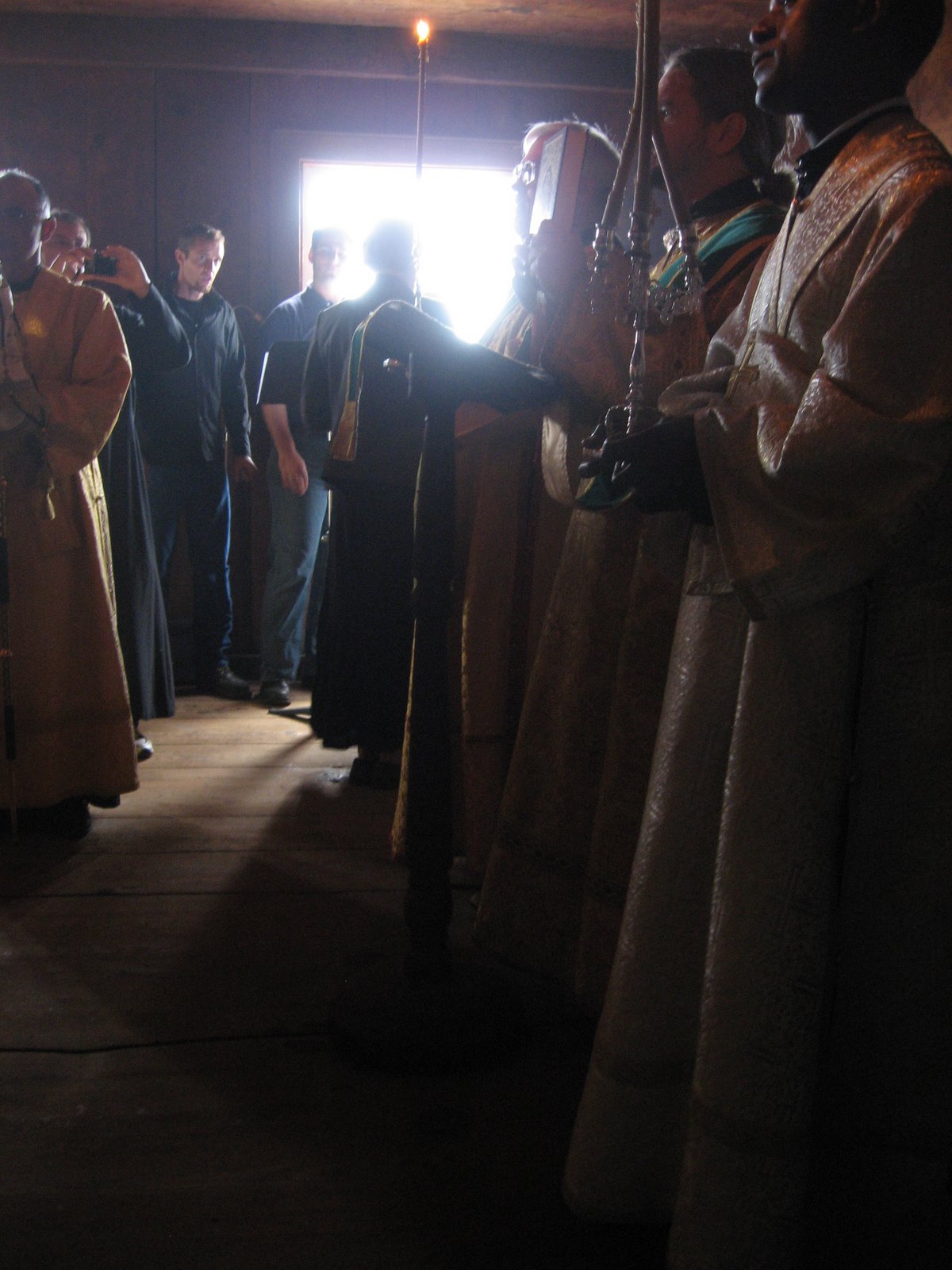
This year we all squeezed into the chapel, which is very intimate. I couldn’t get a good picture because of that window, but I am posting a bad one just to give an idea of the atmosphere. Very thin idea, indeed, as there is only the one visual dimension, and no conveyance at all to the other senses.

After the liturgy, the clergy and many others made the trek to the cemetery to sing a short service for the ones buried there. Others of us waited within the walls of the fort for their return.

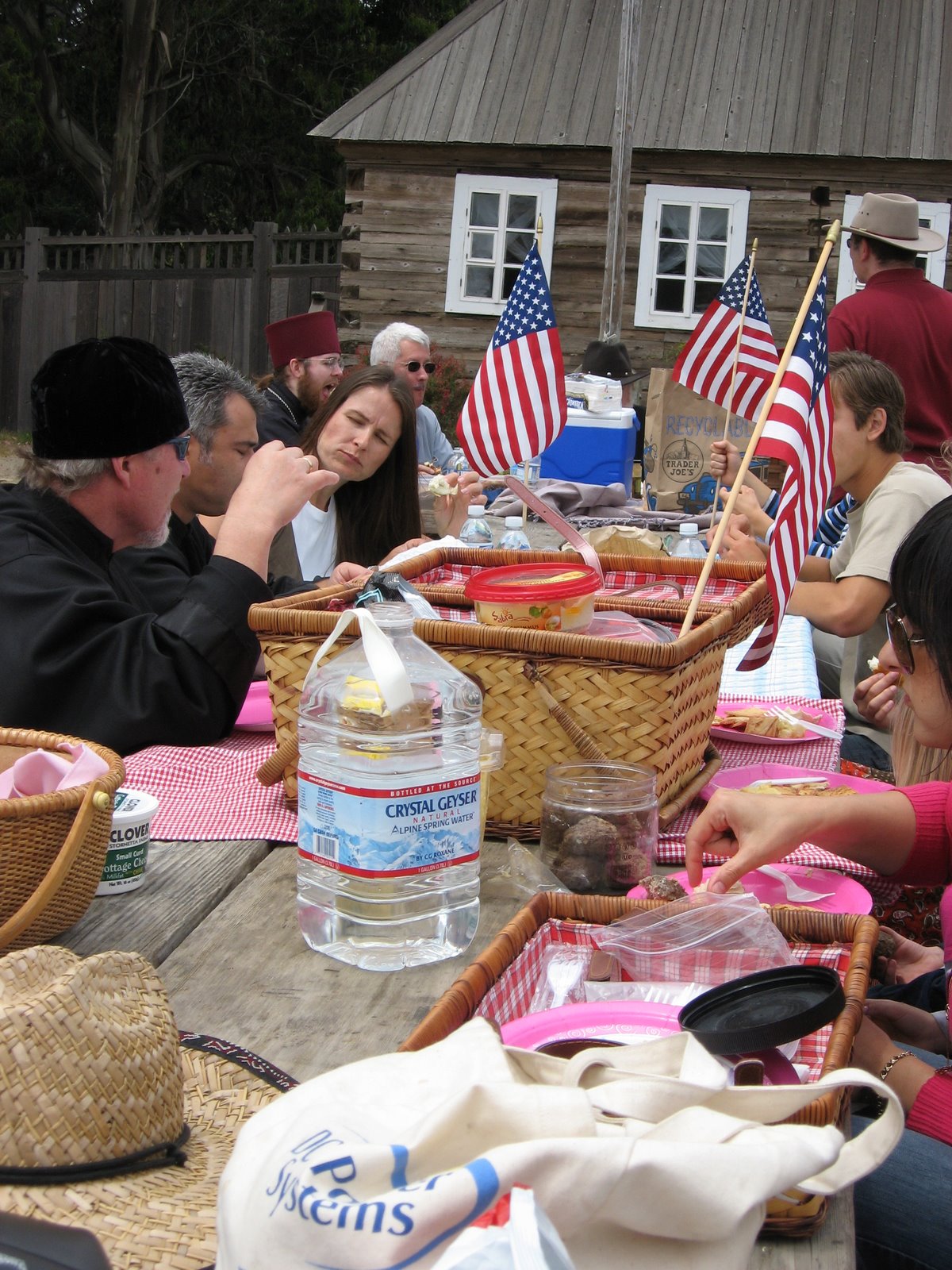
The bishop brought a picnic lunch, too.

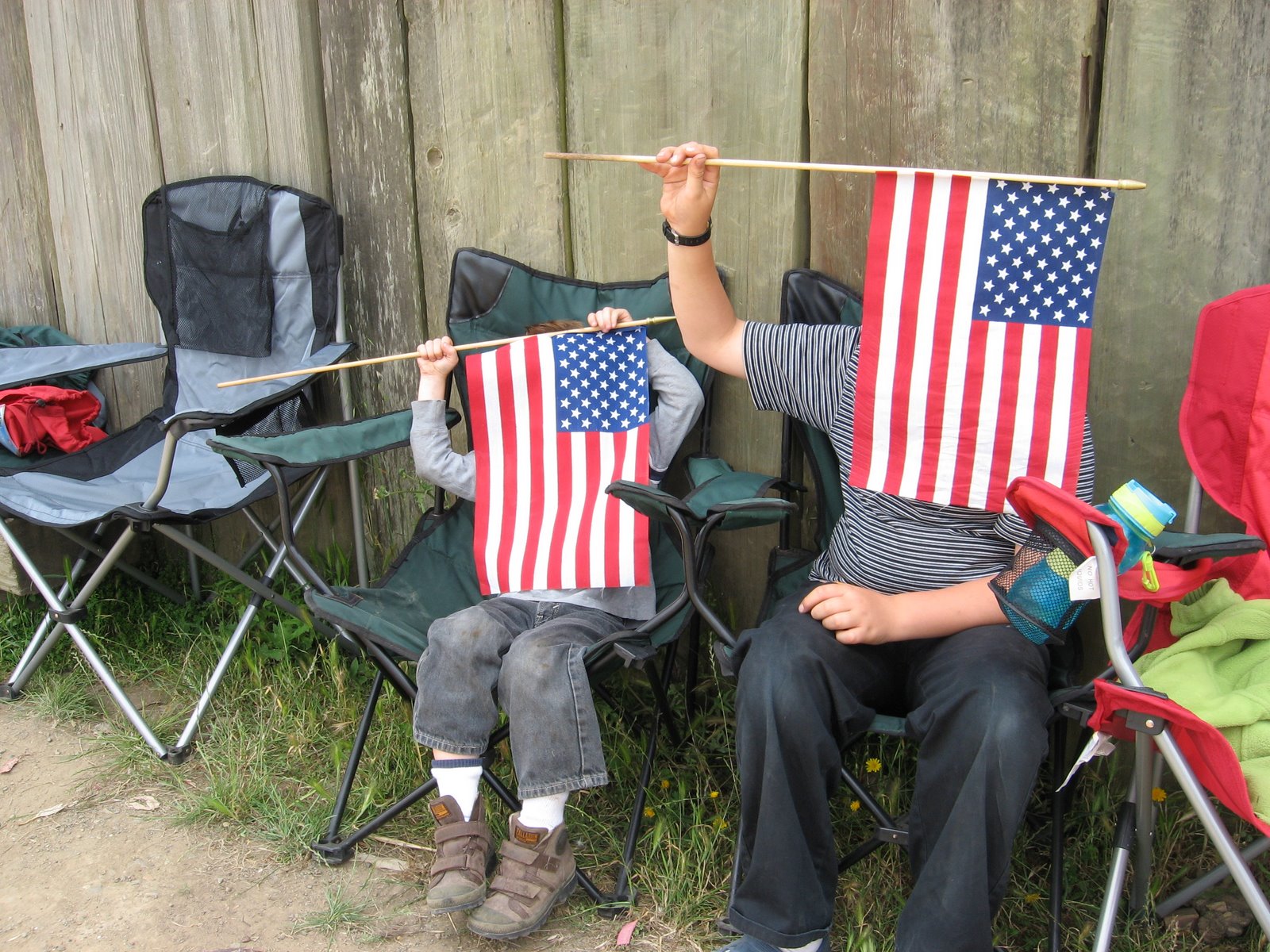
We waved plenty of flags to show our thankful allegiance to the nation whose birthday we were celebrating, at a fort now owned by Americans.

One year N. brought his hammered dulcimer and treated us to music at the picnic.

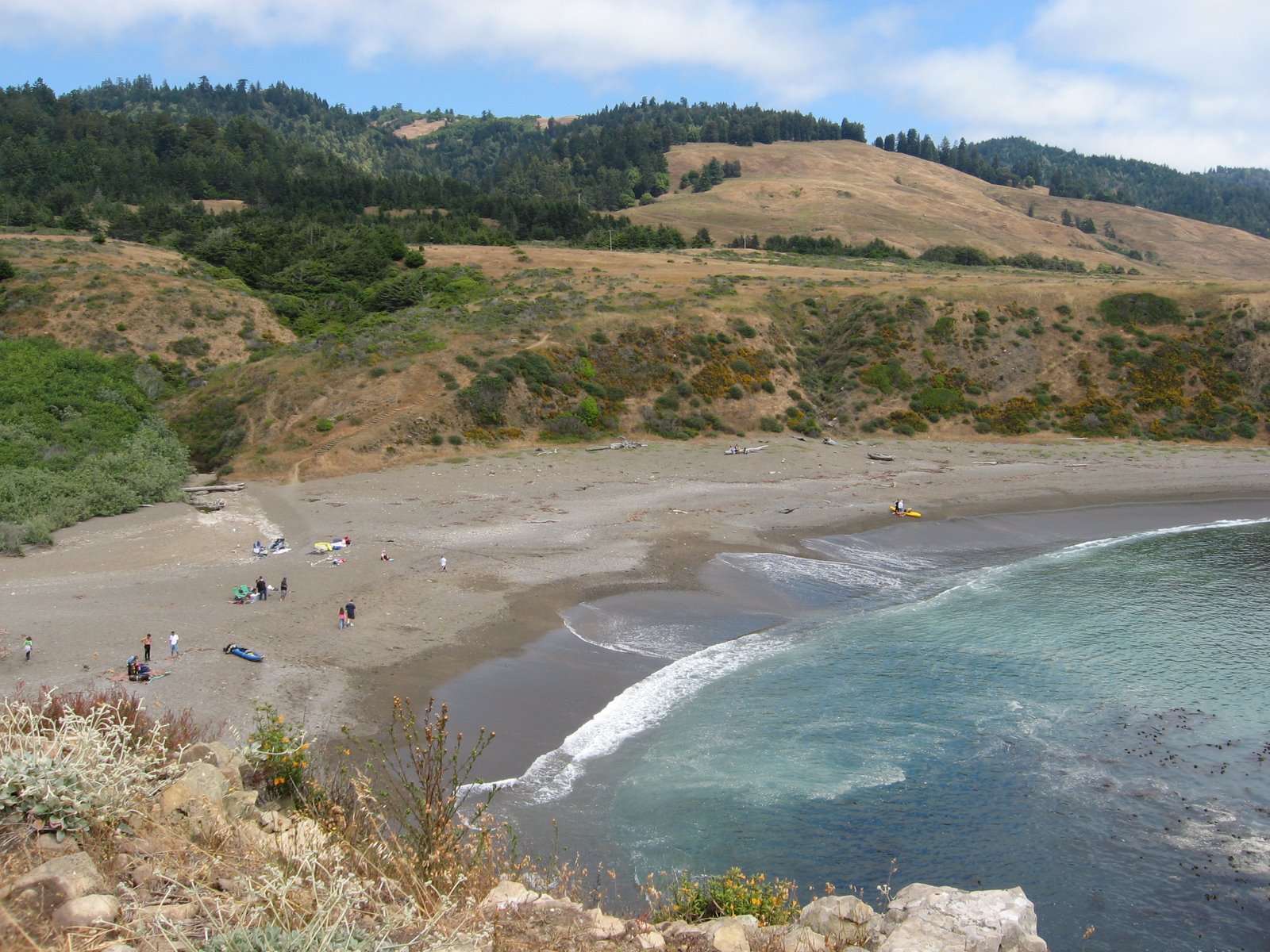
After lunch, K. and I took a walk down to the lovely cove below the fort.

One young parishoner and his mother had found treasures in nearby tidepools.

When we got back, the history talk by the park ranger was still going on. It leads up to instruction in loading and firing the cannons.

My favorite priest is getting ready to load the cannon.

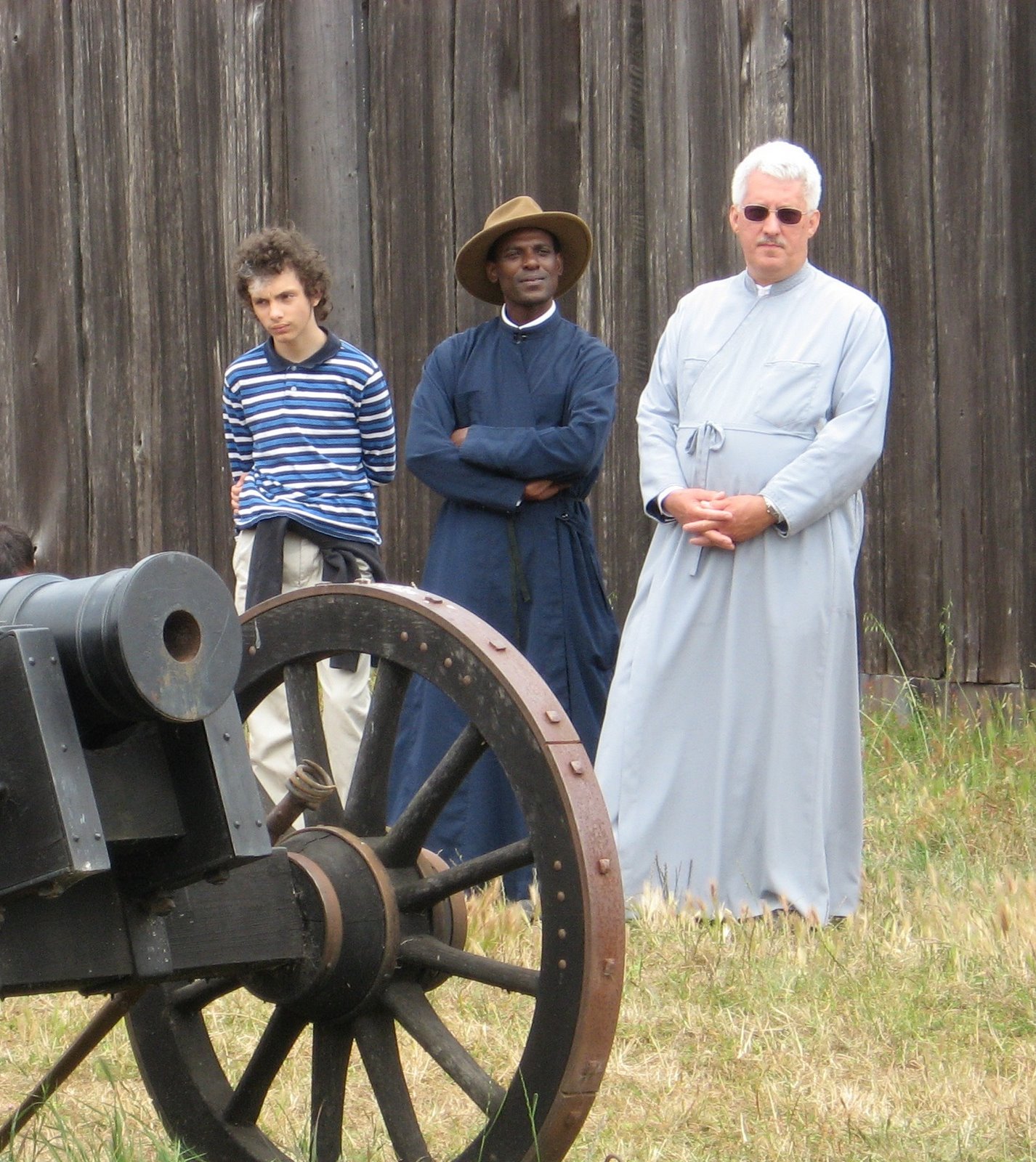
A blue study of guys waiting for the explosion.

Bang! Poof! No cannonball was shot–only gunpowder.

The majority of California’s state parks are likely to be closed because of the deep debt our state is in. If that happens, our Fort Ross pilgrimages may become a fragrant memory, and something to hope for in the more distant future.