“…the fiftieth day stands as the beginning of the era which is beyond the limitations of this world, fifty being that number which stands for eternal and heavenly fulfillment in Jewish and Christian mystical piety: seven times seven, plus one.
“Thus, Pentecost is called an apocalyptic day, which means the day of final revelation. It is also called an eschatological day, which means the day of the final and perfect end (in Greek eschaton means the end). For when the Messiah comes and the Lord’s Day is at hand, the “last days” are inaugurated in which “God declares:… I will pour out my Spirit upon all flesh.” This is the ancient prophecy to which the Apostle Peter refers in the first sermon of the Christian Church which was preached on the first Sunday of Pentecost (Acts 2: 1 7; Joel 2: 28-32).
“Once again it must be noted that the feast of Pentecost is not simply the celebration of an event which took place centuries ago. It is the celebration of what must happen and does happen to us in the Church today. We all have died and risen with the Messiah-King, and we all have received his Most Holy Spirit. We are the “temples of the Holy Spirit.” God’s Spirit dwells in us (Rom 8; 1 Cor 2-3, 12; 2 Cor 3; Gal 5; Eph 2-3). We, by our own membership in the Church, have received “the seal of the gift of the Holy Spirit” in the sacrament of chrismation. Pentecost has happened to us.”
I remember the first time I saw the Carson Valley in the state of Nevada, and my amazement at seeing lush green hay growing in the shade of the Sierra Nevada peaks, on the edge of the desert. That was at least 30 years ago, and on every visit since then, usually just driving through on the way to somewhere else, I have feasted my eyes and heart on those scenes of quietly grazing cattle, and sagebrush lining the roadways.
My friend “Rosemary” and her family have recently moved back to the West, and to visit them where they live a little south of the capital Carson City, I drove east through California and over the Luther Pass at 7740 ft. on Hwy 89 south of Lake Tahoe. The pass is named for Ira M. Luther who traversed the mountains by wagon train in 1854.
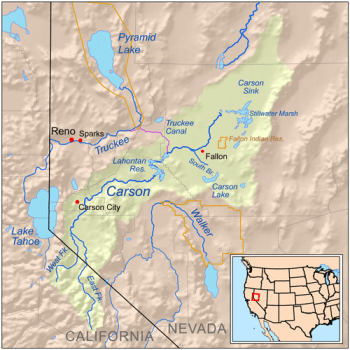
This map shows a much larger area north and east of where I visited, including the whole of Carson Sink as it extends into Nevada and California.
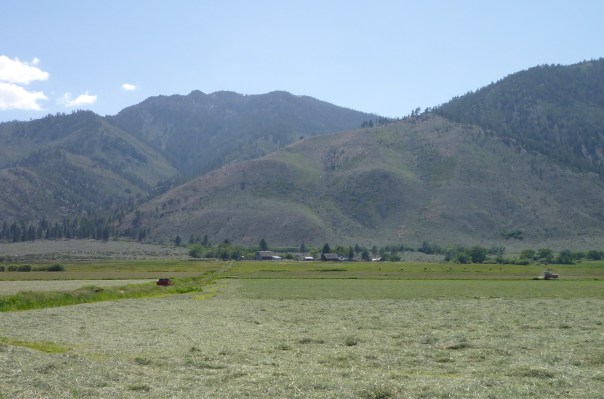
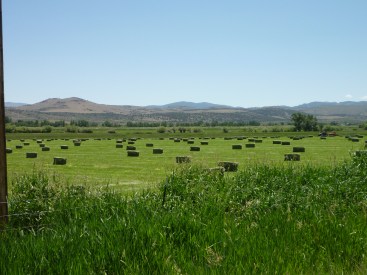
I arrived late at Rosemary’s place
because I just had to stop and take pictures of the new-mown hay.
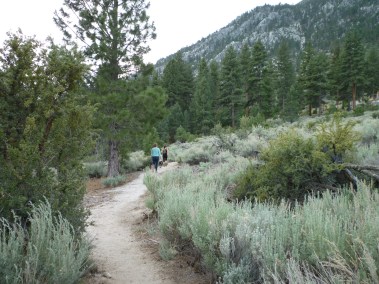
On my layover day my friends took me on a hike up the slope west of the valley, toward Job’s Peak. The skies were black or grey, and we heard threatening thunder, but no rain fell.
In just over a mile we had reached the California border. I thought it was very exciting to be standing on that boundary line. Not that we could see the edge exactly…
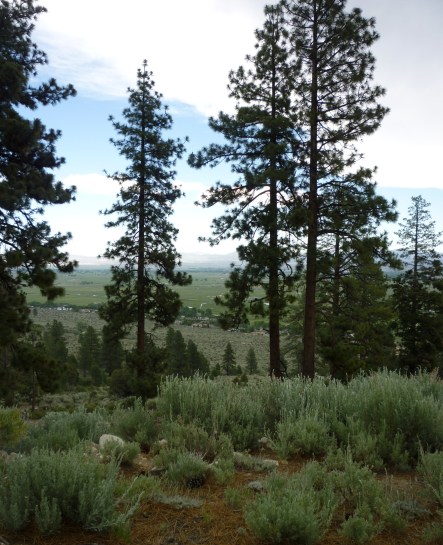
This is what we saw looking down from the state line. We had ever-changing cloud shows that afternoon, which made for varying light conditions, too.
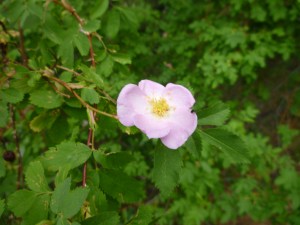
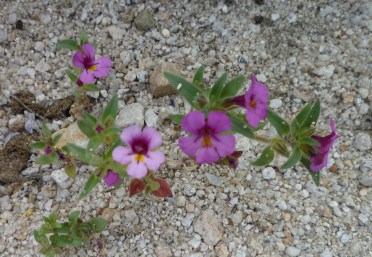
The lupines were finished and had already made thick pods from their flower spikes, but small flowers nestled into the granite gravel, and big bushes of wild roses grew close to the little creek we jumped over.
The air was so dry, my hair hung limply. Though the sun stayed mostly behind the clouds, it still managed to burn my face and lips. But I felt really good, standing on the side of the mountain with the breeze blowing my blouse.
It was a very happy few days, being together with my dear Nevada Family friends. We sat outdoors in the clean and dry, just-warm-enough air for hours catching up on all the concerns of our hearts and minds — well, as many of them as possible in this short visit. I’m looking forward to another trip over to that lovely Carson River Valley.
Anthony Esolen wrote in Touchstone a few years ago his observations of how good and holy people such as Mother Teresa manage to provoke hatred of themselves. This caused him
“…to ask what it is about the holy that strikes fear into the hearts of so many. We think that the saints are beautiful, and they are. Then how do people miss it?
“Then again, why should we be surprised that they miss it, when in Jesus himself, as far as many a Pharisee would concede, no beauty was to be found? When Jesus wrought his signs and wonders, and when he taught with authority about the kingdom of God, what did those Pharisees ask him, but why his disciples did not wash their hands before eating, and suchlike? They had before them the Lord, the long-awaited anointed of God, who had made the blind to see and the deaf to hear, and somehow the truth could not penetrate the shells of their self-regard.
“For the holy is a challenge to us, and therefore an affront. It does not curry our favor. It does not mingle with the guests at parties in our own honor, eating cucumber sandwiches and speaking empty pleasantries. It is not nice. It stands in fearful judgment before us. The holy is set apart; its ways are not our ways; yet it calls us to surrender our ways, and to be converted.”
“Let us, finally, be quite clear about one thing. Those who believe in God, and who honor his holiness, longing to be transformed in mind and soul—they are the true and only humanists. They hold so high a view of man that, if they were to see a victim of cholera dying in a ditch in Calcutta, they would burn in shame that the image of God should be treated with such contempt; or should they see a rich man destroying his soul with the vices that money can buy, they would pray that he might someday see what man is called to be.”
The job I was committed to doing in the church garden was deadheading roses. It took longer than I expected because in the years since I bowed out of regular gardening there, many more floribunda roses have been planted, and most of those needed a thorough trimming right about now.
The first day I put off driving over there until midday, and in spite of my sun hat I got hot and tired halfway through. So later in the week I started earlier in the morning and enjoyed my work very much. Some of the rose bushes are my old friends, and some other plants are, too.
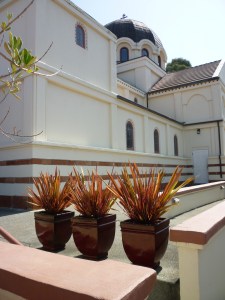
Like this Phormium or New Zealand Flax. I didn’t plant these, but on my watch, maybe five years ago, the plant in one pot died. I combed the nurseries in vain to find a replacement, and then I had a brilliant idea. Since these perennials grow constantly larger, I could “thin” and divide the two healthy plants and use what I cut off to start a new one in the third container.
It was a big project, but I completed it in a few hours one day. I spread a tarp on the concrete nearby, and after watering the pots thoroughly I managed to turn them on their sides without breaking them, and get the plants, dirt and roots dumped out. Then I cut and reassembled my plants and set them back in new planting mix. I must not have had my camera that day because the only pictures of the event are in my mind.
Now don’t they still look good? New Zealand Flax (not related to the Linum usitatissimum that we would call the real thing) doesn’t need much water, and in order to stay attractive it only wants old dry leaves pulled out or trimmed off from time to time. When I passed by these plants I noticed that this trimming hadn’t been done recently so I used my rose pruners and took care of them before I took their picture.
At home, where my tasks are more vast, I have run into problems. I put off adding horizontal support lines for the sweet peas until it would have been near impossible to get behind them to do it — so they grew about twice as high as the trellising, and bravely reached for the sky, holding on with their delicate tendrils — to what? Only to each other. And then, still clinging together, they fell.
At this point the only rescue that could be accomplished was very crude and unpretty, but it should make it possible for me to get a few more bouquets of the flowers that are now on very short stems indeed, because of the heat.
For my birthday a while back a friend took me to the Baker Creek Seed store near here, which is in an old bank building that they now call The Seed Bank. She wanted to buy me some seeds, but as it was a surprise I wasn’t at all prepared. What to get? I ended up with hollyhocks to plant next fall, and hyssop and fennel that I planted this spring, but I don’t remember what day. That’s flaky to begin with.
None of the seed packets from Baker Creek have much information on them of the sort I’m used to. They don’t tell you how many days to maturity, or how deep to plant the seeds, or how many days they might take to sprout. Maybe they have that info online? If so, that’s too new-fangled for me; I don’t have a smart phone that I consult when I’m in the rows.
So I just watched my seed beds and kept them moist and saw that day after day nothing was coming up, except weeds and volunteer nasturtiums. One morning I decided it was time to face the failure and start in on the weeds – but wait! Those tiny two-pronged spikes I see when I put my face down by the dirt…. they just might be the beginnings of feathery fennel leaves! So I will wait a few more days. But the hyssop – I don’t think so.
We put cages around our tomato plants, and I made labels to tape on the wire. Only about half as many plants as last year.
One successful flower in the garden is this nice California Poppy in pink and yellow. I planted it last year from a mixed six-pack of seedlings, and it came back!

 I remember the first time I saw the Carson Valley in the state of Nevada, and my amazement at seeing lush green hay growing in the shade of the Sierra Nevada peaks, on the edge of the desert. That was at least 30 years ago, and on every visit since then, usually just driving through on the way to somewhere else, I have feasted my eyes and heart on those scenes of quietly grazing cattle, and sagebrush lining the roadways.
 rsed the mountains by wagon train in 1854.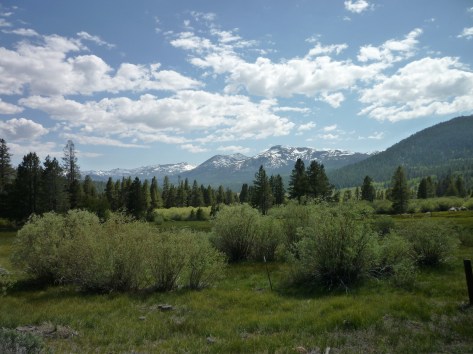
 ere finished and had already made thick pods from their flower spikes, but small flowers nestled into the granite gravel, and big bushes of wild roses grew close to the little creek we jumped over.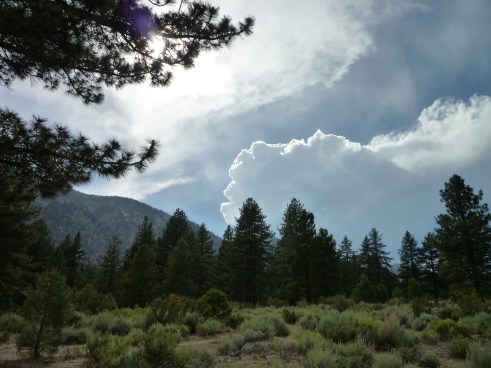
 few days, being together with my dear Nevada Family friends. We sat outdoors in the clean and dry, just-warm-enough air for hours catching up on all the concerns of our hearts and minds — well, as many of them as possible in this short visit. I’m looking forward to another trip over to that lovely Carson River Valley.

 r New Zealand Flax. I didn’t plant these, but on my watch, maybe five years ago, the plant in one pot died. I combed the nurseries in vain to find a replacement, and then I had a brilliant idea. Since these perennials grow constantly larger, I could “thin” and divide the two healthy plants and use what I cut off to start a new one in the third container.


 them of the sort I’m used to. They don’t tell you how many days to maturity, or how deep to plant the seeds, or how many days they might take to sprout. Maybe they have that info online? If so, that’s too new-fangled for me; I don’t have a smart phone that I consult when I’m in the rows.
 was coming up, except weeds and volunteer nasturtiums. One morning I decided it was time to face the failure and start in on the weeds – but wait! Those tiny two-pronged spikes I see when I put my face down by the dirt…. they just might be the beginnings of feathery fennel leaves! So I will wait a few more days. But the hyssop – I don’t think so.

 Gladsome Lights