I have described myself as “giddy” when I am euphoric or joyful, but the sense of the word in the following poem is more along the lines of dizzy or flighty. The poet muses about his giddy state of mind and how he needs God to save him from it.
We Orthodox are often exhorted concerning this problem of the mind’s whirlwind, and the way to calm it, as in this post: Be Still and Know That I Am God, in which we read: “This constellation of desires and feelings is a constant swirl within the mind. Since it consists of desires and feelings, it is extremely ineffective in guarding against outside desires and feelings. We are deeply vulnerable.”
The human condition has not changed much since George Herbert wrote the poem in the 1600’s. Herbert (1593-1633) was a Welsh-born English poet, orator and Anglican priest. Another more famous poet and priest, John Donne, became Hebert’s godfather when his own father died.
What has changed more is the English language, and besides the word giddy I found in this poem one that had been completely unknown to me: snudge. Merriam-Webster speculates that it is an alteration of snug, and basically means to snuggle or nestle.
But there may be more subtle and unpleasant connotations, having to do with antisocial attitudes or behavior. Crooked Talk: Five Hundred Years of the Language of Crime quotes a 1676 use of the word related to robbery: “[He] gives it to his snudge, who snudges away with it to his [fence] who buyes it.” By the time Robert Nares included it in his Glossary in 1822 he said it meant “a miser, curmudgeon, a sneaking fellow.”
Obviously I am attracted to this word snudge, describing something I am prone to doing, which might be perfectly wholesome — or not. I won’t try to determine which, because that effort sounds like too much temptation for my giddy mind.
GIDDINESS
Oh, what a thing is man! how far from power,
From settled peace and rest!
He is some twenty sev’ral men at least
Each sev’ral hour.
One while he counts of heav’n, as of his treasure:
But then a thought creeps in,
And calls him coward, who for fear of sin
Will lose a pleasure.
Now he will fight it out, and to the wars;
Now eat his bread in peace,
And snudge in quiet: now he scorns increase;
Now all day spares.
He builds a house, which quickly down must go,
As if a whirlwind blew
And crusht the building; and it’s partly true,
His mind is so.
O what a sight were Man, if his attires
Did alter with his mind;
And like a Dolphin’s skin, his clothes combin’d
With his desires!
Surely if each one saw another’s heart,
There would be no commerce,
No sale or bargain pass: all would disperse,
And live apart.
Lord, mend or rather make us: one creation
Will not suffice our turn:
Except thou make us daily, we shall spurn
Our own Salvation.
-George Herbert
 From our parish bulletin:
 while in the hot sun on Friday and Saturday, enjoying the pungent smell of the santolina that I was shearing down to stubs. It reminds me of the sagebrush of the desert or the bushes that grow at the beach. I met this mantis there. After I studied him and followed him for a while I had to get back to work, and I couldn’t notice if he went into the lavender or the rosemary, both of which had more hiding places remaining. I wonder which herby scent he likes best?
 Doll who was a gift from my goddaughter. Last month another good friend went to South Carolina and brought me back an Appalachian story-telling doll, who is Little Red Riding Hood, the grandmother and the wolf all in one doll, if you just turn it upside down or switch the bonnet around. I can’t wait to show her/them to the little grandchildren.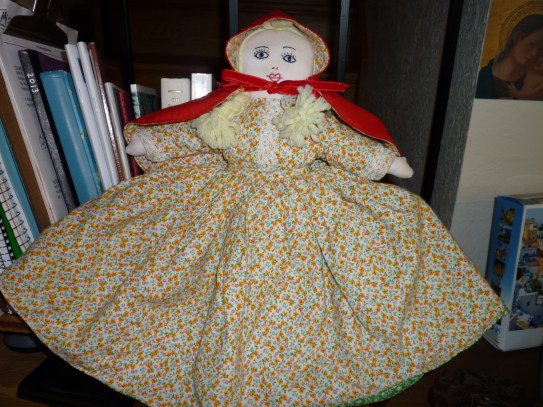
 d new treat. I guess I couldn’t tell you about all of the things I’m thankful for recently, or I’d be writing all day to do them justice. And I like to take some time to browse the good things in other blogs, too.

 Gladsome Lights