To support his country’s part in World War II John Stewart Collis 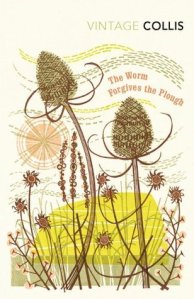 asked to work in Britain’s Land Army. “Since it was clear to me that I would be given some home job for which I should be entirely unfitted, I asked to be excused in favor of agriculture.”
While he did quite a bit of forestry work as part of this commitment, The Worm Forgives the Plough is the book that tells of the subsequent farming experience, and that is what I am currently reading.
Though I am the daughter of a farmer, I think my only direct farming experience was to pick lemons a few times and drive a tractor a few yards at a time between the rows. Until I had my own patch of ground to become acquainted with after I married, I was somewhat like Collis, more linked to academia than to the earth.
It’s always a pleasure to find someone who is able to write, and who wants to write about farming. Reading him I am reminded of Victor Davis Hanson, another member of academia who is also a true farmer, and can articulate the practical matters and heart’s realities that perhaps most farmers just deal with, often silently. Coming “from outside” he also has a perspective slightly broader that can appreciate the humor and relate farm work to life in other parts of society.
Even though reading about the land and agricultural work will never replace actual participation in that process, I want to post some of my favorite passages from Collis as I vicariously join him on the farm. Here’s one:
I had only been working on the land a question of weeks, but one morning as I went past the potato field I realized with what fresh eyes I now could see a field, this field. It was no longer just a bit of earth the beauty of which I perceived from the outside. I saw it a hundred times more clearly, it was a hundred times more real. For I had sown it with potash and superphosphate. I had walked up and down it endlessly. I had counted the minutes nearer the midday meal, I had tried to plough it, I had put down potatoes in the furrows. Already I was no longer an onlooker, a spectator, excluded as if by excommunication from its factual and actual existence. I no longer hung in the void, but had entered in at the door of labour and become part of the world’s work in its humblest and yet proudest place.
 Gladsome Lights
Gretchen, have you read any material by Wendell Berry? When I discovered him, my first thought was “why didn’t Gretchen tell me about this author”?
LikeLike
Yes I have! Novels and essays and poems. I do like him a lot.
LikeLike
Farming is very close to my heart as well. It seems that because of that the drought is much harder to bear.
LikeLike
I like that. There is farming in my family too, but way back before my time. However, two of my four siblings would be very happy as farmers if their life circumstances would allow it.
LikeLike
Only one paragraph of Collis…and already I can hear his poetry in his prose as it at unearths deep longings and sets them out in the sun like fresh turned loam. So you have unearthed another book treasure…as always, thank you for all you share.
LikeLike
THank you for sharing your reading with us. I love writing about nature, the land, farming, all that. And isn’t England in WW2 a fascinating topic too?
LikeLike