Kate visited me from Washington DC for a few days – it was a joy. When your children are spread over thirteen years, they don’t all get the same upbringing or hear the same stories. We went to the beach and sat on a log for a long time talking and catching up.
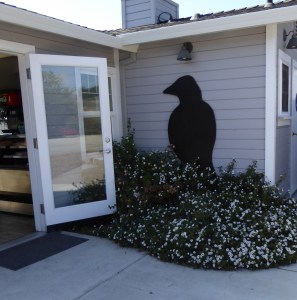
Kate was married just over a year ago near where we went to the beach, in Bodega, at what we fondly called The Birds Church. The fish-n-chips place where we ate in the nearby town of Bodega Bay is called The Birds Cafe. Alfred Hitchcock’s imagination has left an ongoing legacy.
Down on the shore the birds were not scary. Kate took pictures of a gull who hung around our log for quite awhile until he figured out that we didn’t have food. The sandpipers were more naturally seeking for their more natural food. It was the balmiest day I can remember on our typically frigid beaches; even the breeze was warm.
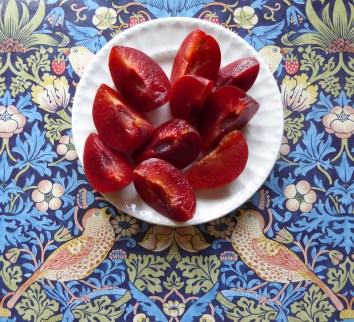
Kate helped me draft a note to leave in neighbors’ mailboxes, asking “Do you have a plum tree?” You see, I fell in love with the Elephant Heart plums that are growing at Pearl’s new house in Davis; they are the best plums I have ever eaten. Though I hadn’t given plum trees a thought before June, I’ve now got it in my head and on the landscaping plans that I will plant one of these trees in my refurbished back yard. These pictures are of fruits that I brought back from my last visit to Pearl.
They are not self-pollinating, so I either need two of them or I need to know that there is another tree in the neighborhood that can be a pollinator. Either another Elephant Heart plum or a Santa Rosa plum will do. I’d rather not have two plum trees, as my yard isn’t that big, and I am not that ravenous for plums. So I hoped to discover another suitable tree around here.
I first asked the neighbors whom I already know. The ones I didn’t know, on my street and the street behind me, I asked by means of my explanatory note, a paragraph with that grabber question at the top, which I dropped off yesterday afternoon. This afternoon two people who received the notes phoned to say that they do have Santa Rosa plums! My tree will be right in the middle of those two trees, as the bee flies.
And now I have two new friends, Rich and Dale. Dale has more than 20 fruit trees in his back yard! Rich planted his Santa Rosa plum as a pollinator for a Satsuma plum that he loved. Next summer we will get together and trade plums — yum.
“What Was Said to the Rose” is a poem by Rumi, the Sufi mystic. I listened to it along with several others on a recording played through my car’s stereo on my drive up to daughter Pippin’s house last month.
Sacramento River headwaters
For the first hour or more I didn’t listen to anything. I am surprised to find that I like just looking at the scenery in our beautiful state. I live in Northern California, and so does Pippin. But she is five hours farther north than I am, and still not at the top of the state.
Some people who have never been here imagine the cities of Los Angeles and San Francisco and have no idea that there is anything north of the latter. But if you’ve read my blog very long you know that there is a wide realm of land to love, and every time I drive through it I love it more.
It is said that Rumi is the most popular poet in the United States. I have one book of his poems, which I rarely crack, and I heard a recording of the translator Coleman Barks reading Rumi a few years back. I enjoy Barks’s personality and southern drawl almost as much as Rumi’s poems. You can hear him reading this poem on a YouTube recording;I think it might be from the same event I was listening to.
Rumi was a Persian Muslim mystic in the 13th century. It seems that the order of whirling dervishes was formed to propagate his poetry and wisdom. He does write as though his meditation and asceticism opened his heart to God, whom he calls “The Beloved” in many poems. The tone of this one is representative of many that I have read, and it inspires praise and joy in me. The version I transcribed here does not have the first line as its title.
WHAT WAS TOLD, THAT
What was said to the rose that made it open
was said to me here in my chest.
What was told the Cypress that made it strong
and straight, what was
whispered the jasmine so it is what it is, whatever made
sugarcane sweet, whatever
was said to the inhabitants of the town of Chigil in
Turkestan that makes them
so handsome, whatever lets the pomegranate flower blush
like a human face, that is
being said to me now. I blush. Whatever put eloquence in
language, that’s happening here.
The great warehouse doors open; I fill with gratitude,
chewing a piece of sugarcane,
in love with the one to whom every that belongs!
–Jalal al-Din Rumi, 1207–1273, translated by Coleman Barks
Perhaps I listened to some music after Rumi. I hope I didn’t jump right into Percy Jackson’s Greek Heroes, which though it references the ancients, is on the opposite side of the literary world from Rumi. I reviewed Rick Riordan’s earlier series a few years ago, about Percy Jackson the demigod and his adventures with the super dysfunctional divine side of his family. I can’t remember much of that one book I read, but when I discovered that the author had more recently retold the original Greek myths (starting with Percy Jackson’s Greek Gods) I thought it would be an even more helpful and fun addition to my haphazard effort to be better educated.
It is more hilarious than the original series. I think that it might also be more entrenched in the middle-school vernacular, including that four-letter “S” word for anything disappointing or bad that is so mainstream now that my own grandchildren are using it in my presence. It’s a sign of the degradation of society, but I guess that fits right in with this collection of stories, because certainly the Greek gods exhibit lots of degraded behavior themselves. Still, it makes me not want to recommend the book to kids.
As I drove up the interstate I could not helping laughing out loud at the lighthearted descriptions of the silly gods and goddesses and the way that Percy tells the drama and draws the characters using modern-day cultural phenomena and slang. Aphrodite sits around reading fashion magazines and looking at herself in the mirror, and various beautiful humans and gods are described as “hot.” The egotism of many of the gods is easily recognized as being like that of some foolish celebrities in the news, or the kids at school who get into trouble, or hurt someone innocent, because of their stupidity and selfishness.
I played a few minutes for Kate the other day and she laughed a lot, too, but she could see why after a couple of hours of these stories I might get tired of them. Is it really necessary to write for such a narrow target audience? How soon will these books sound dated to that age group? I don’t really care that much. The stories are hugely entertaining even for this grandma, and I hope Riordan won’t stop writing for a long time. I don’t know that I will buy a hard copy, though, even though the illustrations are well done.
I turned off my tablet when I got close to Pippin’s house. I drove into the driveway and unloaded my goodies, including an armful of books for the children that I had bought at the thrift store. We read about Ping and Paul Bunyan, and I was glad that these dear hearts aren’t at the age for hearing about Percy and his cohorts yet. They’ll be ready for Rumi sooner.
Every creator painfully experiences the chasm between his inner vision and its ultimate expression. The chasm is never completely bridged. We all have the conviction,
perhaps illusory, that we have much more to say than appears on the paper.
-Isaac Bashevis Singer
Life has been good. I have been busy — not just to be busy and distracted, but busy with people I love, and taking care of household business. I assure you that doesn’t often mean housecleaning.
I’ve made trips, and hosted guests. I’ve worshiped in God’s temple and admired the butternut squashes ripening in my garden. I’ve cooked and pondered and and walked and read. Every day I think of what I want to write about the many facets of my life and thought, and every night I go to bed unsatisfied in that one desire.
Writing, I think, is not apart from living. Writing is a kind of double living.
The writer experiences everything twice.
Once in reality and once in that mirror which waits always before or behind. -Catherine Drinker Bowen
This dissatisfaction hasn’t been at the forefront of my consciousness until the last few days; I normally go to bed happy and thankful for the sweetness of my existence in the arms of God. But now I’m aware as never before that it’s a gnawing hunger I’ve got to attend to.
There are thousands of thoughts lying within a man that he does not know
till he takes up the pen and writes. -William Makepeace Thackeray
Probably the next blog post I write after all this blather will consist of some pictures of flowers, or include an icon of the saint of the day, with hardly any words. But I have a new laptop! I can type upstairs or downstairs now, to put down all that’s swarming in my head. I hope it helps.
I do not like to write – I like to have written. -Gloria Steinem
 from Washington DC for a few days – it was a joy. When your children are spread over thirteen years, they don’t all get the same upbringing or hear the same stories. We went to the beach and sat on a log for a long time talking and catching up.
 ongoing legacy.


 whirling dervishes was formed to propagate his poetry and wisdom. He does write as though his meditation and asceticism opened his heart to God, whom he calls “The Beloved” in many poems. The tone of this one is representative of many that I have read, and it inspires praise and joy in me. The version I transcribed here does not have the first line as its title.
 he interstate I could not helping laughing out loud at the lighthearted descriptions of the silly gods and goddesses and the way that Percy tells the drama and draws the characters using modern-day cultural phenomena and slang. Aphrodite sits around reading fashion magazines and looking at herself in the mirror, and various beautiful humans and gods are described as “hot.” The egotism of many of the gods is easily recognized as being like that of some foolish celebrities in the news, or the kids at school who get into trouble, or hurt someone innocent, because of their stupidity and selfishness.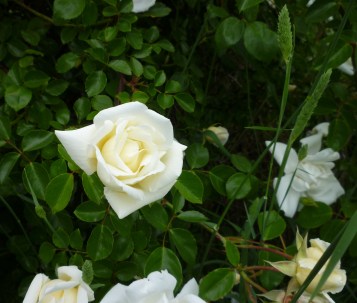
 Gladsome Lights