Monthly Archives: September 2016

Jonah is glorified forever.

I remember as a Protestant gl-jonah-prophet-dome-edit-crplaughing at the prophet Jonah, because he seems to make himself ridiculous in his pouting conversation with God. Essentially, his emotions are all over the place, which I can relate to. Jonah is unhappy when God spares the people of Nineveh, because that means his prophecy of their destruction doesn’t come to pass, and it makes him look bad. Then he is “exceedingly glad” when God makes a gourd grow up to give him a little shade. When the gourd dies he is very displeased again. And God chastises him for having more pity on a gourd than on a whole city full of humans.
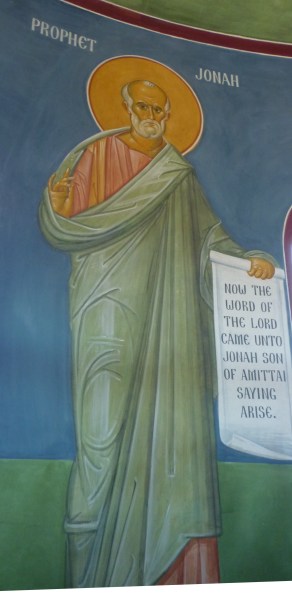
In the Orthodox Church we read the entire book of Jonah in church every Holy Saturday, along with a dozen other Old Testament passages. No one ever chuckles when we get to this part of the story; Jonah has a lot to teach us about our salvation, and we revere him for the fact that God made his life a picture of Christ’s death and Resurrection.

For the Prologue of Ohrid St. Nikolai has written a Hymn of Praise to God for how He worked in and through Jonah’s life, and for His forgiveness. I imagine that much of the poetry got lost in the translation from the Serbian language, but I appreciate the attitude toward the Holy Prophet Jonah, whom we commemorate on this day.

THE HOLY PROPHET JONAH

Nineveh! Nineveh resounds with sin,
And God sends Jonah to heal Nineveh.
Jonah does not want to, and flees from God!
Oh, where will you go, Jonah, to hide from the Most High?
Jonah sleeps; he sleeps and the tempest rises.
God moves slowly, but He will find you in time.
Hurled into the waves, swallowed by the whale,
“From whom did I flee?” Jonah asks himself.
“I fled from Him, from Whom one cannot hide!”
God chastises Jonah and yet delivers him,
And, by His providence, glorifies him forever.
Jonah, you do not want to speak to the Ninevites,
But through your punishment you will prophesy the immortal Christ.
You do not want to by words? Then you must, by deeds,
Prophesy Christ and the death and resurrection of the body!
Your deeds, Jonah, will not fade away,
And Christ the Lord will speak of you to men,
That, through you, the mercy of the Living God might be revealed,
By which you will be saved, as well as Nineveh.
Through you, the power of repentance shall be revealed–
The power of repentance and God’s forgiveness.
You pitied the gourd, and God pitied men.
Help us to repent, O God, and save us from condemnation.

Minding our proper burden.

imacdod001p1

It has been well said that no man ever sank under the burden of the day. It is when tomorrow’s burden is added to the burden of today that the weight is more than a man can bear. Never load yourselves so, my friends. If you find yourself so loaded, at least remember this: it is your own doing, not God’s. He begs you to leave the future to Him and mind the present.

-George MacDonald (1824-1905)

A Breath of Wings

This poem at albits seems to me to describe the ways of a butterfly better than anything I’ve ever read. I used the word capture instead of describe at first, but that word sounds too violent for what the poet has accomplished, in engaging respectfully with such an otherworldly and mysterious fellow creature.

Recently I listened to Antonio López talk about what it means to have a technological perspective on our world. He self-consciously follows the thought of George P. Grant in noting that just by being inhabitants of this culture we live in, we tend to absorb and display a somewhat fragmented and fragmenting attitude toward the people and things around us, failing to see them as whole beings, seeing everything as “piles of stuff” that we may use or manipulate or control at will. He wants us to see the connectedness of everything, and to respect the interiority of each creature, and “let be.”

Some have said that for a writer, “everything is material,” meaning, everything we see, whatever happens to us throughout our days, appears to us as something to write about, something we long to distill into words so that we can know it better and share it with other humans.

It occurs to me that to have this attitude as my first impulse may be an example of this less than fully human, technological perspective; I immediately impose my thoughts and presuppositions on the thing or person before me. But that habit works against my deeper and purer self. If I want to be fully present with the world, with the people and things in it, I need to restrain my mind’s impulsive and constant forming of sentences, at least long enough to let my heart meet the heart of the “other,” and know communion.

Perhaps that is what this poet was able to do when he met a butterfly. It would explain how he was able to catch, not just the first thoughts that came to mind, but this divine vision to share with us.

A BREATH OF WINGS

Walking out with the trash
I saw a butterfly flash by

In a wink and a bright splash
Of light. It made me wish

The yard were lined in rich
Leafy plants that might catch

Her eye in the search for a place
To settle. How could I guess

That she’d choose a blank wedge
Of sidewalk next to my garage

Where grey concrete met brick
And no perch seemed attractive

To a breath from delicate wings.
That’s how I saw her, as a trick

Of nature: two fans of gauze
Waving crazily in the evening air,

Nothing more, nothing else there
But color that seemed to disappear

As she lit. What remained was a stick
On the ground with a flat brown flag:

The wings had closed up tight.
Was she taking a nap, I thought,

Or holding her breath in fear
Of me standing there, a sag

In my face, the blank mind caught,
Transfixed in a magical nowhere

Between this–and the next–flight.

-Albert Salsich

I like the way the sentences sometimes don’t match the lines of the couplets exactly, so that the rhythm of the poem mimics the way a butterfly swoops and flutters, “waving crazily,” and then surprises you when it comes to an abrupt stop on a flower or a sidewalk. It is a good one to read aloud.

The beholding of a butterfly was a gift of grace to the poet, and through his labor of love I’ve been doubly blessed: Through this vicarious meeting I have an expanded appreciation of butterflies, and also the joy of encountering an uplifting poem. I’m afraid to say much more about all the words — I did once write on words for this insect — and the form of the poem because I will get carried away in enthusiastic speculation and wonder, and never make it outside to look at more butterflies.

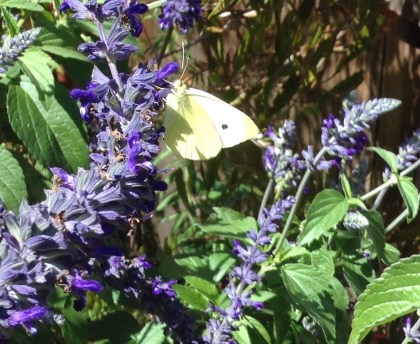
I hope you all might see a butterfly today!

butterfly-9-16-16

Shy and Peruvian, black and beautiful.

gl-15-img_3268-peruvian-sage-sep-16
salvia discolor

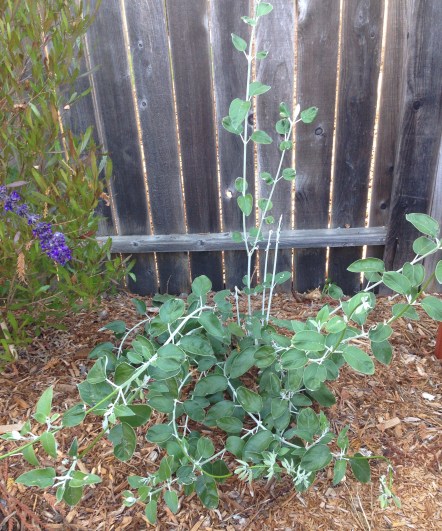
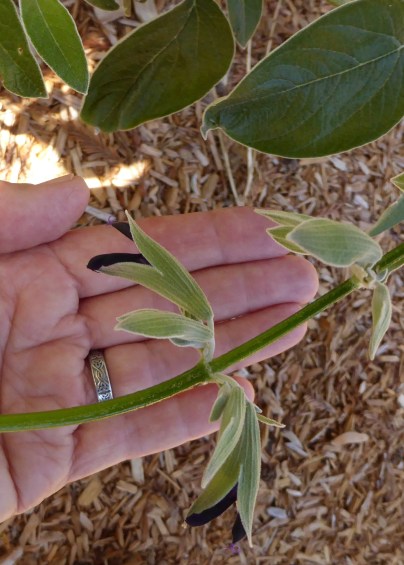
This unusual Peruvian or Andean Sage that I found at a nursery nearby has grown up and started blooming. I almost didn’t see the flowers, they are so shy and mostly hidden. I saw a website that said they were large and showy… if they become that I will be sure to take another picture.

Even without the blue-black flowers, the plant is very pretty, the way it drapes its graceful stems in the air. The stems and the backs of the leaves are silvery white, and the newer parts of the stems are very sticky.

gl-15-p1050493-crp-peruvian-sage

It makes me happy, the way it has quietly thrived and come into itself. I hope it will survive the winter and come again in the spring. It’s not listed in the Sunset Western Garden Book, but since it was propagated locally there’s a good chance it’s suited to our area.

I thought of it when I read this email from Salvo Magazine this morning. Beauty like this naturally makes us humans remember the Creator and Giver of beauty:

Is Planet Earth Trying to Tell Us Something?

You may know the standard line of evolutionary biologist-atheists like Richard Dawkins, which goes something like this:

Biology is the study of complicated things that give the appearance of having been designed for a purpose. (Dawkins, The Blind Watchmaker, 1996, p. 1)

Got that? “Have the appearance.” Don’t be fooled, warns Dawkins, for:

Natural selection is the blind watchmaker … does not see ahead, does not plan consequences, has no purpose in view. Yet the living results of natural selection overwhelmingly impress us with the illusion of design and planning. (Richard Dawkins, The Blind Watchmaker, 1996, p. 21)

It’s all an illusion of design. So ignore what your eyes and brain [and heart? -GJ] are telling you. They’re mistaken.

But apparently this habit of the mind that sees purposeful design in biology has spread beyond biology to the entire planet!

From the Daily Mail:

Sir David Attenborough and Brian Cox’s TV nature shows are ‘putting viewers off science’ because the beautiful scenes reaffirm belief in God.

* New study suggests nature programmes are putting viewers off science.
* Religious people often ‘have faith reaffirmed by the beauty on the screen.’

In the first bullet point, put “science” in quotes. They don’t mean science per se; they mean materialism or scientism.

There is no escaping it: The Planet Earth is stunningly beautiful. A wiser man wrote:

If the beatification of the world is not a work of nature but a work of art, then it involves an artist. -G. K. Chesterton

Draw your own conclusions, but don’t let someone tell you don’t see what you do see.