 Mags and I are reading The Lily of the Field and the Bird of the Air together, and so far it is delightful to be in this mini book club with her. Once her copy of the book arrived she dived in with alacrity and even put the perfect amount of pressure on me, in the form of a meek suggestion, to post our responses as close together as possible.
So here I am, just where I want to be, challenged, but not alone, being in alliance and camaraderie with a friend who welcomes the exercise. I do feel that my engagement is feeble… or perhaps the situation is that Kierkegaard has revealed the feebleness of my soul.
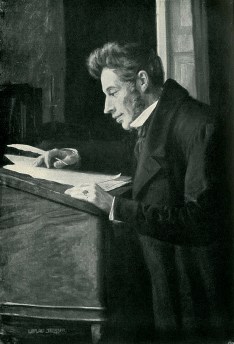 Søren Kierkegaard published the first edition of this work in 1849, but he continued to think about the subject and to write about it in his journals. The translator Bruce H. Krimmse tells us this in the introduction, and quotes from the journals, reflections that I rather wish I hadn’t read, because what’s in the first half of the book itself is quite adequate for stripping away any sentimentality I might have about birds and flowers. As Krimmse says, “[Kierkegaard] never permits the reader to ease up on the oars and drift in an intellectual, ethical, or spiritual sense.” Also, these further explanations were confusing to me, whereas most of the first discourse was more accessible. Maybe this was one of the introductions one should read after.
Kierkegaard begins the first of the three discourses in this little book by telling us what is wrong with “the poet’s” response to Christ’s sermon in Matthew 6. I will put that scripture passage right here so you can review it if you want, or you can skip past easily:
25 “Therefore I tell you, do not be anxious about your life, what you will eat or what you will drink, nor about your body, what you will put on. Is not life more than food, and the body more than clothing? 26 Look at the birds of the air: they neither sow nor reap nor gather into barns, and yet your heavenly Father feeds them. Are you not of more value than they? 27 And which of you by being anxious can add a single hour to his span of life? 28 And why are you anxious about clothing? Consider the lilies of the field, how they grow: they neither toil nor spin, 29 yet I tell you, even Solomon in all his glory was not arrayed like one of these. 30 But if God so clothes the grass of the field, which today is alive and tomorrow is thrown into the oven, will he not much more clothe you, O you of little faith? 31 Therefore do not be anxious, saying, ‘What shall we eat?’ or ‘What shall we drink?’ or ‘What shall we wear?’ 32 For the Gentiles seek after all these things, and your heavenly Father knows that you need them all. 33 But seek first the kingdom of God and his righteousness, and all these things will be added to you.34 Therefore do not be anxious about tomorrow, for tomorrow will be anxious for itself. Sufficient for the day is its own trouble.

The poet, our guide tells us, hears this and despairs of learning anything from the bird, having a sort of romantic notion of the ease of the bird’s life, and “wishing” that he could be bird-like, but having excuses. He sounds humble and childlike, but he “lacks the earnestness of eternity.” However, “The gospel is so earnest that all the poet’s sadness fails to change it….”
We are exhorted to be childlike in a different way altogether, and here I find the image or ideal of the child as Kierkegaard describes him to be a striking contrast to what is expected by most people in the last several decades:
“…the child never says, ‘I cannot.’ The child does not dare to do so… precisely because the child does not dare say, ‘I cannot,’ it is not therefore true that it cannot….” There follows the same thought repeated in various ways, and I am grateful for this repetitive aspect of the author’s style, because I need these things drummed into my noggin.
Okay, so once we have got that essential point, that if God tells us to do something, it follows that we can do it — what is it we shall do? I use the word shall because Kierkegaard very clearly uses it as distinct from will, a distinction that I think has been all but lost since sometime in the last century. Now we might say, “I will learn from the bird, even though I don’t want to.” The child of Kierkegaard’s day would say, “I shall learn from the bird, even though I do not will to do so.” But wait – he wouldn’t dare to say that, or even think it!
Our assignment from Christ: to learn from the lily and the bird, and to seek the Kingdom of God first. I need to work harder to write a proper response to the remainder of this discourse, and publish it later, because that part is the meat of it, and the birdsong.

p.s. I used dived instead of dove above when referring to what Mags did because, although Americans use dove twice as much now, Mags is British, and they still prefer the older form. So do I. 🙂
 For many of us our daily lives have become more home-centered as a result of our larger community’s efforts against the coronavirus, and maybe some have more time for blog-reading. 🙂 I might have more time to write something about the mini book club reading Kierkegaard, or an update on my reading of The Plague.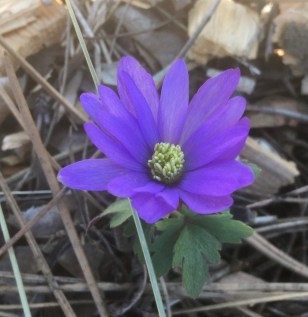
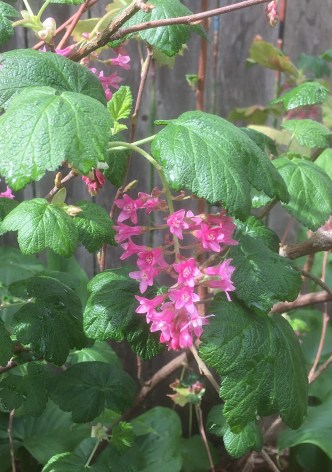
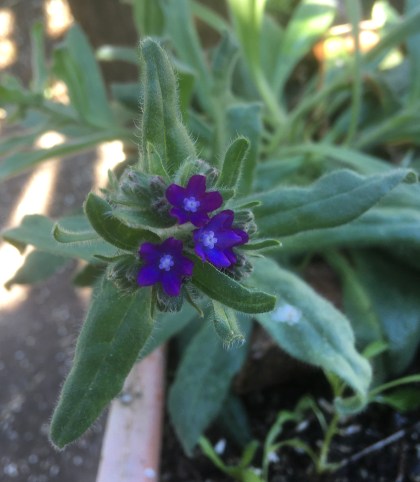
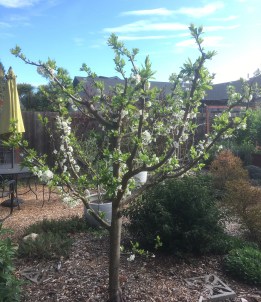 Now that the garden is growing, every day some brilliant color or flower jumps out at me. The pansies I have scattered around in the asparagus bed, irises and poppies and the dear plum trees, which never looked so sweet. I walked all around them to find the best presentation.



 ade institution, but the Harbour of Life that is Christ’s Body. We are fed the food not of men but of angels; we are inspired by the truth, not of this world, but of God Himself; and we are ruled, not by worldly fear which grows and begets more fear, but by the peace of Christ which surpasseth all understanding (Philippians 4.7) and brings unfailing comfort, whether in times of peace or peril. In the present moment, therefore, I urge you to be not afraid (Isaiah 43.1) nor let the concerns of the moment shake you from the firm foundation that is unhindered faith in the living God, Who heals the sick and restores the broken-hearted. The present situation may be a cause of great upset in the world around us, but in the Church, and in our Christian lives, we continue unhindered and undeterred in all that God has delivered into our hands for the salvation of our souls.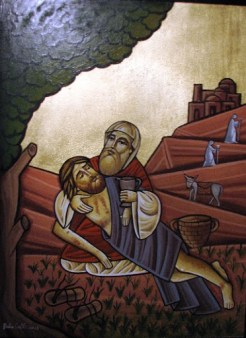
 Mysteries might bring or be the source of sickness or ill-health: by no means! The Mysteries of Christ are the true medicine of our souls and bodies, and bring nothing but life—and life eternal. Any whose hearts are troubled by present matters should pray fervently for an increase of faith so that fear can be cast aside; and the Church will continue her ancient witness to the love that is beyond fear, bringing the Holy Mysteries to the world, and to each of us, in a time when it needs them profoundly. Do not be afraid! As we sing so frequently in these Lenten days, God is with us! And He is merciful and loving, quick to hear and heal and save.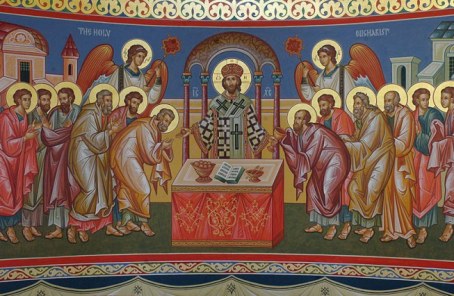
 Gladsome Lights