 It was a drippy and drizzly morning when I drove to the post office to ship Christmas presents to a few of my family. I thought there would be a long line, so I gave myself plenty of time, because I wanted to go directly from there to the cemetery in time to pray with a friend at her husband’s interment.
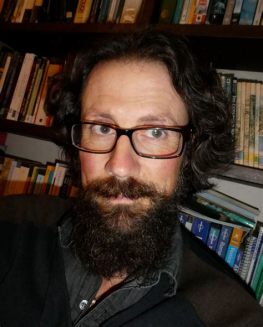
But few people were at the post office, and three workers, so I finished that business and was out the door with time to spare. Before I got my car door open a man with a long and full beard said, “Hi, Gretchen!” but I didn’t recognize him behind his face mask. Actually, I wouldn’t have known him without the face mask, because I hadn’t seen him in six years, and never with such facial hair. I had to ask, “Who are you?” and as soon as he told me his name I gave him a big hug and a kiss. Mike doesn’t live in my town, but the last time we’d met was in the same shopping center, the year in which we both lost our spouses. Back then we weren’t in the talking mood, but this time we stood in front of the post office and caught up for half an hour. He told me that recently he has fallen in love — with the Liturgy of St. John Chrysostom! What a joyous meeting we had.
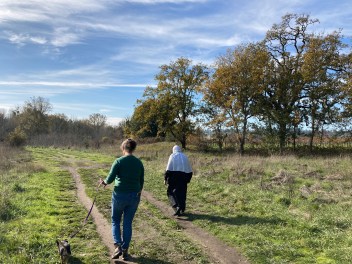
 I had another visit with friends yesterday, for which I made a big pot of chili beans; this afternoon a little tea time with a sister from church when I got back from the cemetery; and last week, a walk with two friends. It’s still fall here, but the colors are all turning to browns and grays, so I was surprised to see this mushroom, the brightest I’ve ever encountered. It was one of several of its kind popping up under bushes.
Some of my family are expected to arrive next week for a nice long Christmas visit. I need to hire a Christmas elf assistant, to help me accomplish all my projects — but that doesn’t sound likely, so I cheerily push one thing after another on to the list of what we can do together, after they arrive.
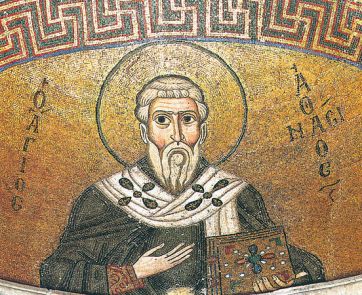
And for this month, our church women’s reading group has picked a great pair of books: A Christmas Carol by Charles Dickens, and On the Incarnation by St. Athanasius. I am just amazed at us! Last month when Pippin’s family was down for Thanksgiving, the Professor and I were sitting around chatting about church history and doctrine, and he shared with me a paragraph from the first chapter of On the Incarnation. My response was that it was crystalline. That’s probably the first time I ever used that word, which just popped into my mind — that’s what Athanasius will do! And I told the Professor that since I was soon to start reading the book again, I would be sure to post that passage on my blog.
Beginning to read St. Athanasius again has been soothing and encouraging. I got the idea of posting a series of excerpts this month of Advent, when we anticipate The Incarnation. But as I looked over my past blog posts to make sure I didn’t repeat myself too much, I discovered that I have already posted that very paragraph the Professor read to me, plus many more long and short quotes. Maybe I will find something different, but not likely a series.
Tomorrow is the Feast of the Conception of the Theotokos. I’m looking forward to attending Liturgy for the feast. I feel very happy at the moment, thinking about it. The world is full of trouble and strife and unknowns, questions about what governments will do, and what I should do. But for at least many hours of every day, I know what to do, and I do it — one thing after another. My mind gets distracted constantly, but often when I bring it back to here and now, a great gush of joy falls on me, knowing that I am alive.

 Jean-Claude Larchet is a contemporary French patristics scholar and theologian who has written on diverse subjects such as the Theology of Illness, life after death, and mental disorders. (I’m currently reading his The New Media Epidemic.) Several years ago our parish did a study of his book, Theology of the Body, and last week when I was thinking on that topic I was glad to find it still on my shelf.
 Two of those “folds” are 1)
 “I realized that a crisis of limits is a crisis of culture, and a crisis of culture is a crisis of spirit. Every living culture in history, from the smallest tribe to the largest civilization, has been built around a spiritual core: a central claim about the relationship between human culture, nonhuman nature, and divinity. Every culture that lasts, I suspect, understands that living within limits—limits set by natural law, by cultural tradition, by ecological boundaries—is a cultural necessity and a spiritual imperative. There seems to be only one culture in history that has held none of this to be true, and it happens to be the one we’re living in.”
 Gladsome Lights