“Humility,
and the most patient perseverance,
seem almost as necessary in gardening
as rain and sunshine,
and every failure must be used
as a stepping-stone
to something better.”
-Elizabeth von Arnim

“Humility,
and the most patient perseverance,
seem almost as necessary in gardening
as rain and sunshine,
and every failure must be used
as a stepping-stone
to something better.”
-Elizabeth von Arnim
 Why am I so happy, suddenly? It’s 4:00 in the afternoon, my kitchen and family room are incredibly messy, it should be depressing. I took a video just now, scanning the room, with dishes sitting in tepid dishwater and empty plastic bags on the counter, bills and book mailers on the smaller table along with the contents of my traveling backpack that I’d dumped there several days ago.
On the big dining table are stacks of papers and magazines and mail waiting to be further sorted, a spray bottle of Mrs. Meyers, and bins from my Big Purge&Sort project; on the sideboard, two handbags in disarray — because I can’t decide which one I’m using from day to day when I do go out; an open planner, more mail and various papers, and stacks of books growing taller every day. Empty cardboard boxes on the floor, and the usual aprons and dishtowels wadded on the counter or slung over backs of chairs…
You know why this isn’t getting me down? It’s the second day in a row that I haven’t had any outside commitments or workers in the house, and I think I am rested from my latest expeditions. I thought I was rested by Tuesday, and today I was bright awake early, but then strangely, fell asleep mid-morning.
I didn’t tell you about my trip home from the East Coast, that involved a twice-delayed flight, the last shuttle bus of the night (2:00 a.m.) not showing up, and me finally taking an Uber all the way from the airport, a one-hour ride. There was so much interesting along that journey, like the red Tesla that brought me home, but I have been too weary to write about it. I got into bed at 5 in the morning. I had written in that planner ahead of time that I should “Stay Home!” all this week, but I’d forgotten about our parish feast day… Anyway, now I have had two good days of solitude, and tomorrow is another one, God willing.
I’ve accomplished so many things in these homey days, slowly and steadily as my wits come around again. When I returned from D.C. there were two large zucchinis waiting to be picked, and three perfect ones, and some rubbery celery in the fridge. This afternoon I cooked up one of the big fruits with the celery. I made appointments (for next week), ordered birthday presents, bought a new lamp online, and took time to read while sitting in my morning room.

And I baked bread! My effort from a few weeks ago was a failure — let’s not talk about that — so I tried a new thing today, and it worked pretty well. I have a small loaf that is just the right size for me, and it didn’t crack on the side very much…

The crack is not big enough that the slice of bread falls apart, and the crumb is nice and “custardy.” With a little more experimenting, I’m hopeful of developing a recipe that will work with my style of homemaking and cooking, and be somewhat reliable. If it can be sourdough, all the better. And if anyone has a theory about the crack, please let me know. Becoming a professional baker, or adopting a systematic, precise and scientific baking personality — that is not going to happen.

It’s 90 degrees today, which is good for my mood, and for bread baking. If it’s colder than 80, the house stays cold, and I behave like a lizard in winter. If it’s 95 or 100 I have to shut the windows to keep the house cool. But today, I can fully enjoy the summer and have the outdoors coming in — through the screens, of course! I never will get over how my grandma in Berkeley summers would have the windows wide open with no screens, and no flies. I can remember how her sheer curtains would float gently in the breeze that blew up the hill from San Francisco Bay….
The front garden is burgeoning, everything bigger than ever, with an added flower growing out from under the germander hedge. It’s not like anything else growing on the property, or the neighbors’ properties, unless you compare it to the Golden Marguerite that can be seen behind it. The Seek app even said it was a Golden Marguerite, but if it is, its petals are albinos.

All in all, I think the balance between tidiness and messiness tipped a tiny bit toward the tidy in the last hours, in spite of added bread dough and starter mess. I promise I will clean the kitchen now and not leave any dishwater in the sink when I go to bed. That will contribute to keeping happiness in ascendance, too. Thank you for sharing my happy day with me.
It’s the season for Cabbage Whites! I’ve written about them before, and posted several poems. Mary doesn’t name these as Cabbage Whites, but I’m assuming. It doesn’t matter; the delightful thing is that she describes the essential “delicate in a hurry” nature of them, such that one wonders if they will ever stop and drink. Of course they eventually do, and I can get a decent picture of them then; but it’s the lobbing and banging I can never capture, so I’m glad Mary has done it, in rhythm and words.
SEVEN WHITE BUTTERFLIES
Seven white butterflies
delicate in a hurry look
how they bang the pages
…….of their wings as they fly
to the fields of mustard yellow
and orange and plain
gold all eternity
…….is in the moment this is what
Blake said Whitman said such
wisdom in the agitated
motions of the mind seven
…….dancers floating
even as worms toward
paradise see how they banter
and riot and rise
…….to the trees flutter
lob their white bodies into
the invisible wind weightless
lacy willing
…….to deliver themselves unto
the universe now each settles
down on a yellow thumb on a
brassy stem now
…….all seven are rapidly sipping
from the golden tower who
would have thought it could be so easy?
-Mary Oliver

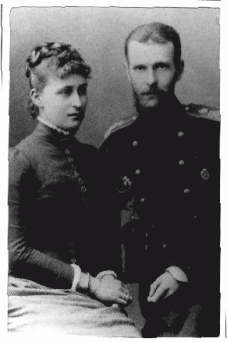 When my Kate was in high school, she and I studied as a part of our history course the children of Queen Victoria, and their marriages and children. You take in a lot of general European and even world history through their stories. Since my conversion to the Orthodox Church, I’ve come gradually to know a little more about some members of the extended family, and one of the most interesting to me is the Grand Duchess Elizabeth.
She was a granddaughter of Queen Victoria through Princess Alice, her father being Ludwig IV, Grand Duke of Hesse and by Rhine; her younger sister married Czar Nicholas II. (That couple are more famous generally, and many books have been written about their family. The only one I have read so far is a photo album sort of book, Tsar: The Lost World of Nicholas and Alexandra, which I loved.)
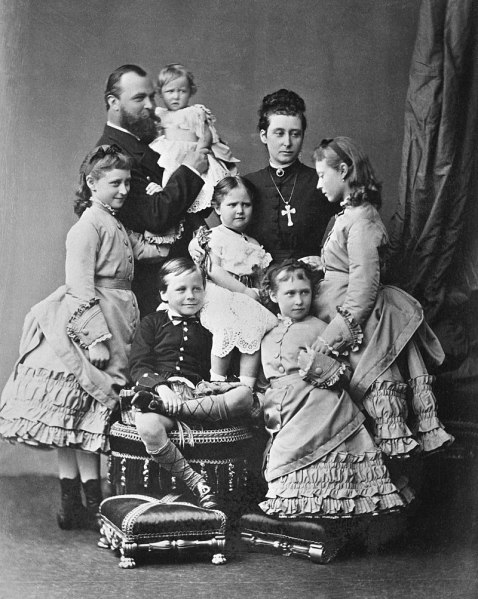

Elizabeth’s mother, who had modeled for her a devotion to helping the poor and living a modest lifestyle, died of diphtheria when Elizabeth was fourteen, along with her youngest sister.
Elizabeth had many suitors and admirers, and was considered by women as well to be exquisitely beautiful in body and soul. She rejected several suitors before she fell in love with Grand Duke Sergei Alexandrovich, son of Tsar Alexander II, who used to visit her family with his mother. It is interesting to me that her grandmother was very unhappy about this, and tried to discourage Elizabeth from accepting Sergei’s proposal. I think she was still trying to arrange marriages, and she had someone else in mind for her granddaughter. But the couple were married in 1884, when she was nineteen. Sergei was appointed Governor-General of Moscow.
Elizabeth and Sergei never had children of their own, but they became foster parents to Sergei’s niece and nephew, and Elizabeth would give parties for children at their summer estate. She converted from the Lutheran faith to Orthodoxy in 1891, against the wishes of her family. The following is from OrthodoxWiki:
“The Kaiser is thought to have been behind the claim that her husband had forced her to convert, but Elizabeth explained that it would be ‘lying before God’ to ‘remain outwardly a Protestant.’ Of all her family, Queen Victoria showed the most understanding, and provided her with moral support for her decision.”
Wikipedia tells us:
“Elisabeth was instrumental in the marriage of her nephew-by-marriage, Tsar Nicholas II, to her youngest sister Alix. Much to the dismay of Queen Victoria, Elisabeth had been encouraging Nicholas, then tsarevich, in his pursuit of Alix. When Nicholas did propose to Alix in 1894, and Alix rejected him on the basis of her refusal to convert to Orthodoxy, it was Elisabeth who spoke with Alix and encouraged her to convert. When Nicholas proposed to her again, a few days later, Alix then accepted.”
 In February of 1905, Sergei was assassinated in the Kremlin by the Socialist Revolutionary Ivan Kalyayev. Elizabeth was, of course, shocked and stricken, but she regained her calm, and according to Edvard Radzinsky,
“Elizabeth spent all the days before the burial in ceaseless prayer. On her husband’s tombstone she wrote: ‘Father, release them, they know not what they do.’ She understood the words of the Gospels heart and soul, and on the eve of the funeral she demanded to be taken to the prison where Kalyayev was being held. Brought into his cell, she asked, ‘Why did you kill my husband?’ ‘I killed Sergei Alexandrovich because he was a weapon of tyranny. I was taking revenge for the people.’ ‘Do not listen to your pride. Repent… and I will beg the Sovereign to give you your life. I will ask him for you. I myself have already forgiven you.’ On the eve of revolution, she had already found a way out; forgiveness! Forgive through the impossible pain and blood — and thereby stop it then, at the beginning, this bloody wheel.”
The widow Elizabeth went into seclusion, and eventually sold her jewels and possessions, using the proceeds to establish a convent of which she became the abbess. She and her monastic sisters opened a hospital and accomplished many and various deeds of mercy.
“This creature, so unlike the others, so towering above all, of such captivating beauty and loveliness, of such irresistible kindness; she had the gift of effortlessly attracting people who felt that she stood above them and gently helped them to rise to her…. She was made of the same material as the early Christian martyrs who died in the arenas of Rome” -Countess A. A. Olsufieva
In 1918 the Communist government exiled Elizabeth to Yekaterinburg and then to Alapaevsk, where with several others she was killed by the local Bolsheviks on July 18.
“They were herded into the forest, pushed into an abandoned mineshaft, into which grenades were then hurled. An observer heard them singing Church hymns as they were pushed into the mineshaft. After the Bolsheviks left, he could still hear singing for some time…. Later the White Army briefly recaptured this area, and her relics were recovered and the account of the person who witnessed it recorded. Her relics were first taken by the White Army to Beijing and placed in the Church of St. Seraphim of Sarov, and then they were taken to Jerusalem and placed in the Church of St. Mary Magdalene, which she and her husband had helped to build.”
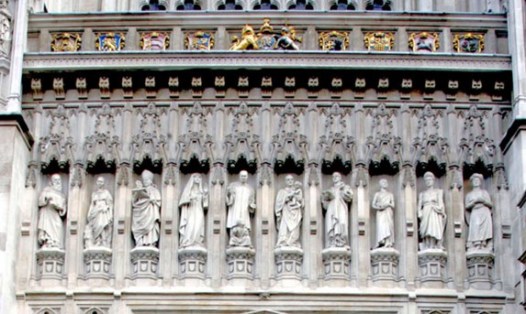
I have had to leave out many details about this saint’s life, but want to share a couple of memorials before I end this particular remembrance. Elizabeth was commemorated by Westminster Abbey as one of ten Modern Martyrs whose statues above the Great West Door were unveiled in 1998.
 And the sand artist Kseniya Simonova has told the story of Elizabeth’s life in a surprisingly moving way here: “White Angel.”
” … if we believe in the sublime sacrifice of God the Father in sending His Son to die and rise again for us, we shall feel the Holy Spirit lighting our way, and our joy will become eternal, even if our poor human hearts and earthly minds pass through moments which seem terrible.”
– Grand Duchess Elizabeth Feodorovna of Russia
May her life and prayers encourage and inspire us to receive with her,
even in our terrible moments, that eternal joy.
 Gladsome Lights