
Only recently did I learn of the existence of Sumela Monastery, a place which briefly in this century became particularly associated with the Feast of the Dormition (falling asleep in death) of Christ’s Mother, which we commemorate this month. This recent connection started in 2010:
“Orthodox Christians from around the world attended a rare Liturgy at an ancient monastery in Turkey… at the Sumela monastery in Trabzon province, north-eastern Turkey. At least 1,500 pilgrims, including people from Greece and Russia, traveled to the Byzantine-era monastery. The service was the first Greek Orthodox Liturgy to be held at the shrine since 1923, after the Turkish government allowed pilgrims to worship there once a year in a gesture toward religious minorities, in line with Turkey’s aspiration to join the EU.
“Those attending were elated, with one worshipper saying it was a great moment as they could now pray on the land where their great-grandfathers had come from. In 1923, the Turkish authorities had banned religious services at the monastery, built on the side of a mountain, and turned it into a museum, after it was abandoned when a population swap between Turkey and Greece saw most local Orthodox move to Greece.”

The Patriarch of Constantinople was allowed to celebrate Divine Liturgy every year on the Feast of the Dormition from 2010 until 2015, but starting in 2016 reconstruction work has prevented this.
I watched several videos about the monastery and the one I really liked was this one: “What is the Sumela Monastery?” because the personable guide had taken time to learn something about the history of the place, and he respectfully refrained from blathering ignorantly, unlike some other visitors who put up videos on YouTube.
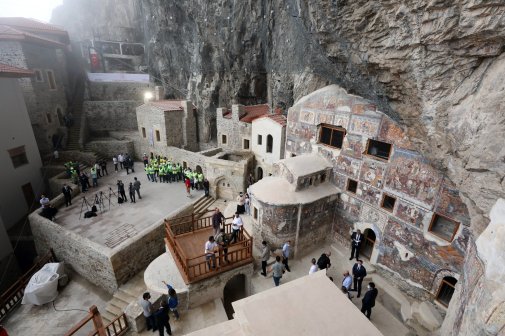
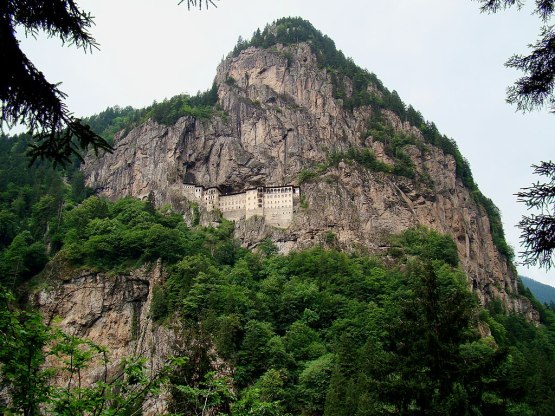
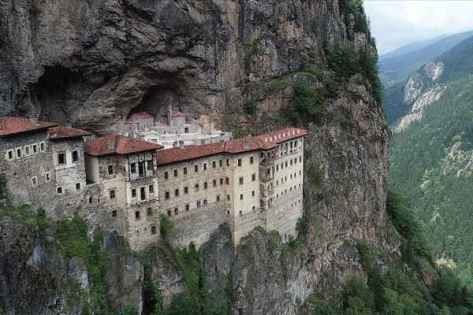
The monastery was founded by two monks in the fourth century, and through the following centuries repeatedly fell into ruin and was restored; in the 13th century it had grown into its present form.

Occasionally when I happen upon pictures or stories of ancient sites like this, built into steep cliffs, I become entranced with the otherworldliness of them and the drama of their settings. I’m glad I can visit them by means of these pictures and videos.
A blessed Feast of the Dormition to you all!


What fascinates me is how they managed to get all their building materials up there and do the construction work on such a knife-edge. It is truly marvellous.
LikeLiked by 1 person
It’s so interesting that you posted this–my koumbaros was blessed to be invited to attend the liturgy there today! I will show my children the video so they can picture where Theio Niko is!
Panagia Sumela has a special connection to Ponitan Greeks, many of whom live in the Philadelphia area. I had never heard of Sumela until we moved to Philly; we know of women who bear the name of “Soumela” in honor of this monastery and the Theotokos.
LikeLiked by 1 person
I first read about the monastery in an announcement that the Turkish government was again this year not giving permission for the Church to use it for the feast — but that must have changed, or have been erroneous to begin with.
Thank you for this joyous news!
LikeLike
It is my understanding that the Turkish government went back and forth until finally granting permission for the liturgy a few days before it was to be celebrated. My koumbaros had four days’ notice!
LikeLiked by 1 person
So beautiful!
LikeLiked by 1 person
What an interesting video – thanks! 🙂
LikeLiked by 1 person
What an unbelievable place and location. Can you imagine building that?
LikeLiked by 1 person