Monthly Archives: August 2023

The wind blew pine needles down.

Our weather here in my northern California county was slightly strange the last couple of days, I think because of being near to the path of the tropical storm Hilary. We had lots of clouds, and it felt like a storm was coming, but no show. I worked in the garden this afternoon and at one point felt the slightest mistiness in the atmosphere. The heat hung on last night longer than usual, but today was cooler; tomorrow is predicted to be back in the 80’s.

What happened at my place, though, was wind! So much, that the wind chimes were making a racket, and when I went out after lunch, the whole southern end of my back garden was covered by a blanket of pine needles, from the Canary Island Pine that towers above that area.

I spent quite a while dragging a trash can around and gathering up armfuls of the needles, picking them off the manzanita bush, the heuchera, lavender, everything. I didn’t get half of them yet.

Last week the lavender got pruned, and the garden generally was looking pretty tidy, until today. On the north side, now that the zinnias are blooming and greens are growing tall, the planter boxes are filling in.
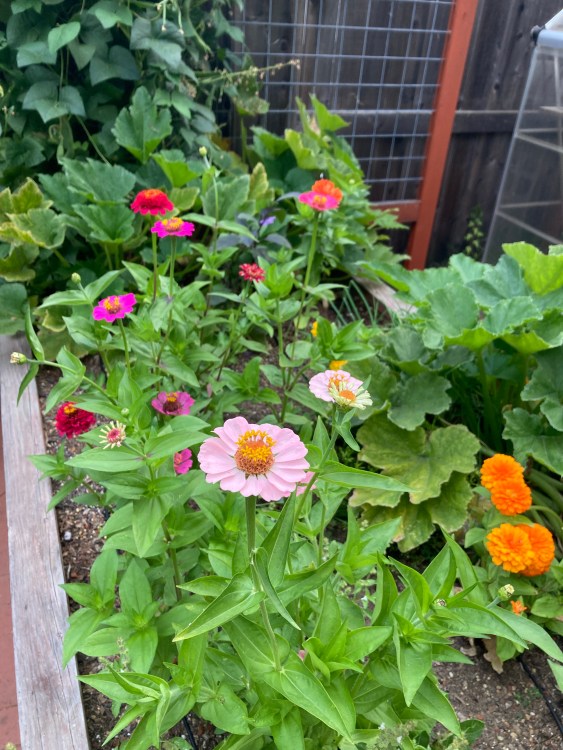
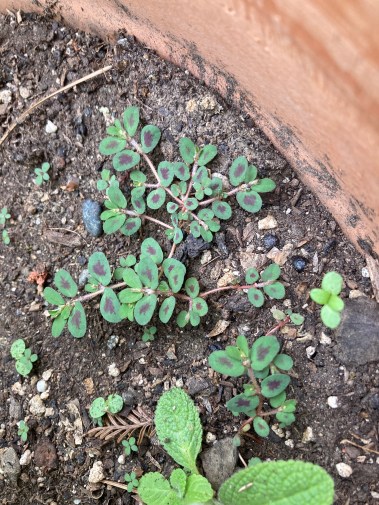
Spurge is growing throughout those boxes, but it’s easy to pull out. It doesn’t look like it would take much water from the other plants, though.
And the Narrow-Leaf Milkweed is blessedly free of aphids so far. I adore its flowers. Every year, so far, these plants are decimated by aphids before they go into dormancy, but the next spring they always come back bigger and stronger than ever.

Last year I tried planting three new species of milkweed, and none of them was successful. The year of the Monarchs, I had a beautiful Tropical Milkweed plant, the leaves of which the caterpillars didn’t care for. I wasn’t surprised when it didn’t survive the winter. That makes a total of six types I have planted in the last several years. The two native Californian species have always thrived, so I think I will give up being milkweed-greedy and not try any others again. I don’t know where I’d plant them anyway! And it’s pretty wonderful to have milkweed at all. ❤
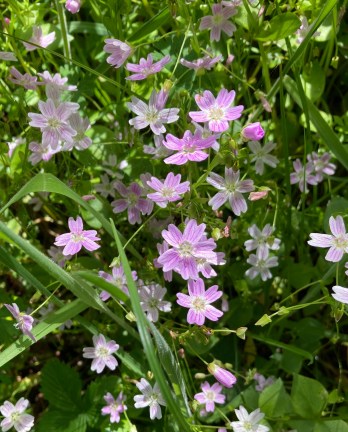
Primroses were floating all around.

My friend K. and I took our first ever hike together — unless you count tromping up and down hills in San Francisco, which we used to do at Christmastime. It was a pretty easy walk, just over two miles, in a place I’d never been before. Three gravel pits near a river have been turned into small lakes, and the trail passes by two of them and loops around the third.

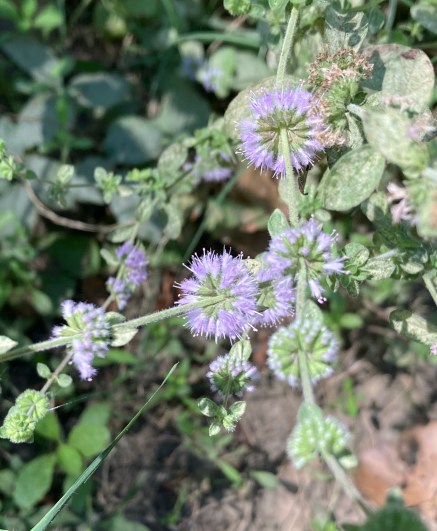
pennyroyal

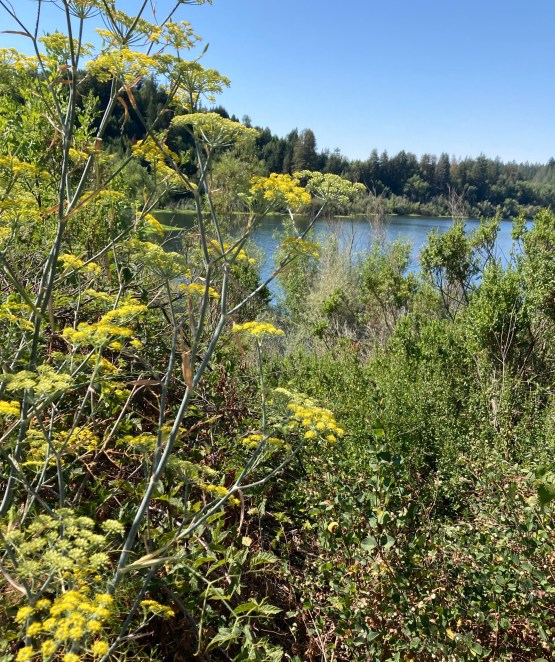
As soon as we set off from the trailhead the distinctive late summer scents of live oak and fennel and redwood filled my consciousness. It was midday, and the warmth of the air brought out their special essences and melded them into that perfume that is one of the best things about the hot season; it makes me feel at home, and quite wealthy.

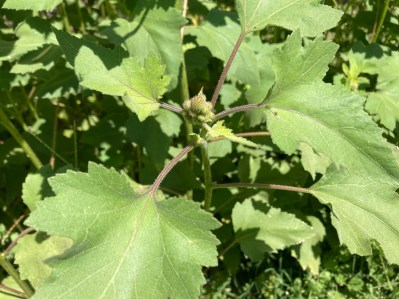
Rough Cocklebur

We saw large clumps of Rough Cocklebur, a new one to me; poison oak (of course), and — elderberries! I had just told a blogger last week that I never see elderberries unless I go to the mountains. And here were gobs of them. I wasn’t prepared to gather the berries, and it probably is forbidden anyway, as they are growing on public land. I didn’t even “gather” a photo, but you probably know what they look like.

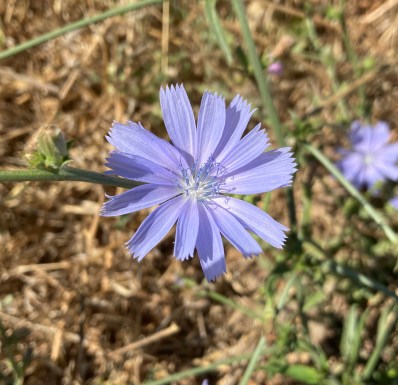
The chicory wildflowers were the most beautiful I’ve ever seen. Usually they are fading or for other reasons not very photogenic when I see them. This is the same plant from which the root is used to make a drink that people use as a coffee substitute. I have developed a love for the drink, hot or cold, that I brew from chicory that has been gathered and roasted by someone else.

chicory

My favorite discovery of the afternoon was Floating Primrose Willow, Ludwigia pepoides which was growing all around the lakes and out onto the water in broad swaths. [update: in my original title I called them “willow flowers” but Linda pointed out that in so doing I gave the impression that they are willows — they aren’t at all, are in a family of aquatic plants sometimes called water-primroses.]

K. and I hope to make a habit of our hikes together; neither of us can seem to make it happen if we are trying to go alone. We loved this outing so much. May God help us to continue!

Floating Primrose Willow

My arms reached for it without thinking.

I TELL YOU

I could not predict the fullness
of the day. How it was enough
to stand alone without help
in the green yard at dawn.

How two geese would spin out
of the ochre sun opening my spine,
curling my head up to the sky
in an arc I took for granted.

And the lilac bush by the red
brick wall flooding the air
with its purple weight of beauty?
How it made my body swoon,

brought my arms to reach for it
without even thinking.

*

In class today a Dutch woman split
in two by a stroke—one branch
of her body a petrified silence—
walked leaning on her husband

to the treatment table while we
the unimpaired looked on with envy.
How he dignified her wobble,
beheld her deformation, untied her

shoe, removed the brace that stakes
her weaknesses. How he cradled
her down in his arms to the table
smoothing her hair as if they were

alone in their bed. I tell you—
his smile would have made you weep.

*

At twilight I visit my garden
where the peonies are about to burst.

Some days there will be more
flowers than the vase can hold.

-Susan F. Glassmeyer

What’s left is The Nothing.

“What is left to a people who have believed only in politics after they lose their faith is ‘nothing,’ or perhaps ‘The Nothing.’ And what follows the failure of politics is not another form of political order but most likely the end of political community as such and therefore of properly human self-government. We are on the cusp of a new age that is at once post-political and post-human….”

The quote is from the opening paragraphs of Michael Hanby’s article, “Nothingness Rules,” in the latest Touchstone magazine. Hanby writes about the modern mind, especially its expression in the American vision, and how it sees the world from the standpoint of pragmatism. As an example he quotes John Dewey saying, “things are what they can do, and what can be done with them.” Any consideration of what things are in themselves, what their nature is, is unnecessary; more likely, it is a bothersome hindrance to getting on with controlling and changing what is.

“At the core of this metaphysical vision is the elevation of possibility or power over the givenness of the actual world. The celebration of possibility takes on mythic tones in American romanticism about the ‘frontier,’ in our political homage to the ‘American dream,’ and in a thousand mind-numbing commercials. But it is also deeply inscribed into our public philosophy, both political and natural.

“Liberalism elevates possibility over actuality in the political sphere by identifying freedom with rights. Rights create what D.  C. Schindler calls an ‘enclosure of a field of power’ around each citizen, transforming every given reality that would define me prior to my choosing—God, the moral order, and, now we discover, even my own nature—into a possible object of choice. Liberal order thereby undermines these basic realities while appearing to uphold them.”

Hanby goes on to discuss the difference between Marxist atheism and previous versions, why authority and not power is the “true source of the law’s efficaciousness,” and how “technocracy is not the rule of technocrats, but the rule of nobody.” He points out that the seeds of the new vision of nature are right there in our U.S. Constitution:

“The U.S. Constitution grants Congress the power to ‘promote the Progress of Science and the Useful Arts,’ prompting Leon Kass to comment that ‘the American Republic is  . . . the first regime explicitly to embrace scientific and technical progress and officially to claim its importance for the public good.'”

It’s a thought-provoking read which you can access online: “Nothingness Rules.”