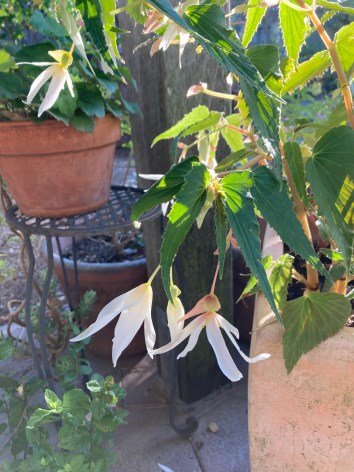
I think this type of begonia boliviensis is Bossa Nova White. I pretty much ignore the plant most of the time, until the flowers come on, and then I adore it. But every year it is showier, and it stays healthy. One can see pictures online of huge displays in hanging baskets (especially of the brilliant colors), and I’m tempted to try rooting a cutting… but maybe I’ll just try to give mine a little more nourishment in the future. I am always thrilled when it sprouts up and begins to bloom again.
The fortune that you seek is in another cookie, was my fortune. So I’ll be equally frank—the wisdom that you covet is in another poem. The life that you desire is in a different universe. The cookie you are craving is in another jar. The jar is buried somewhere in Tennessee. Don’t even think of searching for it. If you found that jar, everything would go kerflooey for a thousand miles around. It is the jar of your fate in an alternate reality. Don’t even think of living that life. Don’t even think of eating that cookie. Be a smart cookie—eat what’s on your plate, not in some jar in Tennessee. That’s my wisdom for today, though I know it’s not what you were looking for.
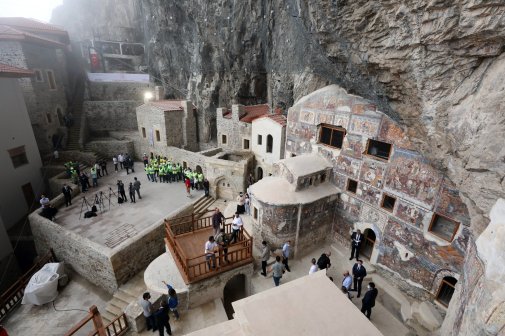
Only recently did I learn of the existence of Sumela Monastery, a place which briefly in this century became particularly associated with the Feast of the Dormition (falling asleep in death) of Christ’s Mother, which we commemorate this month. This recent connection started in 2010:
“Orthodox Christians from around the world attended a rare Liturgy at an ancient monastery in Turkey… at the Sumela monastery in Trabzon province, north-eastern Turkey. At least 1,500 pilgrims, including people from Greece and Russia, traveled to the Byzantine-era monastery. The service was the first Greek Orthodox Liturgy to be held at the shrine since 1923, after the Turkish government allowed pilgrims to worship there once a year in a gesture toward religious minorities, in line with Turkey’s aspiration to join the EU.
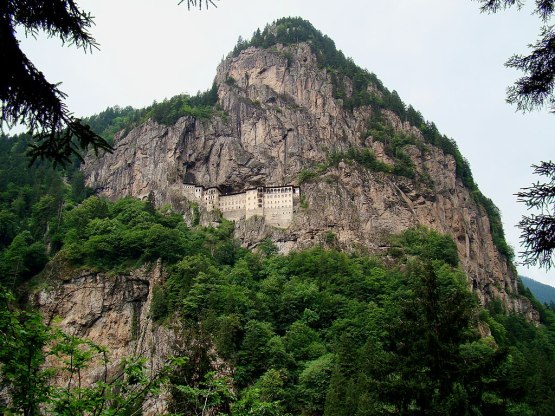
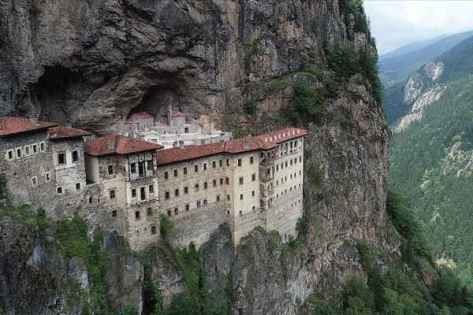
“Those attending were elated, with one worshipper saying it was a great moment as they could now pray on the land where their great-grandfathers had come from. In 1923, the Turkish authorities had banned religious services at the monastery, built on the side of a mountain, and turned it into a museum, after it was abandoned when a population swap between Turkey and Greece saw most local Orthodox move to Greece.”
The Patriarch of Constantinople was allowed to celebrate Divine Liturgy every year on the Feast of the Dormition from 2010 until 2015, but starting in 2016 reconstruction work has prevented this.
I watched several videos about the monastery and the one I really liked was this one: “What is the Sumela Monastery?” because the personable guide had taken time to learn something about the history of the place, and he respectfully refrained from blathering ignorantly, unlike some other visitors who put up videos on YouTube.
The monastery was founded by two monks in the fourth century, and through the following centuries repeatedly fell into ruin and was restored; in the 13th century it had grown into its present form.
Occasionally when I happen upon pictures or stories of ancient sites like this, built into steep cliffs, I become entranced with the otherworldliness of them and the drama of their settings. I’m glad I can visit them by means of these pictures and videos.
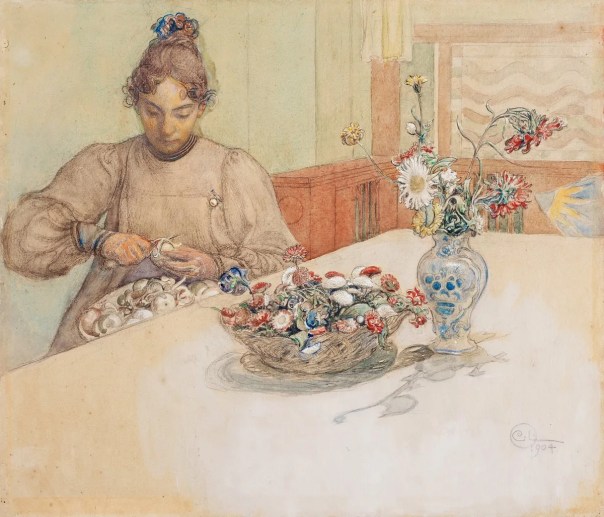
“We are needy creatures, and our greatest need is for home—the place where we are, where we find protection and love. We achieve this home through representations of our own belonging, not alone but in conjunction with others. All our attempts to make our surroundings look right—through decorating, arranging, creating—are attempts to extend a welcome to ourselves and to those whom we love.”
― Roger Scruton
By Carl Larsson
In the last couple of weeks I’ve felt a certain comfort and rest deep in my bones. Maybe it has something to do with having made time for my Hospitality Work. I forced myself to stay home from a couple of events just to recover my peace, which had been disturbed by events hard to explain. Once I was able to focus on my home-work, I also could do it in an honorable way, that is, without hurrying. Instead of “The hurrier I go, the behinder I get,” it’s “Take more time, you’ll get there faster.”
I love to do the dishes calmly, but even when I do, I tend to leave the task before I’m completely done, because I get distracted by a thought, some idea that makes me drop my dishtowel on the counter as I head to the bookcase or the garden and don’t remember to come back until it’s bedtime, and a little late for dishes. Lately, when that happens, I’ve finished up, calmly, self-hospitably, in the morning. So all is good.
One Moonglow tomato so far.
I’ve been cooking zucchini (from my three plants) for myself, and serving myself the first Green Doctors cherry tomatoes right off the vine. In this season when I don’t have anyone upstairs to see my bedroom, I make my bed for my own pleasure and so that the rumpled blankets don’t spread their mood to my easily agitated mind.
If I slow down enough, I can look ahead and plan for full days at home, and occasionally plan the night before to make bread the next day. I have done that three times now, with increasing success. It’s not realistic to think that I will make bread more than once every week or two, and my goals must be adjusted from four years ago when I’d first resumed bread baking again, because as with so many things in life, I realize that I can’t have everything I want, even when I am myself the only (human) guest in my home.
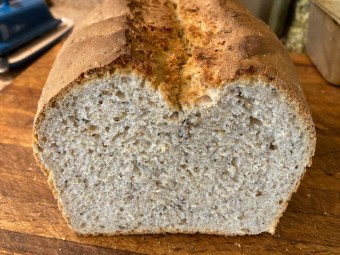
This is the last loaf I made, and I’m pretty pleased with it. If I had started the dough the night before it would have been a little more sour; I’m still experimenting. It has what I would consider a good “regular bread” crumb, not custardy, but not doughy or dry, either. I like artisan breads with that custardy and open crumb, but I also don’t like the holes very big, because whatever I put on my slice of toast will melt through them all over my hand and shirt.
The sides did not crack on this one — I recently remembered that 40 years ago when I’d make four or five sourdough loaves at a time, I had to slash them with a straight gash down the middle, not diagonal cuts as I think looks nicer. Otherwise pieces of the top would break off. Maybe that helped take the strain off the sides as well, to keep them from cracking. This loaf has a little whole spelt flour in it, plus sesame, poppy, caraway and fennel seeds.
I got lots of new plants in the ground this month, the latest being portulaca, which I love, but haven’t always had good luck with. Maybe August is the best month to put that in, when the sun is burning down the way those flowers like it.
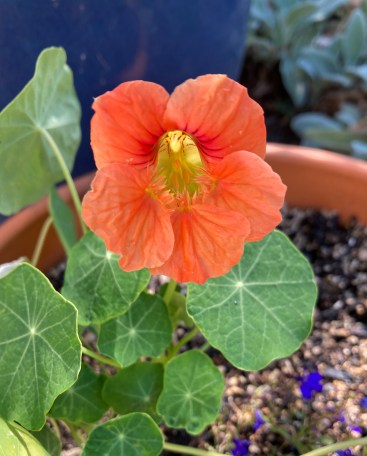
Once again, I planted nasturtium seeds in various places, early and later, and this year I got one plant to grow. Its first bloom just opened this weekend. Welcome, little flower friend!







 Gladsome Lights