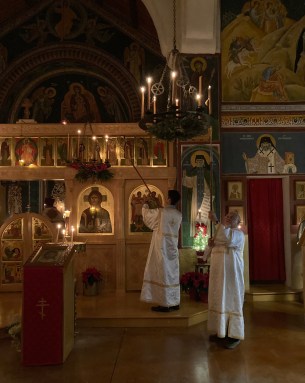
 For the last week or so, I’ve been spending a lot of time in the kitchen, and an equal amount in church. It was quite the experience to attend Divine Liturgy three days in a row: First for Sunday, the usual Resurrectional Liturgy — though the cathedral had been so brightly decorated on Saturday, it was far from the usual visually. Plus, at the end of the service the choir sang several carols with great zest. We returned for a short Festal Matins in the evening, and sang the glorious “God is With Us!”
Then Monday, which was Christmas, the Nativity of Christ, and the church was full again, with lots of families with babies. My baby goddaughter has had stranger anxiety for several months but that morning she was okay with me carrying her up for Communion, after which I toted her around for a while and showed her off to everyone.

Today is the Synaxarion of the Mother of God, she who was so essential to the event we celebrated yesterday. Of course, the church was not as full of people as on Christmas Eve and Day, but it was surprising how many of us came back for more of the rich spiritual feast — and there was certainly more than we could take in, more than enough to fill our cups to the brim, with a holy elixir.

My cookie tins have been filled to their brims, too, with more worldly contents, and then partially emptied as I give them for gifts, and then filled again. I made several kinds of cookies before the First Day of Christmas, and I am continuing now on the Second Day, and have plans for a few more, days and flavors.

I have friends who will be celebrating according to the old calendar, which means they won’t have Christmas until January 7th, which means more opportunities for gifting cookies that I bake “late.”
So far I have made:
Cranberry Jellies
Apricot Macaroons
Ginger Spice Cookies
Salty Licorice Brownie Cookies
Chocolate Almond Macaroons
Fruity Meltaways
Rolled Gingerbread Cookies
Lemon Poppyseed Sandwich Cookies

And I’ve started on:
Flourless Mandarin Almond Cookie (my invention)
 …and still plan to make:
Salted Anise Butter Cookies and
Mexican Hot Chocolate Cookies
I’d like to replenish the supply of Ginger Spice Cookies, because the first batch I made with einkorn flour, and I didn’t know one needs to use more of that type than of regular wheat flour; the cookies came out flat flat flat. Still yummy, but they don’t present so nicely…
None of my own family were able to come spend Christmas with me this year, except for my grandson Pat and his wife who spent Saturday with me. But I have other guests for a month, a family with three children, and the children do not speak more than a few words of English. It’s surprising how little one needs to talk, to bake cookies together. I added the rolled gingerbread cut-out cookies to my list for their sake, and well, for my sake, too, because it’s a lot of fun to help them have fun.


So… today I boxed up some more cookies on Boxing Day, and put them out in the garage to stay cool. Tomorrow is St. Stephen’s Day, and if I weren’t ironing altar cloths (we are going back to gold now, after the Christmas red) I would consider driving to our sister parish where they will commemorate the first Christian martyr with another Divine Liturgy.
But, I will stick closer to home, and hopefully bake a few more cookies, and/or help the children to decorate the gingerbread with Royal Icing. And I will visit some dear church friends to share some Christmas cheer, which may or may not include — cookies!
Happy St. Stephen’s Day!

 Gladsome Lights
Is it confusing, this changing the date of Christmas?
Your assortment of cookies is impressive!! GM
LikeLike
The differing dates for Christmas are one aspect of a decision a long time ago, on the part of *some* Orthodox, to abandon the traditional church calendar for most of the year, and use the civil calendar. So nothing changes anymore, and though the situation is unfortunate, I don’t think it’s confusing at this point. It is a mercy that the whole Orthodox Church still uses the traditional calendar for the Paschal cycle.
LikeLike
Actually, there’s a big problem coming up with some of the Old Calendar things. First of all, the date is going to slide another day in 76 years, so all this talk about January 7th is going to pertain to January 8th… The amount of stuff that has been printed in the last 100 years with that 13-day gap is hard to fathom, and it’s all going to be out of date. Furthermore, as the slide continues, there are feasts and fasts that are sliding into each other as a result of the Paschal cycle being different than the “normal” cycle of the liturgical year. With the new Calendar, you’d never have Annunciation (I think) on Good Friday, which, strictly speaking, is impossible liturgically, though churches have put together something for when it has happened.
LikeLiked by 1 person
We celebrate Christmas January 7th, but it really is December 25th according to the Julian calendar!
LikeLike
Merry Christmas and again on the 7th. 🤗 Do most Orthodox believers celebrate it on the 7th?
LikeLike
I’m glad you asked that, Sandi, because it prompted me to do some research on the question, which I also had wondered about. I learned that “In terms of population, most Orthodox Christians follow the Julian Calendar (roughly 144 million to 41 million) but in terms of numbers of autocephalous and autonomous church bodies, the majority use one of the New Calendars (12 to 8).”
https://orthodoxwiki.org/Church_Calendar
LikeLike
Interesting! I was curious because I just heard Ukraine passed a law (?!) that changed Christmas to December 25 instead of January 7. This year was the first time it has ever been on the 25th. I was very surprised by that.
LikeLike
I read about that, and how very few people showed up at the Lavra on the 25th.
LikeLike
I wondered how the faithful felt about it.
LikeLiked by 1 person
There are a lot of Ukrainians who settled in Chicago, and the Ukrainian Catholic Church has an eparchy based there, and a cathedral – St. Nicholas. (St. Nicholas also has one of the only Ukrainian Catholic schools in the US!) St. Nicholas went to the new calendar in the 1960s. They celebrated Christmas on the 25th, and then, thirteen days later, as there were services happening for Theophany/Ephiphany, the “old Calendar” crowd showed up to church for Christmas, and a major brawl erupted on the steps of the cathedral and the police had to be called to break it up. It’s quite legendary!
Several years later, Cardinal Joseph Slipyi, who had survived many years in the Soviet gulag, did tours throughout the west to encourage and revitalize the Ukrainian Catholic Church in the diaspora. He was fiercely against the new calendar, so in Chicago, a new Ukrainian Catholic Church was established two blocks away from St. Nicholas in order to be “more Ukrainian”. St. Nicholas is still around, but the new church, Ss. Volodymyr and Olha, at one time, had the highest membership of any UCC in the US.
LikeLiked by 1 person
Some of this stuff is just hard-wired, to a point. I know a priest who is Vladimir, whose name’s day is one date, and his church is new calendar. Most of the people who go to that particular church are recent immigrants from Russia and Ukraine, and they barely acknowledge the new calendar date, but he gets all the gifts and cards 13 days later!
LikeLiked by 1 person
When the OCA came into being, the Hierarchs as I understand let each monastery or parish decide which calendar to follow. My priest said that was a mistake. In our area we have two monasteries in our diocese, one on the New and one on the Old, and we are very close to several other parishes in the area, in other jurisdiction, several of which follow the “other” calendar. The whole thing is an annoyance, but generally we live with it in Christian charity.
LikeLiked by 1 person
From what I understand, the OCA churches are new calendar except for the diocese of Alaska. My kids’ dad grew up in the Carpatho-Russian church; each parish was allowed the option to go new calendar, with the caveat that they couldn’t go back if they didn’t like it. I believe most have gone over, but I think their largest parish hasn’t.
LikeLike
I checked with my priest on this, and we have three old calendar parishes just in our deanery of the OCA.
LikeLiked by 1 person
That’s crazy! *L* However, there are all sorts of crazy little things with Orthodoxy in the US. Did you know that there are a few Russian Orthodox Churches up in Canada that didn’t join the OCA but remained part of the Russian Church? All of it is so fascinating to me! 🙂
LikeLiked by 1 person
A big part of the issue was that still in the early 1900s, Russia and Greece continued to be on the old calendar civilly – if you travelled to Russia in the days of Tsar Nicholas II, you could do it by train, cars existed, you could take a camera with you, but you’d be going “back” in time 13 days, which, I’d have to imagine, made it more difficult to make plans to go there. In both Russia and Greece, it was anti-religious, secular governments that forced the calendar change civilly, and … the church never complied, feeling that they weren’t going to go along with such “crazy” dictates. (Mind you, especially in Russia, there were all sorts of things that were being introduced, including a short-lived attempt to get people to write Russian with Latin letters!) Unfortunately, adhering to the “old” calendar has kind of turned into a kind of “purity test” for some. I was baptized into a church on the Old Calendar, and I’ve celebrated Christmas on January 7th, and found it beautiful and meaningful, but the older I get, the more I think we need to be united in celebrating Christmas on the “civil” December 25th.
LikeLiked by 1 person
I have friends who recently immigrated from Russia (via Georgia, Turkey and Mexico) and just last night they were talking about some problems with being on the old calendar there. New Year celebrations are currently bigger in society than Christmas festivities, and the time when people exchange gifts, but the faithful would still be on the Advent fast.
Then, when the Feast of the Nativity comes a few days later, it’s rather anticlimactic, nothing to get excited about.
LikeLiked by 1 person
This might be sacreligous, but I attend a Serbian Church, celebrating on the 7th, and I started the fast November 15th so that I could take my kids to church on December 25th (to an OCA parish) so that everybody is “together” with this. Their dad started going to a new calendar church, they go to a Lutheran school, etc., and at this point, it seems silly to “hold out” for the seventh.
This post was really interesting. Rod Dreher pointed out this blog about 6 years ago, and I stop by every once in awhile. I generally don’t read the political stuff, but the culture/family stuff is fascinating (and a lot has happened to the gentleman since Rod’s post): https://halfreeman.wordpress.com/2023/12/23/christmas-new-year-observances-in-my-two-worlds/
LikeLike
What I’ve seen that is interesting is that in the glorification of Alexander Schmorell, who lived most of his life in Germany, there seems to be a tacit acknowledgement that the date of July 13th (new calendar) is probably more important than the old calendar date (June 30). The issue is, come 2100, if they keep the old calendar date, the civil calendar date becomes July 14th, which is obviously not the day that he died. All the books, all the files, even his headstone all say July 13th. To keep July 13th, though, his “old calendar” feast day is going to have to slide back to June 29th – that is, if the decision isn’t made to bring the church calendar into line with the “new” calendar.
LikeLike
“Flourless Mandarin Almond Cookie”
Do you ever share you recipe? 😄
I clicked on it, but it was not a link.
LikeLiked by 1 person
I’m still in the invention phase!
LikeLiked by 1 person
😀
LikeLiked by 1 person
What a generous baker you are!
LikeLike
Your church is so beautiful. And so, too, is that array of cookies! Oh, the people on your list are lucky ones indeed! I love that you had a little help, too!
LikeLiked by 1 person
I had hoped you had links to the cookie recipes! I’m interested in making the apricot macaroons.
We will always be old calendar especially in Jordanville, NY. There is a big community here of homeschoolers, too, and we can live away from many worldly things, such as the civil calendar. I was baptized and raised in several different states (PA, IN, OH, CT, VT and MA), always attended churches following the Julian calendar.
LikeLiked by 1 person
I will post some links to recipes, or the recipes themselves, soon. I see that I’ve never put the Apricot Macaroons recipe on my Recipes Page. Thank you for the prompt, Martha ❤️
LikeLike