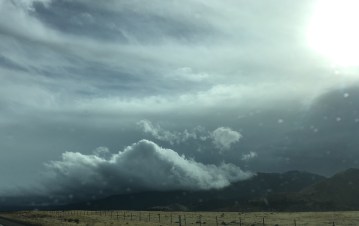
Like Rain it sounded till it curved And then I knew ‘twas Wind— It walked as wet as any Wave But swept as dry as sand— When it had pushed itself away To some remotest Plain A coming as of Hosts was heard That was indeed the Rain— It filled the Wells, it pleased the Pools It warbled in the Road— It pulled the spigot from the Hills And let the Floods abroad— It loosened acres, lifted seas The sites of Centres stirred Then like Elijah rode away Upon a Wheel of Cloud.
When I recently encountered the W.S. Merwin poem that I posted yesterday, “Losing a Language,” it reminded me of a passage from The Folding Cliffs, which was the first thing I ever read by the author, many years ago. It tells the story of a 19th century native Hawaiian family who did not want to be separated by leprosy, so they escaped into the mountains, where they were pursued by government soldiers.
Back then the book had been lent to me by K., so I had to borrow a copy from the library to find again the passage that had stuck in my mind. It is only one page in this epic narrative of Hawaii that is told in poetic lines. If you have any interest in the history and culture of Hawaii, you might want to look into it. I never would have thought to read it myself, and when I first opened its pages and saw the form Merwin uses, I was dismayed. But I knew I must try at least a few pages, to honor K’s suggestion, and no more that that were needed to hook me into the compelling story.
The particular scene that came to mind recently takes place not long after missionaries arrive on the island of Kauai. They have started a school for the children, and the pastor’s wife had planned to teach them, but she can’t handle the “rough children,” so the pastor himself takes on the job. Here is most of the section “20”:
Whatever the pastor pronounced to them in that voice ……..that was not the one he talked in and not the one he spoke in when he stood up during the church service ……..and not the one he used for English with other foreigners whatever words the pastor uttered from the moment ……..they walked through the door onto the dead wood each syllable of their own language articulated so carefully ……..that it did not sound like their own language at all not only because every sound that he uttered ……..with that round deliberation was always wrong in his particular way but because it was coming from those ……..particular clothes that face mouth regard that way of turning and staring at them and because those words although they ……..were like the words of their own were really arriving out of some distance that existed for him but not ……..for them and they could hear it echoed in his children…
………………………………………………….…but they repeated the names of the solitary letters that they ……..said every day the threads of a seamless garment and he showed them what each letter looked like it was ……..white whether large or small straight or flowing and it was in itself silent in a black sky where his hand drew it ……..and it stayed there meaning a sound that it did not have
As I say, this scene was memorable for me, capturing my imagination on the subject of indigenous children trying to learn the language of strangers, from someone who makes even their native language strange to them. I was affected by the whole story such that it changed my overall perspective on Hawaii; whereas it had been in the back of my mind as a tourist-y place I didn’t care about, it became full of people and stories. I went on to read the story of Father Damien, the Catholic saint “of lepers and outcasts” — and about other related topics I don’t remember at this remove.
After reading yesterday’s poem and having my interest in The Folding Cliffs renewed, I saw an article criticizing Merwin for cultural appropriation and for changing important parts of the story, a story that is well documented in its historical facts, in publications that Merwin doesn’t give credit to. I wrote a comment about that article, responding in particular to one section of it:
“I still think that The Folding Cliffs overall is wonderful. Poetic license is one thing, but this seems to be going too far: ‘Merwin implies that Pi‘ilani is only superficially Christian and that desperation causes her to reveal a more deeply held set of native beliefs. This is nonsense…. There is no mention in any of Kaluaikoolau! of Pi‘ilani’s faith in anything other than the Christian God.’
“I wonder if Merwin was trying to rectify the harms of colonialism by suggesting that there was no reality to the faith the indigenous people acquired. I doubt he was trying to ‘cash in on’ the story, and the term ‘cultural appropriation’ I think meaningless, but it’s unfortunate that the telling of the whole story of the protagonist was beyond the scope of his sensibilities.”
The offended critic included this information I want to pass on, about factual historical sources, books in which one can read the story of Pi‘ilani:
1) Pi‘ilani Ko‘olau’s Kaluaikoolau!, published in Honolulu in 1906 by John G. M. Sheldon and available in the Archives of Hawaiʻi
2) Helen N. Frazier’s translation of Pi‘ilani’s memoir, The True Story of Kaluaikoolau, or Ko‘olau the Leper, published in the Hawaiian Journal of History, vol. 21 (1987) and available in libraries everywhere.
My readings back then created a desire to visit the island of Kauai. But when my late husband and I did vacation in Hawaii for our 40th wedding anniversary, we stayed on Maui instead. Those rugged mountains where lepers hid from soldiers are still waiting for me.
At Vespers last night, the lighting was unusual, in that electric lights had been turned on in the dome; typically we do without those, and in the winter it means that we see the icon of the Pantocrator only dimly. Because the amount of light, and the angle at which it enters through the cathedral windows, is always in flux, every service at every time of day is differently illumined — but the effect is always sublime.
Over the last two days, at church and on my neighborhood path, I was warmed by the beauty of physical lights, not separate from their symbolic role: They represent and mysteriously convey the presence of Christ Who is, as the Evangelist said, “The true Light, which lighteth every man that cometh into the world.”
Today was the Leavetaking of Theophany, and I was the chanter of the Third and Sixth Hour prayers before the service. On Sundays we always have hymns of the Resurrection, and usually hymns of that Sunday’s feast or saints as well. It was the Kontakion of Theophany that got my attention this morning:
On this day Thou hast appeared unto the whole world, And Thy light, O Sovereign Lord, is signed on us who sing Thy praise, and chant with knowledge: Thou hast now come, Thou hast appeared, O Light Unapproachable.
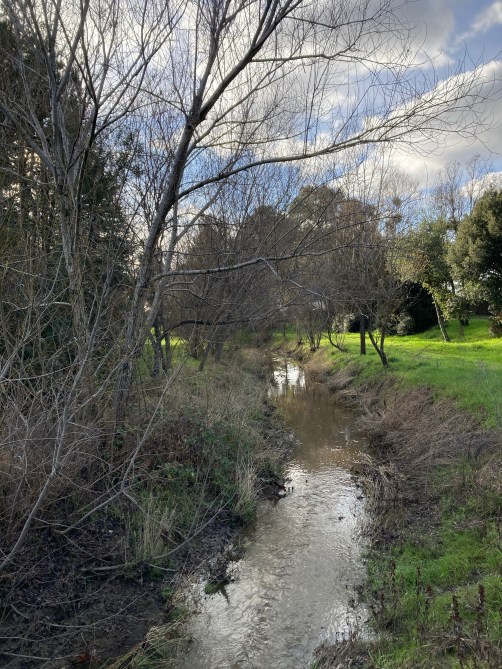
As soon as I returned after church, I (shock!!!) changed my clothes and went for a walk. We had been surprised by the sun coming out in the afternoon, so it was delightful out there. Even though the creek was muddy from rain, the light shining on it made it lovely.
And I practiced Psalm 89 some more. Reading the same lines and stanzas over and over, thinking of links to help me transition from one thought to another, has been the most rewarding kind of meditation; the theology and the poetry fill my heart, certainly in much the same way as one line states:
We were filled in the morning with Thy mercy, O Lord, And we rejoiced and were glad.
But this line is in the latter half of the psalm, when the mood has turned upward. A few stanzas before, the psalmist is considering how in the evening man “shall fall and grow withered and dry.” “We have fainted away,”“our days are faded away… our years like a spider have spun out their tale,” and “Return, O Lord, how long?”
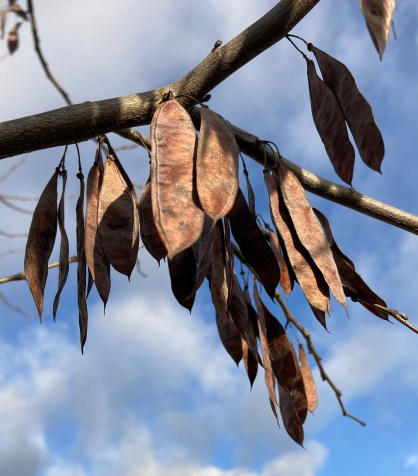
Withered and dry, but still handsome.
I have looked at two other translations of the Psalm, one of them a different version of the Septuagint, and compared with the one I am using (see sidebar note), to me they both are clunky and harder to read, though they do have many of the same vivid images that help me to learn this poem.
I stopped a couple of times on my walk to sit on a bench and think about these things. And when I got home again I looked at the notes in the Orthodox Study Bible, which points out that this is “a morning prayer designed to keep one focused on the Lord rather than on this temporal life and its hopelessness. For He exists outside time, and is therefore our only refuge…. It is read daily at the First Hour.”
There are many references to morning and evening, days and years, and our lifespan being “in the light of Thy countenance.” But one reason I have wanted to learn the whole prayer poem is the last verse, whose first line brings me back to “Thy light is signed on us” in the hymn we read and sang this morning:
And let the brightness of the Lord our God be upon us, and the works of our hands do Thou guide aright upon us, Yea, the work of our hands do Thou guide aright.
 When I recently encountered the W.S. Merwin poem that I posted yesterday,
  As I say, this scene was memorable for me, capturing my imagination on the subject of indigenous children trying to learn the language of strangers, from someone who makes even their native language strange to them. I was affected by the whole story such that it changed my overall perspective on Hawaii; whereas it had been in the back of my mind as a tourist-y place I didn’t care about, it became full of people and stories. I went on to read the story of Father Damien, the Catholic saint “of lepers and outcasts” — and about other related topics I don’t remember at this remove.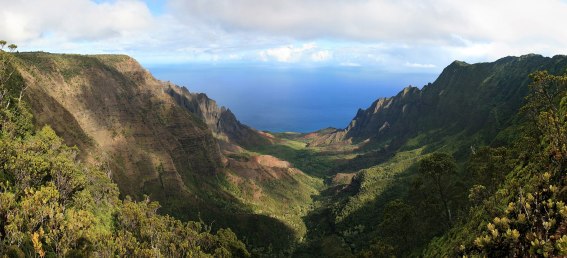




 Gladsome Lights