Tag Archives: Emily Dickinson

This, and my heart.

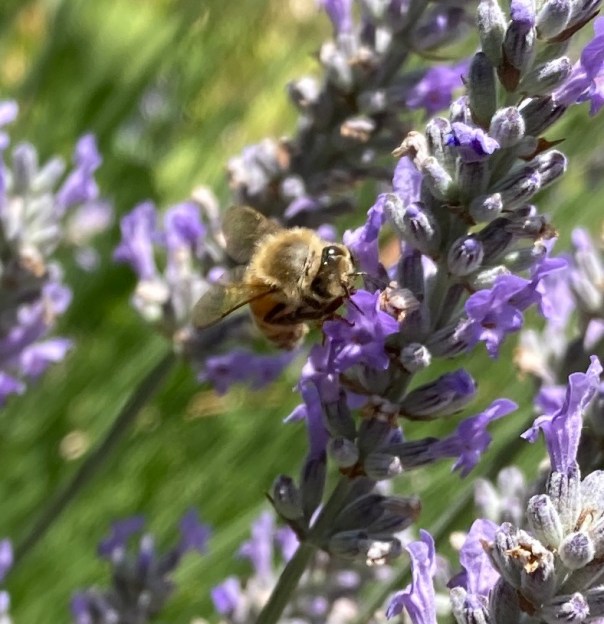
Western Honeybee and Patchwork Leafcutter Bee

This afternoon the sun came out, but my house was cold, so I took my lunch into the garden and sat in the sunshine, on the edge of the planter box. A few inches away several plants were draping their heavy, flowery stems over the brick area between my seat and the fig tree: Milkweed, salvia, borage, oregano, and lavender were all tucked in close together. The bees were loving it. Carpenter bees, honeybees, some little bees I didn’t recognize. It’s very sweet to be able to take a few steps out my back door and find myself in a world where a thousand tiny creatures are flying about and feasting.
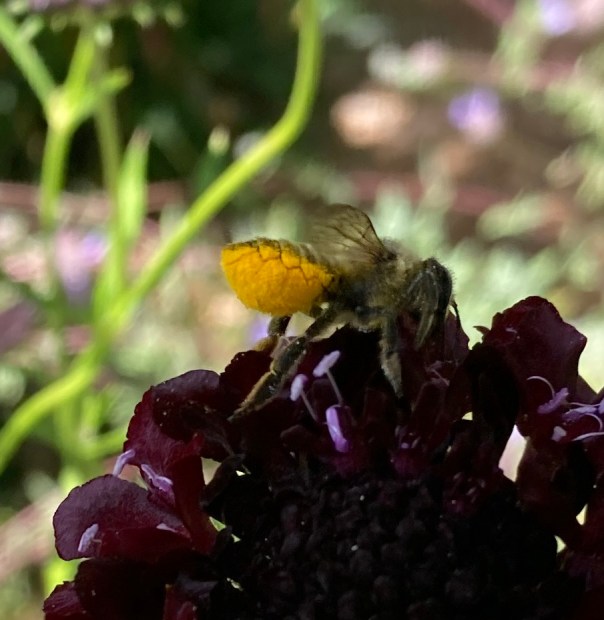
My hands were occupied, I couldn’t take pictures of them, and that was nice for a change. I did take pictures on other days so I am sharing those here. The two just above are from the front garden, where the pincushion flowers are a bit hit. Leafcutter is new to me. While she was buzzing around and I first caught glimpses of all that yellow, I thought maybe it was pollen. But no, it’s not on her legs, it’s her own body that’s so bright. [But YES, shoreacres explains in a comment below, while it’s not on her legs, it is indeed pollen!]
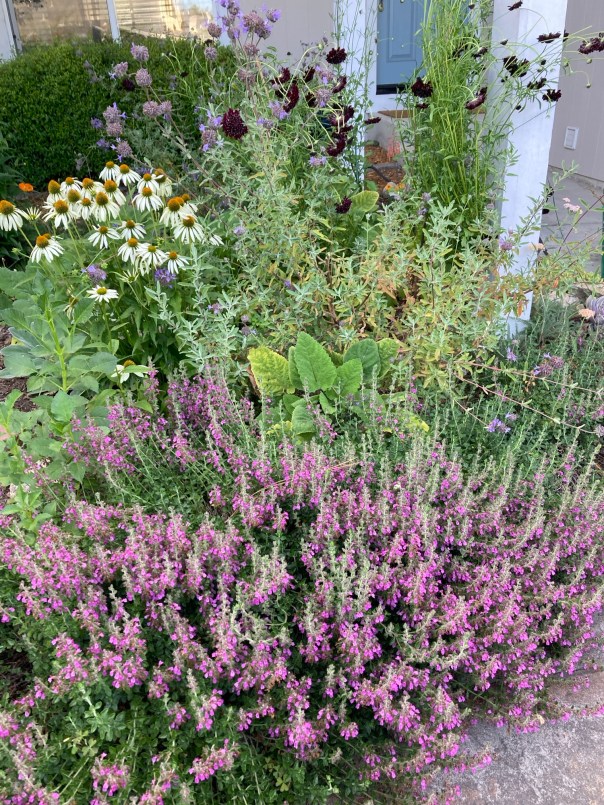
Yes, the pollinators love all these flowers, too: the white echinacea, germander, and salvia clevelandii. I took the picture above just after I propped up the pincushion flowers that grew to 6 feet, looking for the sun. I hadn’t realized that that area is now Part Shade, because of the crape myrtle. I’ll have to move the pincushions in the fall; it’s quite a jumble in there with the flowers in back shorter than the ones in front. I’m in no hurry to do it as long as the bees are so happy.
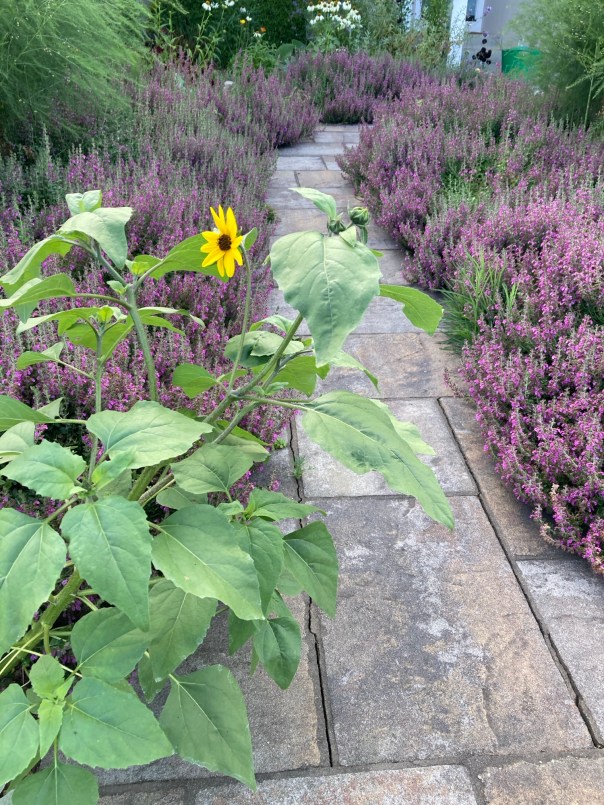
My first draft of this post was just the poem and painting below,
but then my own bees got added to Emily’s.
It’s all we have.

IT’S ALL I HAVE TO BRING TODAY

It’s all I have to bring today —
This, and my heart beside —
This, and my heart, and all the fields —
And all the meadows wide —
Be sure you count — should I forget
Some one the sum could tell —
This, and my heart, and all the Bees
Which in the Clover dwell.

-Emily Dickinson

Claude Monet, The Summer Poppy Field

Playing around his knees.

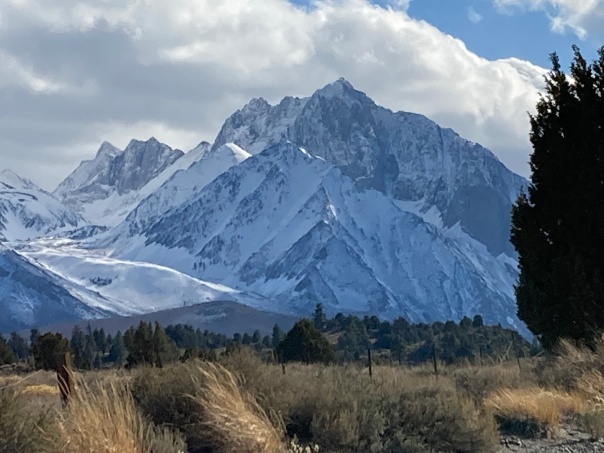
Eastern Sierra Nevada

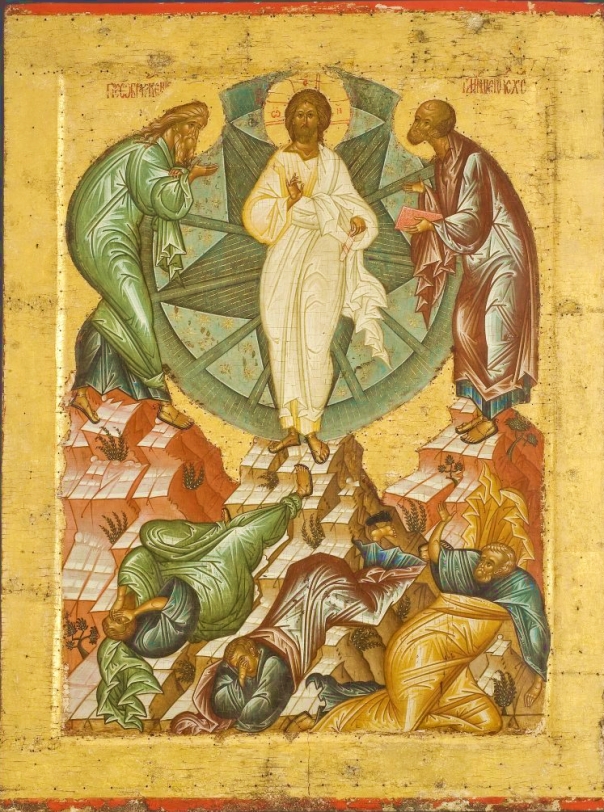
The poem below got me started thinking about mountains and their symbolism. I discovered a very long article on the subject, “The Transfiguration on Mount Tabor: The Symbolism of the Mountain,” which I don’t have time to read deeply, because as I type this draft, I’m in the midst of packing the car for five of us who will be in the mountains together by the time you read my post. I hope the article is not paywalled. It is a treatise on the subject going back millennia, opening with this from René Daumal:

“[The] summit touches the sphere of eternity, and its base branches out in manifold foothills into the world of mortals. It is the path by which humanity can raise itself to the divine and the divine reveals itself to humanity.”

The Transfiguration, Mount Tabor

The author examines traditions throughout the world, beginning in ancient times and concluding with thoughts on what The Mountain means for us Christians who are on a continuum with those 2,000 years ago. Here is one excerpt to help you know if you are interested in the subject from a scholarly perspective :

“In the traditional Hebrew and Christian understanding of the world, places are what they are by their teleology: it is not so much by the material or structural elements that they are recognized, but by their function. Things are what they are because of their purpose and their place in a web of relationships within reality which help create our own map of meanings. Therefore, it is very difficult to understand from a purely geographical (time-space) position where God dwells with regards to this or that mountain. For this reason, many physical mountains have been ‘the mountain of God’. There is only ‘one’, but it’s not confined to one geographical space-time location as we modern people understand it.”

I guess it’s obvious that I myself am interested, and I thought of printing this article to take with me to the high country, but I’m afraid I won’t have time to read it up there, either. My family and I will be too busy playing around our grandfather’s knees.

THE MOUNTAIN

The Mountain sat upon the Plain
In his tremendous Chair—
His observation omnifold,
His inquest, everywhere—

The Seasons played around his knees
Like Children round a sire—
Grandfather of the Days is He
Of Dawn, the Ancestor—

-Emily Dickinson

Sierra Nevada, Tioga Pass Road

Have You Got a Brook?

This poem seems fitting for the season of Lent, when we make a special effort to lay aside distractions and turn inward — to make a spiritual journey, drawing near to the place where, as Christ told us, “The Kingdom of God is within you.” May we find our brook to be the River of Life, of which He also speaks: “He who believes in Me, as the Scripture said, ‘From his innermost being will flow rivers of living water.'”

HAVE YOU GOT A BROOK IN YOUR LITTLE HEART?

Have you got a brook in your little heart,
Where bashful flowers blow,
And blushing birds go down to drink,
And shadows tremble so?

And nobody knows, so still it flows,
That any brook is there;
And yet your little draught of life
Is daily drunken there.

Then look out for the little brook in March,
When the rivers overflow,
And the snows come hurrying from the hills,
And the bridges often go.

And later, in August it may be,
When the meadows parching lie,
Beware, lest this little brook of life
Some burning noon go dry!

-Emily Dickinson