Monthly Archives: December 2024

Tea and stollen for the whirled.

Early this morning I waved good-bye to the last Christmas guests as they drove off toward home in Colorado. A few minutes later I was back in bed, and soon after that had fallen asleep while listening to Jonathan Pageau’s podcast on “Christmas: The Anchor of Reality.”

Now it’s afternoon, I just finished breakfast, and decided to try one of the new teas I received recently from Tea Runners. The grandchildren who just departed liked this one, called Winter Wonderland Rooibos. I added half and half, and served up a slice of the stollen Soldier gave me for Christmas.
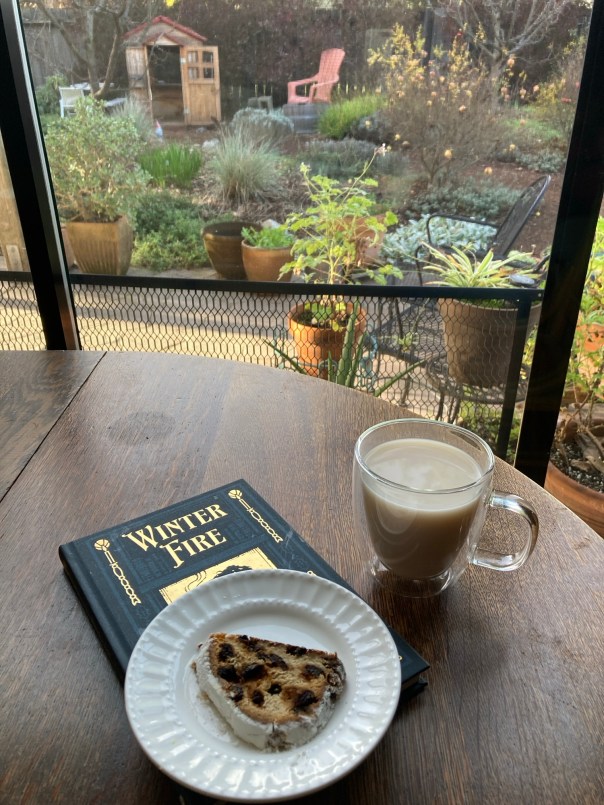
 

I was arranging my stack of Christmas books and realized that I have not read Winter Fire during either of the Christmas seasons since I got it; it is subtitled Christmas with G.K. Chesterton, and is compiled by Ryan Whitaker Smith. So I opened its pages and browsed a little, and remembered that it is arranged as somewhat of a 30-Day Advent collection. Yet for myself I think it will be a good read in the next few days, as winter has only begun here, and I could use more meditation on the Incarnation, as I process all the events large and small that have whirled around me of late.

There are so many things I want to write about, to highlight here, of our splendid Glad celebrations over the last ten days, but at this point my head is still spinning a bit too crazily, and my heart just wants to go to church, light a candle on St. Basil’s Day and The Circumcision of Christ, and give thanks for all that God has done.

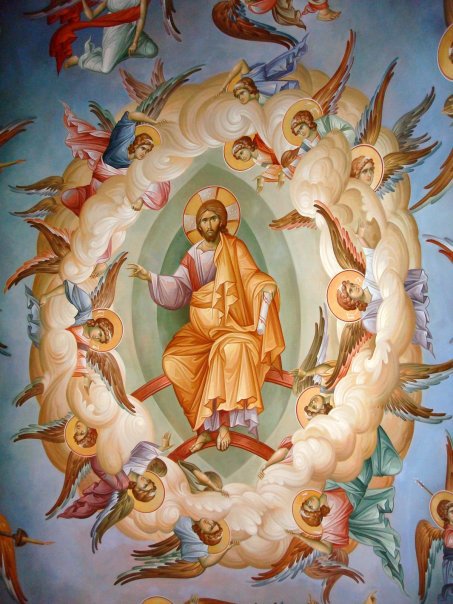
Gift from a friend at church.

Theophanies into which we may enter.

As we close in on the end of the calendar year, our rector posted thoughts about the liturgical calendar in our parish bulletin. We Orthodox know at some level that the calendar of festal events and saints’ days “sanctifies time” — but do we live it fully? It’s not an easy thing to prioritize the “holy appointments,” as Fr. Stephen Freeman recently characterized them, in our lives that are typically super busy with various other activities. An excerpt:

This feast, this day, this time in my life, if I will keep the appointment, I can meet God. The feasts on the calendar are not appointments with memorials, the recollection of events long past. They are invitations to present tense moments in the liturgical life of the world. In those moments there is an intersection of the present and the eternal. They are theophanies into which we may enter. The events in Christ’s ministry that are celebrated (to use one example) are of little importance if viewed in a merely historical manner. It is not enough to say and remember that Christ died. The Christian faith is that I must become a partaker of Christ’s death. Christ is Baptized, but I must be a partaker of His Baptism. This is true of all the feasts and is the reason for our liturgical celebrations. The Church is not a memorial society—it is the living presence of Christ in the world and the primary means by which we may share in His presence. There is no time like the present, for only in the present does time open its riches to us and bestow its gifts.

Becoming Christmas

It is a great blessing that some of my family are still here with me during Christmastide. This morning after breakfast, while I was listening from around the corner in the kitchen, my son “Soldier” taught his children a little Bible lesson, and I think he mentioned the passage that includes the words, “all things pertaining to life and godliness,” because when I read an article online just now, that line jumped out at  me, as being a theme of his message.

The article is “Keeping Christmas All the Year,” by Mark Dooley; here is the first paragraph:

“We have just celebrated the sacred feast of Christmas and are embarking upon yet another new year. But why talk about Christmas when, as many may remark, it is over and done with? This question reveals a profound misunderstanding about the nature and meaning of the birth of Christ. The fact is that we do not so much celebrate Christmas as become it. The wonder of this divine intervention in human history, is that the separation between man and God was bridged through the Incarnation of Christ. Not only were we reconciled with our Creator, but, through his “divine power,” we have been granted “all things that pertain to life and godliness.” Indeed, as the Apostle Peter writes, we have “become partakers of the divine nature, having escaped from the corruption that is in the world because of sinful desire.”

And Dooley continues to gather up many such uplifting passages from scripture, such as:

“Put simply, Christmas is neither day, a feast, nor a celebration—even if that is how the world perceives it. Rather, it is a transformation of life from “being alienated and hostile in mind, doing evil deeds,” to being “reconciled in his body of flesh by his death.”

Truly, this event of Christ’s birth, the Incarnation, empowers us to live an exalted life:

“Becoming Christmas means realising that we have died and been reborn in Christ. It is coming to terms with the revelation that ‘God is love, and whoever abides in love abides in God, and God abides in him.’ It is living in the knowledge, as St. John writes, that ‘as he is, so also are we in this world.'”

Understanding the Nativity Icon

Read the whole article here: “Keeping Christmas All the Year”

A merry chime from India.

CHRISTMAS

The sky is dark, the snow descends:
Ring, bells, ring out your merriest chime!
Jesus is born; the Virgin bends
Above him. Oh, the happy time!
No curtains bright-festooned are hung,
To shield the Infant from the cold;
The spider-webs alone are slung
Upon the rafters bare and old.
On fresh straw lies the little One,
Not in a palace, but a farm,
And kindly oxen breathe upon
His manger-bed to keep it warm.
White wreaths of snow the roofs attire,
And o’er them stars the blue adorn,
And hark! In white the angel-quire
Sings to the Shepherds, ‘Christ is born.’

-Toru Dutt (1856 – 1877) India