Here is another poem by Miriam Pederson. Though she refers to mothers, in my case it makes me think more of my grandmother.
One tradition I was fond of in the Presbyterian church of my childhood was tied to Mother’s Day, when every person in the congregation was noticed for having a mother, and given a rose to commemorate her. I am not certain about this, but I think it was a white rose if she had died, a red rose if she were living. It might have been the first time I as a child was made to feel equal in some way to the adults. We all had mothers, and my rose was no different from everyone else’s.
MOTHERS NEWLY GONE
Our mothers are leaving us. One by one they flutter through the door as if we had expected it, as if we had prepared for this good-bye. We can hardly follow their recipes. Their remedies for flu, for heartache, are somewhere in the cupboard; the names of relatives to be invited are mixed in with the old Green Stamps. How can we, their busy daughters, sew on patches to make things last? What are we to do with these old compacts, these letters, cards and cold creams? How will we behave without their disapproving frowns, their Listen, honey… their Oh, sweetheart! We’re standing up straight, we’re being kind, and we’ve sent off the thank-you notes, but they are minding other business beyond the blue, leaving us in middle age to sift through their precious lives for clues to who we are.
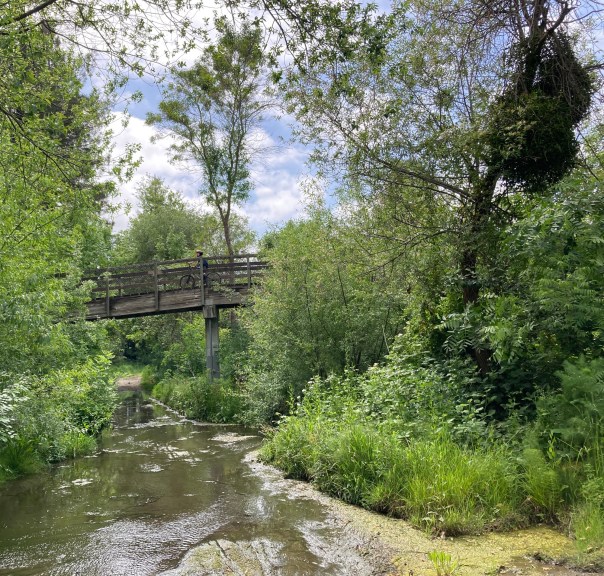
This evening I made it out for a walk, which turned into two walks, because of something new I saw on my usual route. I stopped at the bridge to look down at the seasonal creek that is getting low… and up at all the bushes and trees growing out of it. Every few years the city maintenance crew dredges out these waterways, but right now everything is growing lush and thick.
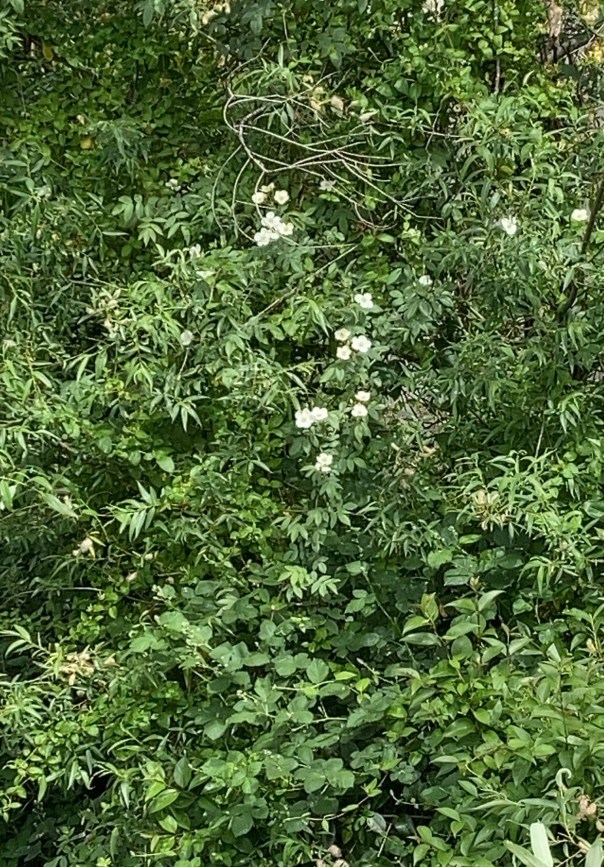
The willows are the tallest plant that grows down there, and buckeyes are numerous. What was that I saw climbing up in the tallest willow bushes? White flowers… if I only had a better camera, or even binoculars… I pointed my Seek app at the flowers and it said Lady Banks’ Rose. Even as poorly as I could make them out, that didn’t seem right.
The roses were growing in the area in the middle of the creek bed, between two creeks right where they join to become one. I thought I would try to go down closer to the water where there is a jumble of unpaved dry-season paths that some people run on with their dogs, and a few children explore. Also there is a sloping cement driveway of sorts for the maintenance vehicles, that is submerged in the winter. Two paved creekside paths also meet at the bridge. But when I got to the place where I would cross the southern stream to get to that middle area, the rocks were covered with algae, and it all seemed too muddy and messy for me to attempt while wearing my new boots.
So I came home and looked up Lady Banks Roses. They did not at all resemble what I’d seen; I guess they were too distant for Seek to make out. The bright idea occurred to me: Why not change into my old boots that I was thinking of giving away, and go back? Why not, indeed?
lemon balm
When I arrived at the crossing place again I had to squish through the mud and the algae, but with only a few steps I was over, and my old boots were mostly waterproofed and barely noticed.
watercress
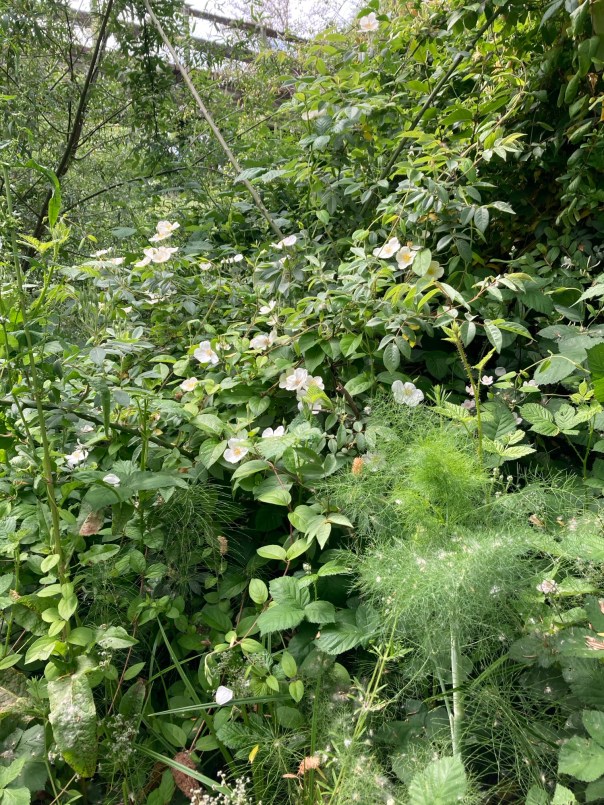
My, what a lot of plants in that mid-creek jungle! Once before I walked down there, but it was in September when everything starts drying up. The roses today were growing in the middle of the willows, honeysuckle, horsetail grass, fennel and bedstraw.
Watercress, Greater Plantain, and Bermuda Grass
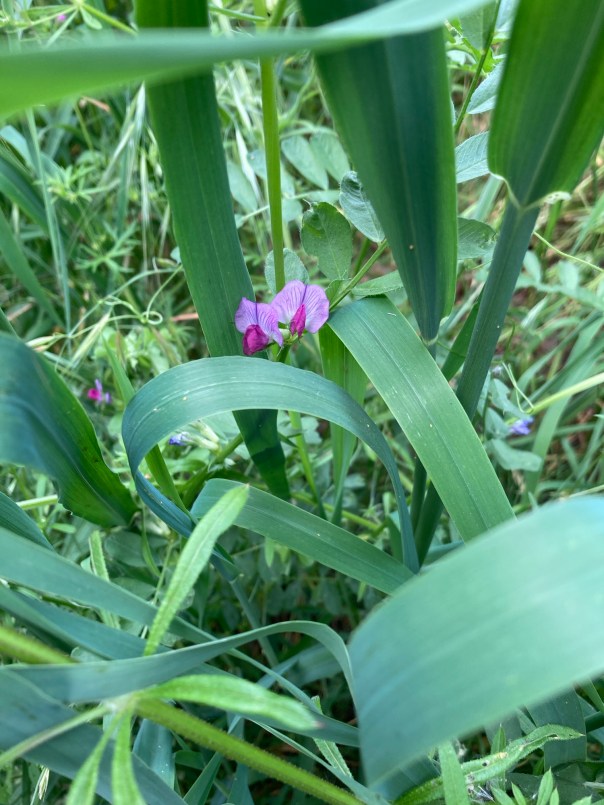
Many of the plants are naturalized from backyard escapees. The Bermuda grass for sure, and the lemon balm, and the roses. Wild blackberry brambles snagged my clothes and grabbed at my hair, but I managed to feel my way with my feet along the edge of the creek that was hidden by bullrushes, right up close to the flowers I wanted to see better.
When Seek could assess the image better it identified it as Rosa multiflora or Rosa polyantha, a native of eastern Asia. It also told me I’d observed it two years ago near my daughter Pippin’s place in the farther north part of the state. These roses were to me the prettiest thing in all that jungle.
It really made my day to make this little excursion and discover who they were, and to meet as well many of their companions in the creek. I think I’ll hold on to my old boots.
To be held this way in our mother’s arms, to be nestled deep in the warmth of her body, her gaze, to be adored, to overwhelm her with our sweetness. This is what we seek in chocolate, in the food and drink and drugs that stun the senses, that fill the veins with the rich cream of well being. What we take for lust—can it be, perhaps, a heavy pang of longing to be swaddled, close, close to the heartbeat of our mother? No bucket seats, Jacuzzi, or even a lover’s embrace can duplicate this luxuriance, this centered place on the roiling planet.
When the old woman, small and light, can be carried in the arms of her son, he, at first, holds her tentatively, a foreign doll, but gradually, as the pool loses its ripples, he sees his face in hers and draws her to him, rocking to the rhythm of her breathing. This is the way to enter and leave the world.
After church on Sunday I had twelve friends over for a little party. Half of them were children under ten, and all of those had been in my house before; they fell to right away playing with my dress-up clothes, dolls, and matchbox cars. At one point the squirming baby let me remove her to the armchair in the play area where we read a couple of stories together, so that in the other room her mother might drink tea with both hands.
dwarf pomegranate and helianthemum
The weather had warmed up just enough between Saturday and Sunday to make it pleasant for eating outside, and for the children to enjoy organizing the playhouse. I had spent more time cleaning that little hut in preparation than I did the real house — but I still have not sewn new curtains for its window, in these ten years since it became mine.
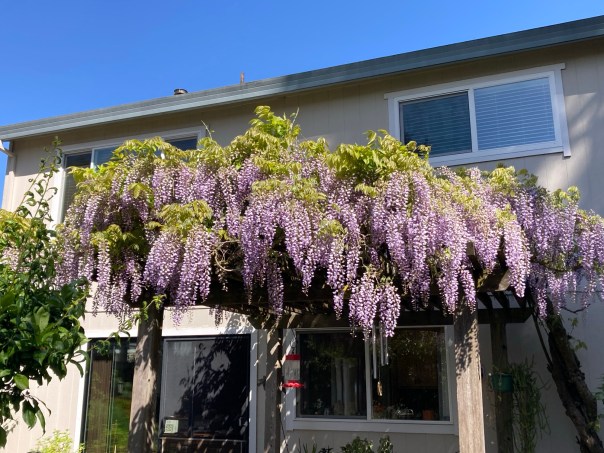
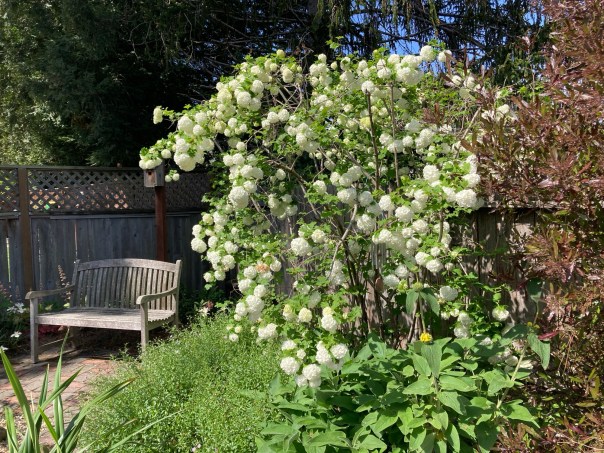
May is in many ways the perfect month for a garden party, because of the variety of blooms — and what a joy to have other people soaking up the beauty with me. This spring, since I “lifted the skirt” on the pomegranates, the orange helianthemums are bursting with more flowers than ever before; the wisteria is in its prime, and the bees are buzzing all over it. The snowballs on the viburnum are at their best. And we have the possibility of temperate and sunny afternoons. I always think it should be easy to host more such gatherings, but just finding a date that works for everyone takes a lot of effort; in this case I’d begun that process seven weeks ahead.
snowball bush
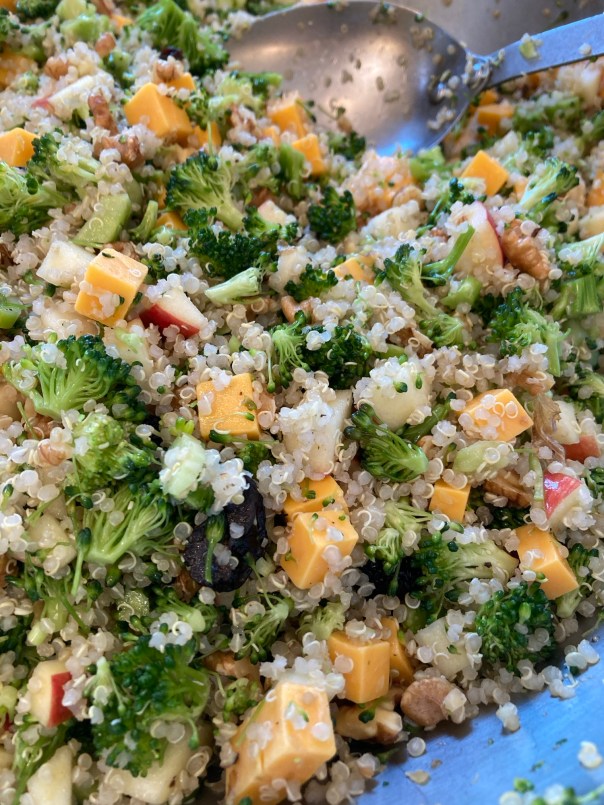
I’d started planning the menu, too — it needed to be items that wouldn’t need fussing over that day. One thing I made the evening before was this favorite quinoa salad that is tweakable to what one has on hand, which I found on the New York Times cooking site. I am unlocking the recipe for you, and you can access it through the link: Quinoa and Broccoli Spoon Salad.
A warning about the quantity of salad that came from one of the cooks who joked about it supposedly serving 4-6: “…it serves 4 to 6 distance swimmers during an Olympic training camp.” I used two cups of quinoa and ended up with plenty left over for my guests to take home plus more than I can eat staying here. I don’t like mustard so I left that out, and I used dried California cherries instead of cranberries, toasted walnuts instead of pecans. I like these NYT recipes because the cooks who try them share things they learned when making them according to the original instructions, or after they alter various ingredients or procedures.
figs in the fall
Few people like raw broccoli, but as I have learned and other cooks testified, the dressing in this dish quickly marinates the small pieces of broccoli and removes the unpleasant rawness, while retaining a little crispness.
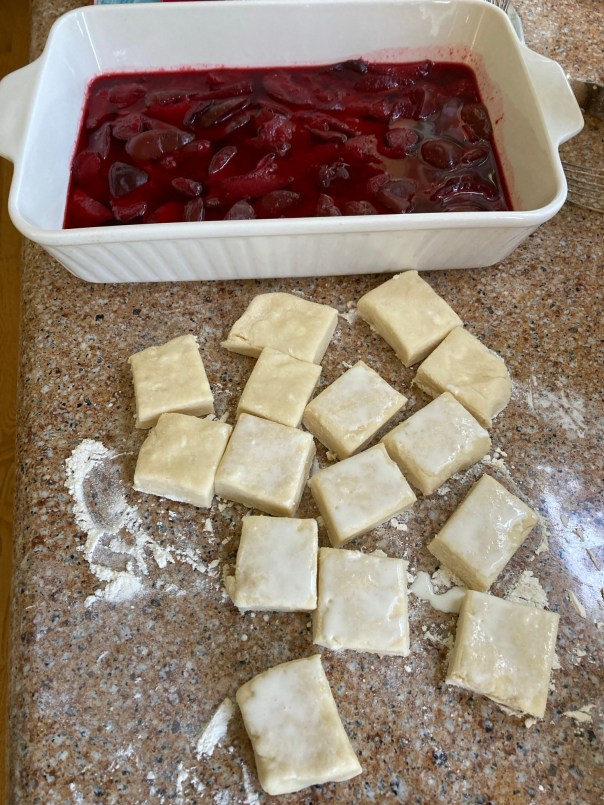
In an effort to use up foods from my freezer and pantry, I made one dessert using plums from my trees that I’d put by last summer, and another dessert using figs that I had tried freezing raw for the first time. Both worked well and were heartily eaten. Plum and Cream Scone Cobbler from Smitten Kitchen I’ve made before with peaches, but this time I had enough plums to use them.
It was delicious, but I will change some things if I make it again. The scones that make the cobbler topping are just too rich, with a whole stick of butter and a cup of cream in the dough. At least, they are too rich combined with the amount of fruit called for. Maybe I would decrease the butter by half next time, and use at least 50% more fruit. (Ha! I see that last time I made it I told myself to make those very changes next time, and forgot.) I also seem to have cut my scones too large…
My guests and I didn’t only talk about books over the course of our leisurely afternoon, but many book titles popped up in our conversation, more than I even know about. A few that I can recall just from our last hour together were: The Ethics of Beauty;St. Ephrem the Syrian: Hymns On Paradise; The Hidden Rainbow; Christ the Conqueror of Hell; The Little Liar; and Orthodoxy and the Religion of the Future.
At one point I ran upstairs to get this book to show the others, my latest deep read. They all had a good laugh with me. It’s not just goofy, but is actually a very thought-provoking book! Maybe I will tell about here it sometime: How to Talk About Books You Haven’t Read. I do a lot of that already, but I’m sure there’s room for improving my skills.
Usually when children play in the playhouse, they like to prepare salads or other halfway-pretend dishes made of all the edibles I give them permission to pick from the garden, including flowers as well as vegetables.
collard flowers
I meant to point my younger guests to my exuberantly flowering kale, parsley and who-knows-what in the planter boxes I am not cultivating right now, but I never got around to it. After everyone had gone home I checked out the back garden to see if there was the sort of happy mess I’m used to in and around the playhouse. There was no evidence that anyone had done any “cooking,” but rather a lot of setting in order, with the dish soap by the sink and a lavish bouquet completing the scene. It was symbolic of all that I had received from my guests who gave me an afternoon in spring.









 My guests and I didn’t only talk about books over the course of our leisurely afternoon, but many book titles popped up in our conversation, more than I even know about. A few that I can recall just from our last hour together were: The Ethics of Beauty; St. Ephrem the Syrian: Hymns On Paradise; The Hidden Rainbow; Christ the Conqueror of Hell; The Little Liar; and Orthodoxy and the Religion of the Future.


 Gladsome Lights