My front garden had turned into a jungle by the time I returned after nearly three weeks away; I expected that, but didn’t anticipate all of the species that would get tangled together. Some of them, like the nigella and poppies, were way past their prime and I could simply pull them out.

There was a certain weed that had flourished under the asparagus fronds and was climbing by means of its yard-long stems up behind and over the germander, which is just starting to bloom. It also was growing in the cracks in the walkway. I knew I had seen it before somewhere, but never in this quantity, so I looked it up: Black Medick. I pulled at least most of it out, and added that to the green bin.
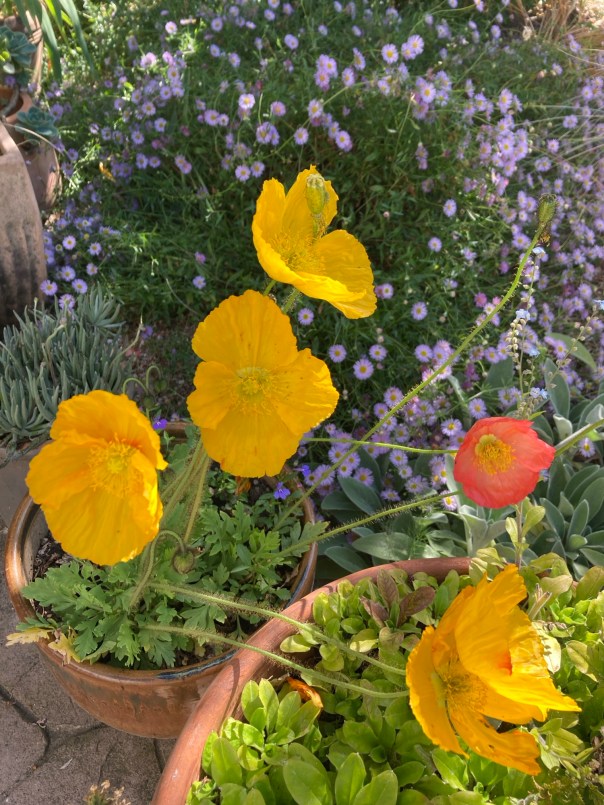
I bought cosmos and some shorter flowers to replace all the things that I removed; and a few basil, summer squash and zinnia plants to put in the planter boxes. Because spring was cool here, the Iceland poppies are still blooming, and welcomed me home.
The Showy Milkweed is blooming and the bees are on it.

In Greece, in addition to the live, rustic and thorny version of acanthus I’d seen on Paros, I saw plenty of carved acanthus leaf designs in the ancient Byzantine architecture in Thessaloniki. I came home to see my own plants looking more majestic than ever.


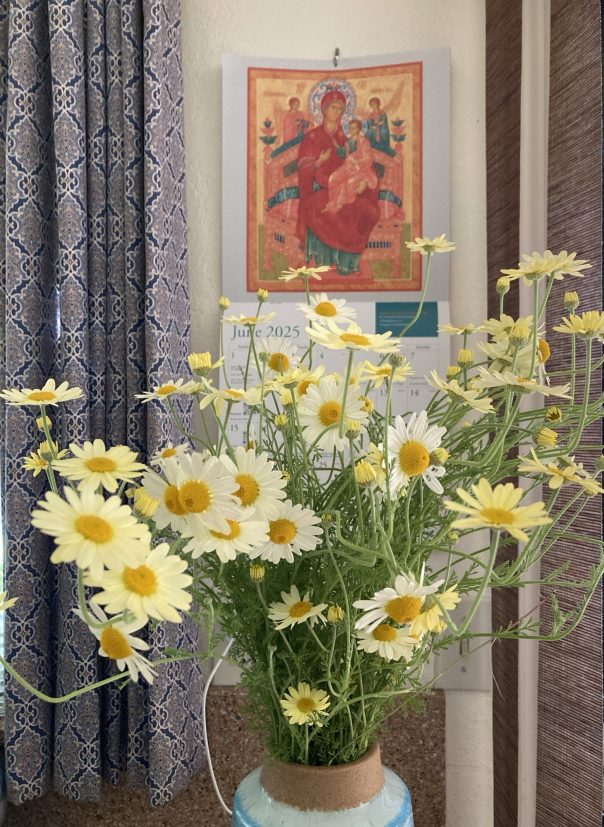
The lavender has come out, and the Mock Orange, and the little campanula that hides under the Mock Orange. The Golden Marguerite that I’d pulled out of the front garden last year — it returned, and was aggressively invading my new landscape, so I cut it back, and stuck the clippings in a vase. After all that, and a few days recovery from jet lag, I’m beginning to feel myself again ❤
 Gladsome Lights
I enjoy seeing the plants in your garden! Welcome home … enjoy the memories of your trip washing over you during quiet moments too.
LikeLiked by 1 person
What a wonderful welcome home.
LikeLiked by 1 person
I should think one of the better things about returning home after a lovely trip would be making friends with your garden again. I’m sure it missed you!
LikeLiked by 1 person
Three weeks can make such a difference in the garden both in flowers and, unfortunately, also weeds. It sounds like you’re getting those weeds and over-enthusiastic flowers under control. At this moment I’m boiling water to go and scald weeds that grow in cracks between pavers ( garden path). It’s the best way I find.
LikeLiked by 1 person
Welcome home. Hope by now your body has adapted back to home. Jet lag is hard. Your plants look happy. Enjoy the last few days of Spring.
LikeLiked by 1 person
I so enjoyed your travelogue that was so personable with your attention to plants and conversations with your daughter and the foods you ate and sights that caught your eye. It was just lovely. Glad you are home and being welcomed by your plants, yes, even the departing ones.
I love the vibrancy of iceland poppies, but they seem pretty short lived in our much hotter climate. It’s been a banner year in my neighborhood for monarch caterpillars — hope some will find your welcoming milkweed.
LikeLiked by 1 person
I laughed to see that black medick. I tend to shy away from calling plants ‘weeds,’ but that’s a flat-out weed. It’s quite common around here, and it can run rampant. I’ve pulled it a time or two myself. Your milkweed’s beautiful; I’ve never seen that one. And I really like the Golden Marguerite. The color is beautiful against the stems and the leaves.
LikeLiked by 1 person
I thought of you when I was pulling it out, and when I typed “weed” into my post, and I thought the very same thing, that it is unquestionably a weed with no redeeming value… Except, the first time I saw it, its seeds fascinated me. That was a few years ago, my first encounter with it, only one stem’s worth. And just now, looking for a picture of those seeds, which, thank goodness, had not set on the plants I yanked out yesterday, I read:
“The seeds of black medick (Medicago lupulina) are used as a cover crop and are known for their ability to fix nitrogen and suppress weeds. They are often sown amongst brassica crops and can thrive on thin calcareous soils. Black medick seeds should be sown in autumn, either outside where they are to flower or in seed trays and covered lightly with compost. These seeds are easy to germinate, and the seedlings grow quickly.”
They are known for their ability to suppress weeds??? I’d rather cultivate a different weed that might suppress these!
LikeLiked by 1 person
I just pulled out that black medick from my garden too but I didn’t know that’s what they’re called until you mentioned it.
LikeLiked by 1 person