On this day ten years ago I did not post anything about St. Nicholas, whose feast day it was and is. Just now I was checking back through the years to find out what I’ve already said about the God-loving man who is so dear to people all over the world, when I discovered this post from ten years ago, at the time my new garden was pretty much installed (the back part of the property). If I didn’t have pictures like the one below, I would not believe how fast a garden can happen. The fountain shown did not remain long, because it exfoliated in its first winter and was returned to the nursery where I’d bought it.

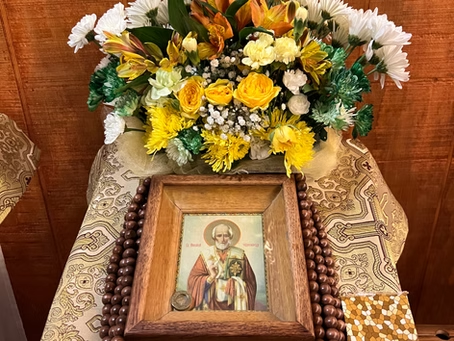
The most enjoyable posts here over the years on St. Nicholas Day seem to me these two: One when I traveled to a parish of which he is the patron saint, and one in which I have a lovely icon and the quote from Fr. Thomas Hopko in honor of him. So if you’d like to read about St. Nicholas or his feast you can click on those links. One of the posts includes this photo:

2025 is another year in which I won’t be celebrating with our sister parish on their feast day, because I am not completely well from a cold that knocked me down a bit, and I’m catching up on rest and everything else that didn’t happen for a few days. But it doesn’t feel right to let the day pass without joining in the commemoration at some level.
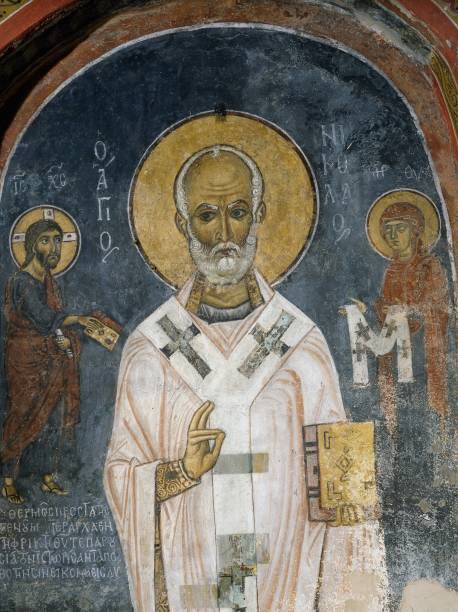
I’m sure that after Divine Liturgy for the feast, everyone at St. Nicholas parish will be singing this song at their festal meal. It is playing in my mind right now:
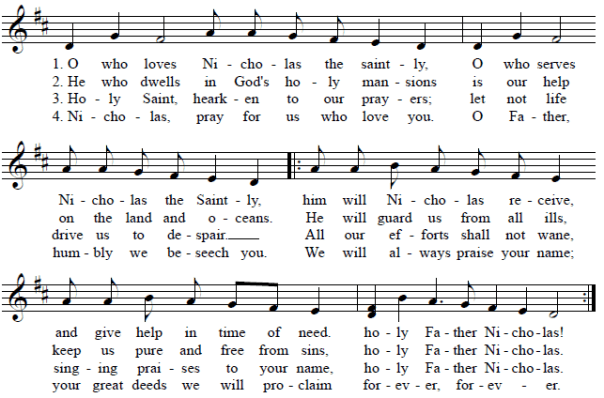
Though they are singing in a different language, Old Church Slavonic or Russian, I like the rendition of these men the best: “O Who Loves Nicholas the Saintly.”
I pray that the joy of St. Nicholas reaches you wherever you are.
 Gladsome Lights
A lovely post, and a nice counterpoint to the commercialized Santas all around just now. I was curious about your comment that “The fountain shown did not remain long, because it exfoliated in its first winter and was returned to the nursery where I’d bought it.” I knew it didn’t have leaves, but I’d never heard ‘exfoliate’ used in that way. The dictionary expanded my knowledge, and reminded me that ‘exfoliation’ also is used to promote various skin products!
LikeLiked by 1 person
Haha – it was also my first experience of the word used that way! I was dismayed to discover that the finish had layers that could peel off. The replacement fountain that endures is not painted but stained, which is much better.
LikeLiked by 1 person
Sorry to read you are ‘under the weather’ and I do hope you will be tip top soon! The language and the singing on that link sounds very familiar to me. Brings back memories of Russian church growing up.
LikeLiked by 1 person
Thank you, Ellen. Memories of Christmases past are such a big part of celebrating the season. I was just asking my hairdresser yesterday what Christmas was like for her growing up, and she had very heartfelt stories about moving from Mexico when she was five and the big change in Christmas traditions. We’re blessed to be in families where these memories, whether sweet or difficult, are born and shared.
LikeLike
I’m so sorry you are dealing with a terrible cold and I hope it is short-lived. I think you found a perfect way to celebrate this day, even without being with others. I do love the icons and that photo is lovely.
LikeLiked by 1 person
happy St Nicholas Day!
LikeLiked by 1 person
Happy feast to you!
LikeLike
thank you 🥰
LikeLiked by 1 person
Gosh, I hope you’ll be feeling better soon. Thanks for sharing the information and the song sheet. Happy St. Nicholas Day!
LikeLiked by 1 person
Thank you, Beth!
LikeLike
Hi.. I loved the story of St Nickolas and the song…. being from German people I looked up the German story of St Nick.. it is good too… thank you for your , always, wonderful love and sharings. Praying you are feeling well again … at least to bake those Christmas cookies you bake.. mmm love Merri and us in Minnesota. In Germany, Saint Nicholas Day is celebrated on December 6th, and on the night before (December 5th), children clean their shoes and place them outside their doors. The tradition involves St. Nicholas (Nikolaus) filling the shoes with treats like nuts, fruits, and chocolate for good behavior, while less well-behaved children may find a switch or stick, often with the help of companions like Knecht Ruprecht or Krampus. In some regions, a single boot is used, while in others, a plate or whole boot is left out.
You can watch this video to learn more about the German tradition of St. Nicholas Day:
33s
Mommy Hedz
YouTube · Dec 6, 2020
Key traditions
This video explains the role of Krampus in the German tradition:
LikeLike
I hope you regain your good health very soon.
I love that picture with the light streaming in!
LikeLiked by 1 person
Thank you, GM, I think it’s back 🙂
LikeLike