Orthodox Christian, widowed in 2015; mother, grandmother. Love to read, garden, cook, write letters and a hundred other home-making activities.
View all posts by GretchenJoanna →
At Vespers last night, the lighting was unusual, in that electric lights had been turned on in the dome; typically we do without those, and in the winter it means that we see the icon of the Pantocrator only dimly. Because the amount of light, and the angle at which it enters through the cathedral windows, is always in flux, every service at every time of day is differently illumined — but the effect is always sublime.
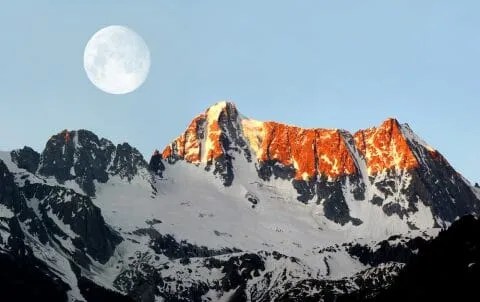
Over the last two days, at church and on my neighborhood path, I was warmed by the beauty of physical lights, not separate from their symbolic role: They represent and mysteriously convey the presence of Christ Who is, as the Evangelist said, “The true Light, which lighteth every man that cometh into the world.”
Today was the Leavetaking of Theophany, and I was the chanter of the Third and Sixth Hour prayers before the service. On Sundays we always have hymns of the Resurrection, and usually hymns of that Sunday’s feast or saints as well. It was the Kontakion of Theophany that got my attention this morning:
On this day Thou hast appeared unto the whole world, And Thy light, O Sovereign Lord, is signed on us who sing Thy praise, and chant with knowledge: Thou hast now come, Thou hast appeared, O Light Unapproachable.
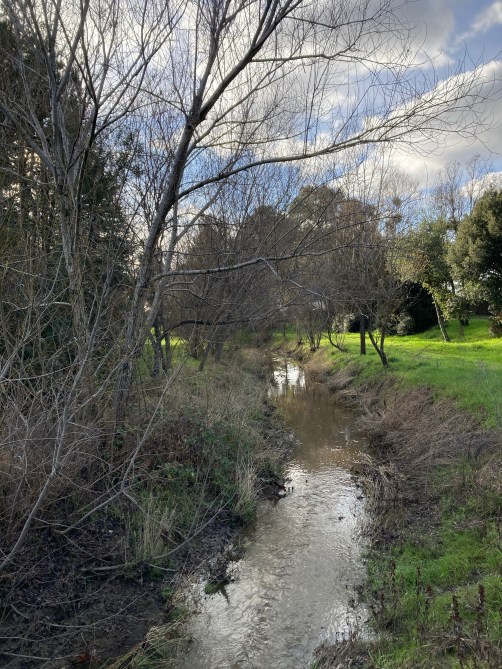
As soon as I returned after church, I (shock!!!) changed my clothes and went for a walk. We had been surprised by the sun coming out in the afternoon, so it was delightful out there. Even though the creek was muddy from rain, the light shining on it made it lovely.
And I practiced Psalm 89 some more. Reading the same lines and stanzas over and over, thinking of links to help me transition from one thought to another, has been the most rewarding kind of meditation; the theology and the poetry fill my heart, certainly in much the same way as one line states:
We were filled in the morning with Thy mercy, O Lord, And we rejoiced and were glad.
But this line is in the latter half of the psalm, when the mood has turned upward. A few stanzas before, the psalmist is considering how in the evening man “shall fall and grow withered and dry.” “We have fainted away,”“our days are faded away… our years like a spider have spun out their tale,” and “Return, O Lord, how long?”
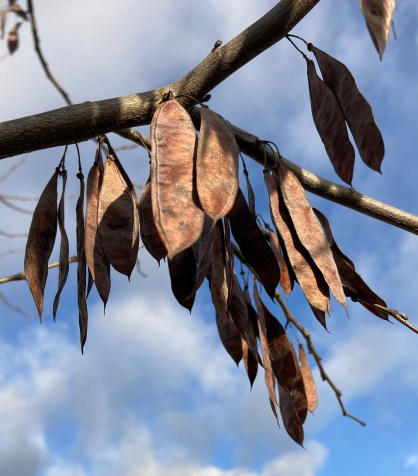
Withered and dry, but still handsome.
I have looked at two other translations of the Psalm, one of them a different version of the Septuagint, and compared with the one I am using (see sidebar note), to me they both are clunky and harder to read, though they do have many of the same vivid images that help me to learn this poem.
I stopped a couple of times on my walk to sit on a bench and think about these things. And when I got home again I looked at the notes in the Orthodox Study Bible, which points out that this is “a morning prayer designed to keep one focused on the Lord rather than on this temporal life and its hopelessness. For He exists outside time, and is therefore our only refuge…. It is read daily at the First Hour.”
There are many references to morning and evening, days and years, and our lifespan being “in the light of Thy countenance.” But one reason I have wanted to learn the whole prayer poem is the last verse, whose first line brings me back to “Thy light is signed on us” in the hymn we read and sang this morning:
And let the brightness of the Lord our God be upon us, and the works of our hands do Thou guide aright upon us, Yea, the work of our hands do Thou guide aright.
Last night the women’s book group of my parish met at my house to discuss Summer Lightning by Wodehouse, and The Holy Angels by Mother Alexandra. I cooked up two pots of soup, and the other women brought rustic loaves of bread and salad and dessert.
Long ago I had got the idea of Cuban Black Beans from the Laurel’s Kitchen cookbook, and devised a soup with the same name to eat in winter, when the fresh and raw veggies the book’s authors suggested for a topping weren’t available from the garden out back. Now in the era of internet recipes, I discovered several recipes for the soup, and they used a sofrito, added in the last stage of cooking, made up of the peppers, garlic and onion sauteed with olive oil and bacon, topped off with vinegar and spices. This is what my sofrito looked like:
The beans in this case are cooked with ham hocks at the beginning, so it ends up a meaty and flavorful bowl for a winter’s evening. Mine was just the amount of spicy I wanted, but I’m not sure I could replicate that next time, if there is a next time. I had printed out three recipes from online, and concocted a unique stew, using parts of all of them and my old recipe, too. It took two pounds of beans, and I had plenty to send home with a few guests, as well as to put in the freezer. Because we also had Florentine Spinach Soup, which I have posted about before. Overall the women liked the soups very much.
Thanks to our member who enjoys coming up with appropriately themed foods for our meetings, we ate angel food cake last night as well! I hadn’t read the Jeeves book that was discussed, but I did read The Holy Angels, and I plan to share a bit about that soon. We all thought it was a treasure.
This morning I actually took my walk before breakfast — that mostly because I ate breakfast so late. Now that I’m putting a high priority on walking, I need to keep re-setting it at the top of my mental list, so I don’t forget. One of these days I’m sure I will forget, and then (note to self) I’ll need to take a quick spin around the block in the dark, just before bed. I wonder if this is one of those behaviors that becomes a habit if you do it every day for three weeks?
I worked some more on Psalm 89 as I walked, and the beauty of its poetry did not distract me from the startling sights along the way, whose images I have shared here. One line from the Psalm:
So make Thy right hand known to me, And to them that in their heart Are instructed in wisdom.
“…winter is an abstract season: it is low on colors, even in Italy, and big on the imperatives of cold and brief daylight. These things train your eye on the outside with an intensity greater than that of the electric bulb availing you of your own features in the evening. If this season doesn’t necessarily quell your nerves, it still subordinates them to your instincts; beauty at low temperatures is beauty.”




 Last night the women’s book group of my parish met at my house to discuss Summer Lightning by Wodehouse, and The Holy Angels by Mother Alexandra. I cooked up two pots of soup, and the other women brought rustic loaves of bread and salad and dessert.
 Thanks to our member who enjoys coming up with appropriately themed foods for our meetings, we ate angel food cake last night as well! I hadn’t read the Jeeves book that was discussed, but I did read The Holy Angels, and I plan to share a bit about that soon. We all thought it was a treasure.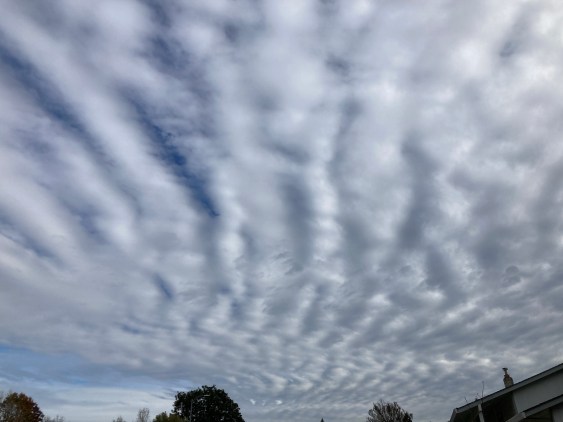
 Gladsome Lights