“In all nations, storms are gathering; minds are confused. May God save this poor world of ours that is blowing steam like a pressure cooker! Look at those in power! The schemes they come up with! They throw it all into a pressure cooker and leave it, boiling and boiling; the cooker is whistling now! The steam valve is ready to explode!”
“We have not yet realised that the devil has set out to destroy God’s creation and all His creatures. He has put together an alliance to destroy the world… He has become even more vicious now because he knows that he has but a short time. (cf. Revelation 12:12.) He resembles a criminal, who, when surrounded, thinks to himself, ‘There is no way out ; they will get me,’ and he starts destroying everything around him. Or, he is like soldiers at war who, having run out of ammunition, draw their bayonets or swords and start slashing away at everything because they have nothing to lose. They say, ‘We are going to die anyway; let’s get as many of the enemy as we can.'”
“Wherever one turns, one thing is clear: things are falling apart! It’s not, for example, that we have a house, and we need to fix a window or something else. No, here it is an entire house that is in shambles — worse yet, the entire village. Things are spinning out of control. Only God can step in and stop it…. The world has an inflamed wound, full of pus, that needs to be opened and treated. But it’s too soon to open it now; evil must first run its course as it did back in Jericho (cf. Joshua 6.), a long time ago.”
-St. Paisios of Mt. Athos, 1924-1994
From With Pain and love for Contemporary Man
 “Revolutionaries are always in the wrong, since, in their juvenile fervor for everything new, in their hopes for a better future, and a way of life built on justice, they always base themselves on theories that are abstract and artificial, making a clean sweep of living tradition which is, after all, founded on the experience of centuries.
 r theory (understood in the true sense of the word, namely ‘vision’) is based on a constant experience of Truth. Which is why she is in possession of those infinite resource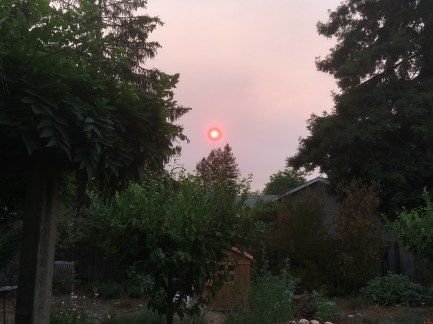

 Currently the only direct effect on me seems silly to mention. Smoke drifts through from nearby fires; I keep checking the AirVisual app to see if I am in the “Good” green range, or if the Air Quality Index has jumped past “Moderate” to “Unhealthy.” Daughter Pippin is not close to a fire, but has been suffering from unremitting high smoke levels for days and is on her way to Oregon in hopes of being able to breathe at least a little better up there.
 midday, I open the windows to cool off the house; most homes around here don’t have AC. So far we’ve had a Green period once or twice a day, and the recent heat wave has ended, so all is tolerable. But I did just order air purifiers, so that if evacuees need to come here, it will be a reliable refuge from smoke as well as danger.