That wonky redwood is the “Dr Sues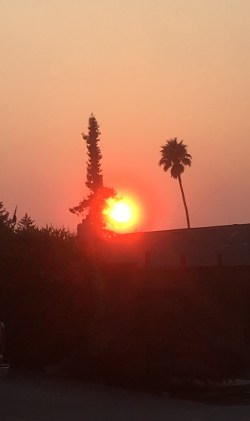 s Tree” as we call it, on the other side of my backyard fence, that towers above my garden from my neighbor’s place. I took the picture from down the street, quickly before the sun set.
We are seeing the setting sun through smoke. It’s been like this since last Thursday, when shortly after wildfires began to destroy the town of Paradise in Butte County, ashes and cinders from that destruction floated three hundred miles to the south, here and beyond here, at least to San Jose. Students and teachers in our schools are on the fifth day of their weekend, what with Veteran’s Day and smoke days.
It’s gloomy. My friend Myriah may have lost her house, though she was mercifully stuck in Texas when the chaos began. Or, her house might still stand, one of the few that weren’t destroyed by the blazes. The prospect of being a householder on an outpost in the middle of a burned-out town, “in the middle of an ash heap,” as Myriah puts it, is bleak. Whatever the condition of her house, her home is gone.
Lately in Liturgy the litany has included prayers for those suffering as a result of shootings, and this week “fires” was added to the phrase, along with the extra remembrance of soldiers slain in wars. Our parish was also commemorating the repose of a beloved priest, and we met at the cemetery Sunday afternoon for a prayer service in his memory. Several parishioners wore masks against the bad air.
It was a sweet gathering and memorial, for a man who was in many ways the heart of our parish — and still is. After the prayers and hymns and aromatic censing of the graves, we sang “Memory Eternal,” and the service ended. A little table had been set up on the grass next to the grave, with a candle and a icon on it, and our priest poured the melted wax from the candle on to the grave marker in the shape of a cross. Then he emptied the charcoal from his censer and remaining bits of incense on top of that.
A couple of the children crouched down to ask what he was doing, and I didn’t hear his answer, but I did hear him say, “I need to you blow on that, gently.” He wanted the incense to go on smoking for a while, so the kids got to provide the supporting wind.
A lawsuit has been filed against the utility company that supplies electricity to Butte County, claiming negligence on their part; it may have been sparks from their wires that started the fires. They had previously talked about the possibility of shutting off power to several counties because of extreme fire danger, and wanting to avoid all possibility of sparks or downed power lines instigating a disaster. I can see how they would at the same time like to avoid depriving their customers of what is a means of life support for many, especially in that mountain community where many retired people are now missing the comfort of winter coats that are turned to ashes.
I have no thesis around which to organize my ramblings, only sightings and impressions and feelings. Myriah is collecting clothing and supplies that match the actual needs of specific people in her hometown, and she will stop by here to get a few things on her way there. That is the most concrete and encouraging thing I have to write today; as was the case last year when the inferno was right here, the stories of sacrifice and true community are heartening.
One friend at church wrote on a chalkboard by his front door, “The love in the air is thicker than the smoke, and depression is a close second.”

 reason not to indulge myself. When in this state of mind that demands, “Slow down, quiet yourself,” I also think of reading poems. And I wondered, Is there a good poem around, about bread?
 It is said by some that God has no boundaries regarding us, that He is God and may do with us (and to us) whatever He wills. This, of course, is true in an abstract sense. However, it is not true of God as He has made Himself known in Christ. Christ is a God who “asks.” He is the God who allows a freedom so great that it can kill Him.