
When 10-15 years ago a friend mentioned that she was making Thai stir-fry for dinner, I was immediately very interested and asked her how she did that. It’s more of a stew, actually, she said, and gave me a list of the ingredients and how she puts it together. Since then I have experimented a lot with her basic recipe, but let’s start with those simple fundamentals. Here is what she wrote:
A Thai curry is not exactly a stir-fry, but more like a stew. For a good beef curry, I would cube some chuck or whatever, add a can of green chiles, a chopped onion, some chopped garlic, some chopped cilantro, 1/4 cup of fish sauce, a Tbsp or two of sugar, and a can of coconut milk.
 Stew it all together about an hour. For a much hotter sauce, you can use a Tbsp. or two of canned red curry paste. But I can’t stand the heat. For chicken, I would do basically the same thing, but use canned green curry paste. For a mild paste, put the chiles, onion, garlic and cilantro in the blender with a bit of water, and add that to the coconut milk and chicken. Don’t forget the fish sauce…it’s the salt.
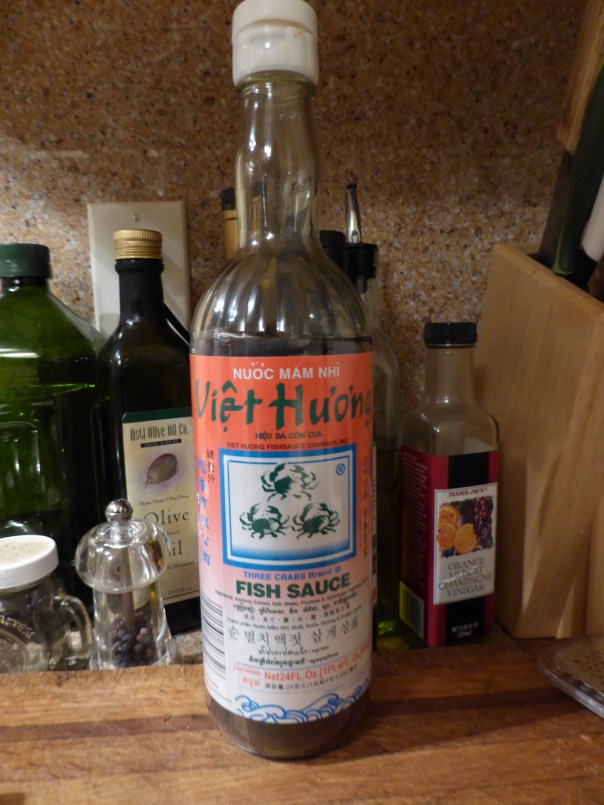
That was when bought my first fish sauce. Now I always enjoy looking at the many brands in the store I go to. This photo is of the one I have in my cupboard currently. It’s hard to imagine that the flavor varies much; in any case, it’s not something I want to sample by the teaspoon, or even quarter-teaspoon.
Over the years I worked out my own basic recipe for this stew, which I see departed from my friend’s in several ways:
Thai Stew
Put in a pot:
coconut milk – 1-3 cans
Thai curry paste – ½ to 2 T.
fish sauce – ¼ c.
1-2 onions, chopped
1-2 Tblsp. sugar
beef chuck in cubes
Cook for 2 hours, adding water as needed; then add whatever vegetables you like. My favorites are:
cauliflower
carrots
red bell pepper
cilantro
Cook until done. Adjust seasonings. Put some Sticky Rice in a bowl and ladle the stew on top.

These are flexible amounts where given. You can make this with chicken, pork, fish, shrimp or tofu. Adjust the cooking times accordingly. You can also use part vegetable, fish or meat stock in place of part of the coconut milk, and use part or all soy sauce in place of the fish sauce. But the Thai curry paste (not expensive if you can find it at a Southeast Asian store), fish sauce and coconut milk make the Thai flavor.
I will  interrupt the string of recipes to talk about the rice. I do have another post in which I discuss the rice component, but just today I showed my housemate Kit how I make it, and that generated some more pictures for me to share.
When this stew first became part of my repertoire, I probably served it over sweet brown rice, but eventually I learned how to make the Thai Sticky Rice that really finishes off the exotic meal. I like to form it into balls while it is still warm; some go into bowls with the stew, and some are to serve on the side, for dipping into a mild coconut sauce.
One time I had three different brands of coconut milk in my pantry and when I opened them I noticed how different they looked and tasted, so I wrote down my findings; the calories listed below are per can. This week I added to my information card when I discovered the last brand, and now I have two favorites. I found them both at the Thai store, and also at Food Maxx, a dollar more expensive. I know many people will only be able to find the Thai Kitchen brand in supermarkets, but if you can locate an ethnic market to shop at even once a year you can save a lot on all these ingredients.

After I wrote down that very flexible recipe above, I had occasion to  create a fish stew for a crowd, on a Lenten “fish day.” I’ve done it three times now, and have this “new” recipe on its own card. I needed the stew to not be too spicy, so I switched to Yellow Curry Paste, the main ingredient of which is lemongrass instead of chiles. I like to get these pastes at the Southeast Asian store, where they cost only about $2 each.
Thai Fish Stew
Put in a soup pot and begin cooking:
2 cans coconut milk
4 cups water
4 teaspoons vegetable stock base
1 tablespoon sugar
2 tablespoons fish sauce
2 teaspoons yellow curry paste
4 medium cloves garlic, minced
2 teaspoons salt
1 chopped onion
After this mixture has simmered for a while, add vegetables:
1 bunch of cilantro, chopped
1-2 bunches of green onions, sliced
1 large carrot
And whatever other vegetables you may like, however much you like. I have used bok choy, snow peas, sweet potato, butternut squash, mushrooms, sweet red pepper….
When the vegetables are just tender, add:
1-2 pounds of fish, in chunks
1/4 cup fresh lime juice
And simmer until the fish is opaque, just a couple of minutes. Serve over sticky rice.
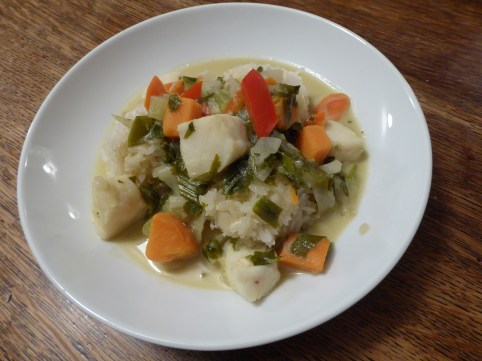
This is the version of stew that I made yesterday to take to the family with a new baby and sickness in the house. It seemed to me that they might like something different from the usual chicken or lasagna. I made eight quarts, enough to keep half at home. This was the first time I used bok choy; I loved the yams in there, and noticed that the cilantro stems I hadn’t had time to remove had disappeared on their own. When the vegetables were almost done I took out half for us and put that in the fridge, and added pork to their pot.
Tonight I heated up our portion and added fish, and made another batch of rice. We made it all into balls, and ladled the stew over three of the rice balls in each bowl. The rice in the bowls quickly gets soft, but you can enjoy a still-chewy rice ball on the side dipped in a sauce.
Here is one version; you can experiment and make your own, varying the amounts and seasonings. This sauce can also be spiced up, all or in part, by the addition of extra curry paste. If your stew is mild but some people enjoy more heat, they can add spicy sauce to individual bowls.
Thai Coconut Sauce
1/2 cup coconut milk
1/2 teaspoon yellow (or other) curry paste
1/2 teaspoon fish sauce
1/4 teaspoon sugar
I hope if you try any of these foods you’ll let me know how it goes. Or maybe you already have your own similar recipes and methods you will share back. Now I should know some Thai phrase to close with, but lacking that, I’ll leave you with my wish that you will have “Good Eating!”

 [February 2010] Today marks a year that I have been blogging, and that seems like an opportunity to tell
  the origin of my blog’s name. I only now looked on Wikipedia for the vesperal hymn “

 After the rock is smoothed out with a rake, it has to be tamped down by someone with muscle equal to all the pounding foot-by-foot until he has flattened all the paths very hard. The playhouse served as a coat rack, and the snowball bush gleamed on the afternoon.
 Today was the big day when the first of the plants went in, most of the dononea or hop-bushes along the fences. I could have helped with this if I hadn’t been running to the store or in the kitchen for those hours, making a very involved meal for a new mom. I did dash outside a few times to take pictures. Today it was the womenfolk, Landscape Lady herself and her assistant.
  They lovingly and carefully put the bushes in their new home, and then I sang,
