It wasn’t my idea to make cheesecake bars, but once I accepted the assignment I took ownership with my usual under-deadline obsessiveness. Lucky it was that I only had a week to fill up with the project, as it turned out to be one of those tasks that swell up to take as much time as you give them.
 If you want to see how and why a recipe might evolve, devolve, and eventually get tuned up into its final and praiseworthy rendition, keep reading. This is where I play the professional baker (I know, that’s tooo funny.) If you just want the recipe, please skip over all of the tedious and painful story and go straight to the bottom of the page.
At church the Sisterhood was giving a dinner to celebrate the 60th anniversary of our priest’s ordination, and the 85th birthdays of him and his wife. We threw in a celebration of their 61 years of marriage. We love them so much, we wanted it to be a Very Special dinner, and many people put in many hours and days of planning. I came late to that part, when the final plans for the end of the meal settled on a dessert sampler, and I was asked to make cheesecake bars.
 The other four choices on the dessert table were to be Chocolate Peanut Butter Bars, Greek kourabiedes, baklava, and orange chiffon pie. The pie and the cheesecake bars would be baked in bun pans, which are 18x26x1″, so that we could cut them into approximately 2″ pieces and end up with close to 100. I was offered a recipe that called for a commercial cookie mix, but I decided immediately to find a recipe that I could be proud to serve to honored guests. For this kind of occasion I didn’t want to include anything like that.
The things I wanted or needed in a recipe were cottage cheese as well as cream cheese (because I remembered liking what the cottage cheese did to the texture), a streusel topping, and a balanced relation between crust, filling, and topping. It couldn’t be much taller than one inch, if I were going to bake it in a bun pan. I wanted a bar that would present well on a tray, and that could be moved from the pan to a serving platter to a dessert plate without its layers mushing together or becoming a crumbly mess.
 |
| for the streusel |
Pinterest and other sites are replete with pictures and recipes for cheesecake bars, but very few of them met my requirements. Some looked tall and ready to topple. Many were too gooey, or had base layers that seemed too thin to support the cheesecake. And few had cottage cheese as an ingredient. Eventually I went to my old recipe binders and discovered that I myself had made two different versions of this dessert many years ago, and I’d written notes about them. One of them contained cottage cheese.
So I started with that one, and built on it. After several hours (I kid you not) of this creative culinary plagarism, I had a plan, and I put together a 9×13 test pan of the goodies. A bun pan’s horizontal space is four times that of a 9×13 pan, so if I kept the height to 1″ I could easily adjust the recipe for the larger pan.
The kitchen table was covered with old recipes from my files, and new printouts from the computer, from which I’d cobbled together my own possible versions that I scribbled on a legal pad. First lesson I learned from the test: I should carefully write out, or better yet, print the recipe off the computer in a large font, and double-check that I haven’t left out an ingredient or transcribed something wrong.
Test batch #1 was a failure, mostly because I goofed up the streusel and it was way too crumbly. I made a couple of other boo-boos also. After that I studied up on streusels with the goal of producing a topping that would decorate the smooth cheesecake layer and hide any little imperfections or bumps. It would not spill crumbs too readily and mess up the sides of the bars when they were cut. And it wouldn’t be too thick, because I wanted to be sure that the cheesecake layer was prominent. I planned for mine to feature walnuts and not cinnamon.
 |
| test batch #2 after setting up overnight |
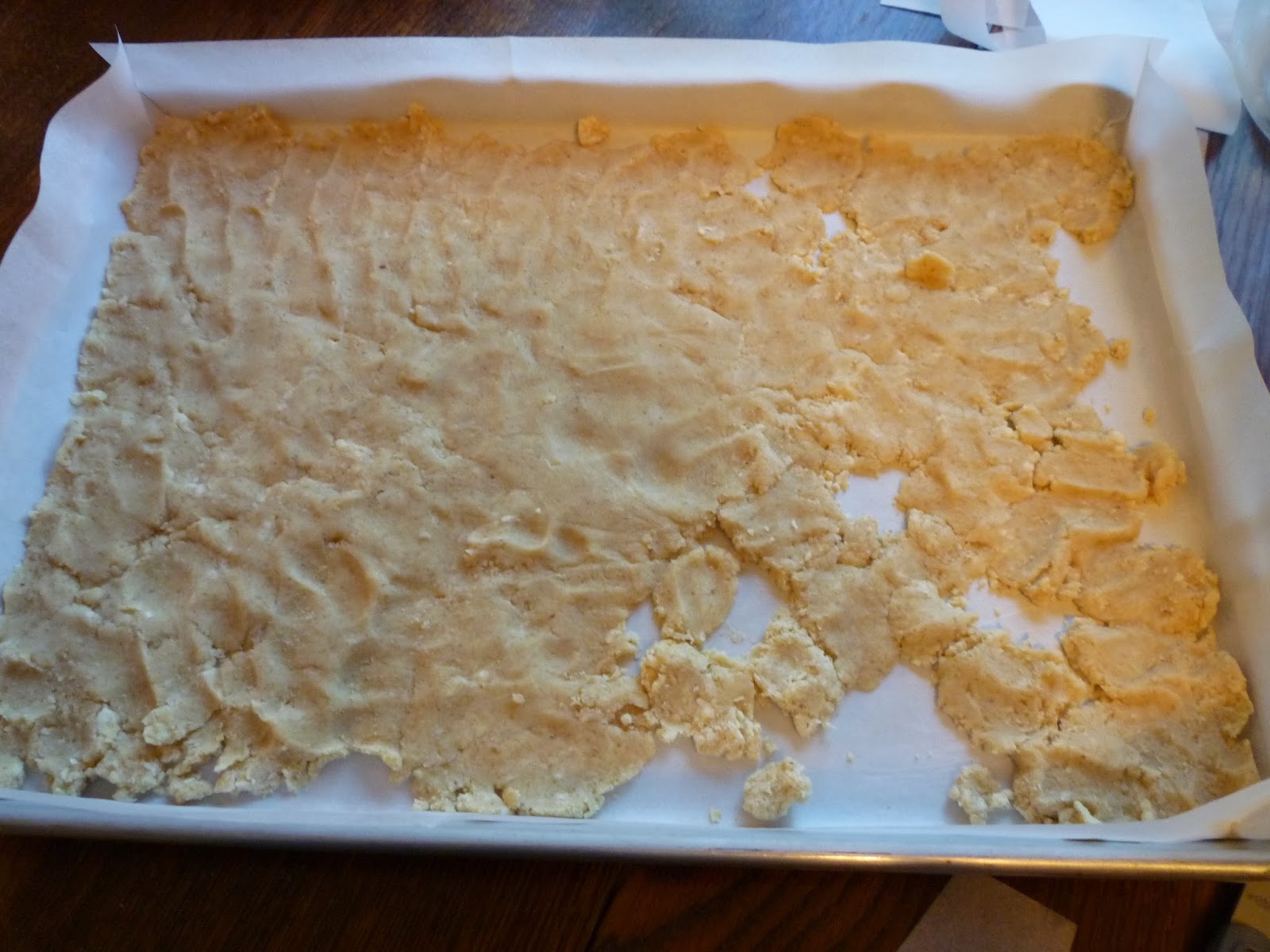
Those messy bars were not a complete failure, and the boys next door enjoyed them very much. But I wanted to make a second small batch that was good for my purposes in every way, so the next day I produced Test Batch #2. I remembered to put in the parchment paper before I pressed in the crumbly crust, and the next morning it was very easy to remove the whole cake by lifting up on the sides of the paper.
I set it on the cutting board and began to trim away the unattractive edges. The streusel was just the way I wanted it, but the crust was too crumbly and uneven. There was more crust and less filling than desirable. And maybe the whole thing had been in the oven too long, because the edges of the filling were dry and cracked.
 |
| Test batch #2 had several problems. |
 |
| Layers of the unacceptable Test #2 |
There wasn’t time enough for me to make a third test batch, or even to shop for more ingredients to make it, so I just took care to adjust the amounts and change a couple of things in preparation for making the final huge panful — though I’d decided by that time to make them in two half-size bun pans.
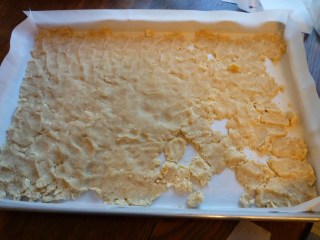 The next morning was the real thing. I tried not to be my usual loosey-goosey self. I moved slowly and methodically and stopped to clean up several times during the assembly, so that I wouldn’t get stressed and confused by all the mess. If I ever play professional baker again, I’ll have to bring in a sous chef and/or a dishwasher. But I hope my experience has taught me not to do this kind of thing a second time.
 I mixed the base in the food processor this time, after grinding the walnuts finer. I cut down on the amounts, and then I had a really hard time making the dough cover the bottom. Oh well, it’s too late to change now, I thought. After it rose in the oven, though, I was surprised to see that the base layer had puffed up a bit. Maybe it wouldn’t be too thin after all.
I also increased the amount of the filling, which I had reduced in the second test batch in an effort to achieve that elusive 1″ height. I hoped that the shorter crust layer would make room for more filling, which was, after all, my favorite part.
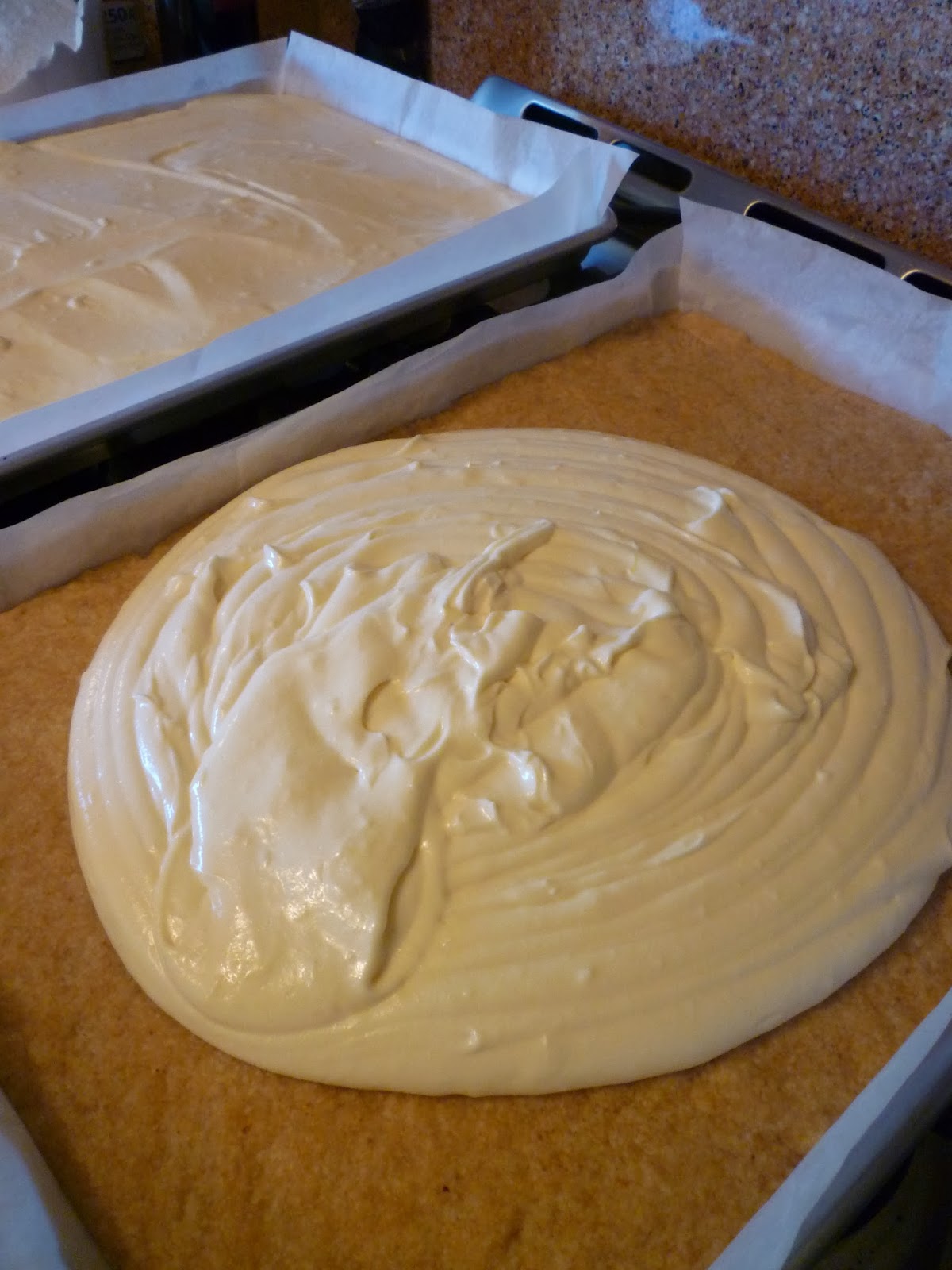
The most fun was spreading all that creamy cheesy lemony filling on to the crust…
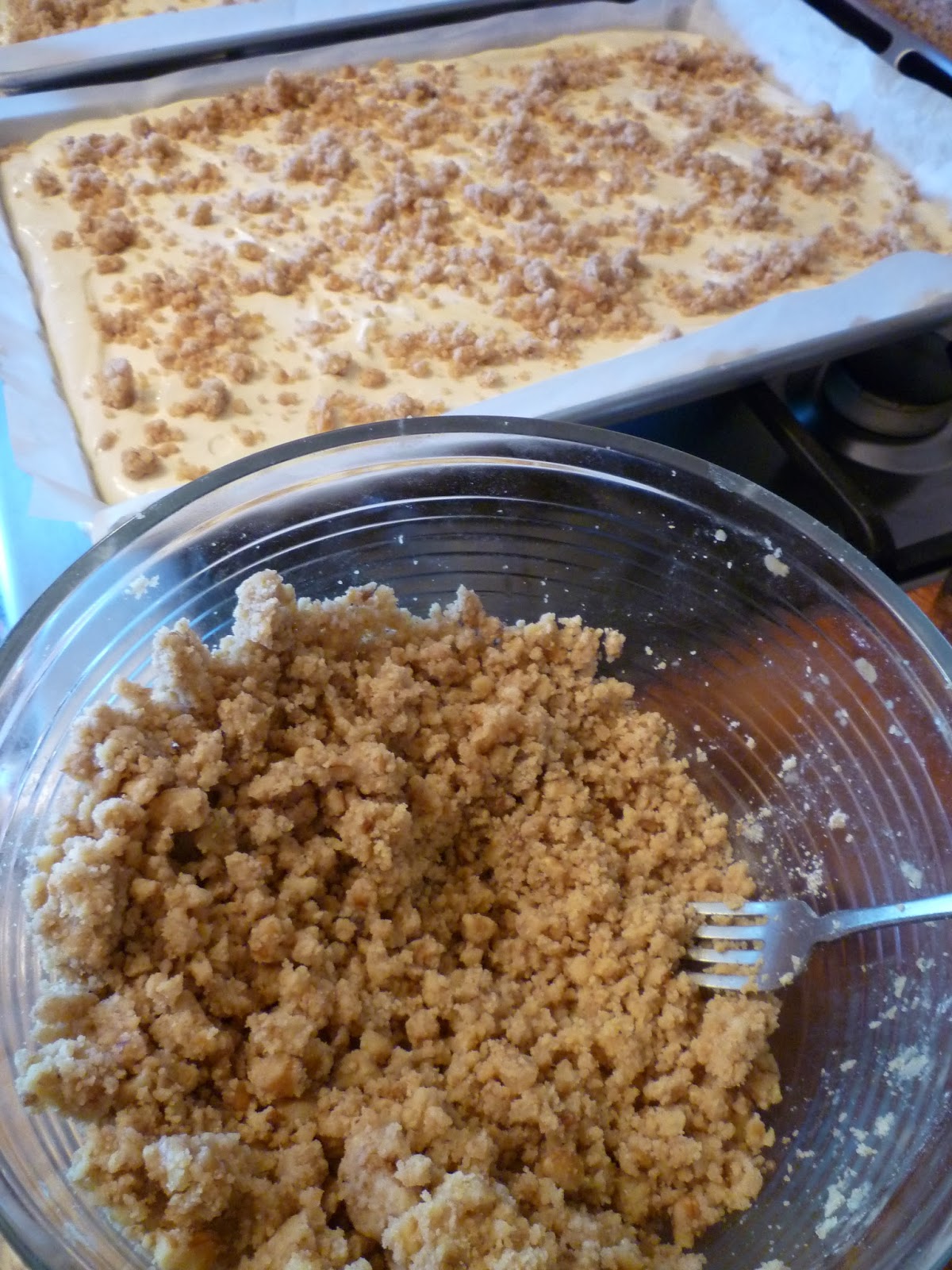
 …though sprinkling buttery streusel on top was a close second.
I baked the two big pans in my oven, being careful not to overbake, and when they had cooled I took them to church to store overnight, because we have an extra-large refrigerator there. In the morning all of us dessert-bakers got together in the church kitchen and prepared our sweets for serving.
I didn’t try to remove the huge cheesecake from the pan in one piece, but I cut the bars right in the pan. They were just as I wanted them to be. The scraps from the edges — not dry, but a little raggedy — were passed around to all the people setting up tables and decorating, and they were declared scrumptious.
Some other things I want to remember about this consuming experiment: In the end we served all of the dessert samples in paper muffin cups, so there wasn’t as much opportunity for squishing. I decided that it would have been much easier to make four 9×13 batches than to go to all the trouble to adjust for big shallow pans. And after all the cheesecake bars had been cut and made ready in the cups, I heard how a local expert in a sister church makes cheesecakes for a crowd. She bakes individual servings right in the muffin cup!
For a smaller batch to be served at home, I might try this recipe without the streusel and top the bars with something that is less like the base. But for a while, these will be my standard, gorgeous, addictively creamy — ta da! Cheesecake Bars!!
 |
| Perfect Cheesecake Bar |
Lemony Walnut Cheesecake Bars
Base/Crust:
Line a 13×9 pan with parchment paper, overlapping sides a little.
¼ cup already chopped walnuts
½ cup cold salted butter, in chunks
3 tablespoons brown sugar
¾ cup white flour
Using the steel blade, chop the walnuts further in food processor until fine. Add the other ingredients and mix until they clump together.
Press evenly into bottom of lined pan, and bake at 350° for 15 minutes. Remove from oven.
Filling:
1 ½ cups full-fat cottage cheese
8 oz. cream cheese, softened
2 large eggs
1 teaspoon vanilla
1 teaspoon lemon zest
2 tablespoon lemon juice
½ cup sugar
Blend cottage cheese in food processor until smooth; add all other ingredients and mix until blended. Spread on baked crust.
Topping:
½ cup flour
4 tablespoons brown sugar
2 tablespoons powdered sugar
½ cup walnuts chopped
¼ cup butter, melted
Mix all with pastry blender until the crumbs are the size you like.
Sprinkle topping evenly over filling. Bake for 35-40 minutes or until a table knife inserted in the middle comes clean. Cool in the pan on a rack. Refrigerate overnight, then use the parchment paper to lift out carefully onto a cutting board. While the loaf is still on the parchment paper, use a sharp knife to cut the bars, dipping into hot water and/or wiping on a wet towel as needed. Trim edges as necessary and cut into 24 bars. Keep refrigerated.

 Being raised in Protestant churches, I learned little about angels. Since coming to Orthodoxy, I’ve been introduced to a large body of teaching, and some practices that help me learn experientially, too. Some lessons come through the feasts such as on November 8th (beginning with Vespers tonight, actually), when we celebrate the Feast of The Synaxis of the Chief of the Heavenly Hosts, Archangel Michael and the Other Heavenly Bodiless Powers.