All posts by GretchenJoanna

Unknown's avatar

About GretchenJoanna

Orthodox Christian, widowed in 2015; mother, grandmother. Love to read, garden, cook, write letters and a hundred other home-making activities.

How Not to Use the Vernacular

In those long-ago days when new cars had built-in cassette players and we were a large homeschooling family, I invested in a set of tapes of the New Testament, narrated by Alexander Scourby. Those were the only straight readings of the Bible I heard until last week, when I popped The Message into my CD player.

Eugene Petersen is a man whom I admire and respect. The first I ever heard his name was as the author of a book with a compelling title, A Long Obedience in the Same Direction. To hear him speak, as I have recently on the Mars Hill Audio publications, is to know that he has received a goodly share of grace and wisdom from God. In introductions to the recordings he explains that his motives for writing The Message paraphrase of the Bible were to make it accessible to the everyday English speaker as a “reading Bible,” to introduce them to God’s words and God’s ways, with prayers that they would go on to read a study Bible, and learn to participate in the life of God.

A couple of years ago I read a few passages in the printed version of his translation, as he loosely calls it, and was neither impressed nor offended. But I’m past the stage of needing an introduction, so I didn’t pay much attention. I bought the recording because it was the least expensive experiment I could make in a newer format, and I didn’t imagine that the experience would be so far removed from listening to Alexander Scourby.

It was only a year ago that Scourby read the entire gospel of Matthew to me while I was driving to the mountains and back in my old car. It was a flood of God’s blessing to hear that much of the earthly life of my Lord — His words, His being the Word — in one sitting, and I thought my heart would burst with the overflow. The several hours’ drive was over before I knew it.

But the narrator of The Message series makes me remember why we always chant or sing the Scripture in the Orthodox Church. The first portion I listened to was Matthew’s gospel, in which John the Baptist and Jesus appear early on, and the narrator gives them the voice and intonation of an actor over-dramatizing his role. In tone, it is so not the vernacular, unless you are a football coach at half-time when your team is losing, or a political talk-show host on a rant. To have the words of Christ spoken that way is to make Him out to be a cheerleader or an ad-man. Even the most Pentecostal preachers I have heard do not speak with such urgency through their whole sermon.

If only Eugene Peterson had been the one to read aloud his rendition of the Bible. He would not have been capable of such a style, nor would he have thought it necessary. He knows that the words of God do not need hepping up. Let your yea be yea and your nay, nay. But he speaks more slowly even than Scourby, whose pace sacrifices speed to dignity.

I had to dig out our old cassettes to check who the narrator was, and then I googled his name. Wikipedia says, “Although Scourby made voice recordings of over 500 different books, he considered the Bible to be his most important,” saying “‘…it is the one book that has the power to inspire, encourage, comfort and change the life of the person who hears it.'”

The Orthodox believe that worship services should be in the language of the people, the vernacular, so priests and missionaries through history made great efforts and sacrifices to translate the Bible and prayer books. St. Innocent is one I have heard the most about; he traveled by kayak all over the frozen north to minister to the native peoples of Alaska, and learned several languages besides his native Russian.

But we do not read the Scriptures aloud in church in the tones of our everyday speech, even though the words are in our respective languages. If you do that, it is nearly impossible not to emphasize one word over another and lend changeable meaning to the sentences depending on who you are and what assumptions and personality, not to say errors and misunderstandings, you bring with you. The only way to let the words speak for themselves is to chant or sing them without emphasizing one over another.

Scourby was Greek and baptized Orthodox. I wonder if he had a sense of how to read the Bible from hearing it chanted or sung in his youth. His reading resembles the way many ministers in Protestant and even Evangelical churches used to read, and I’m sure some still do, not with a lot of expression, but clearly and reverently.

And why did someone decide to intersperse jaunty electronic quiz-show music in between some tracks? Is that supposed to be the vernacular as well? Petersen says that he wants people to become familiar with “the way God speaks,” and he wants us to be mindful that God in the Incarnation did not take “the role of a sophisticated intellectual.” The style of The Message‘s narrator may not be sophisticated, but it is affected and distracting.

Not that I would give anyone even Alexander Scourby’s Bible readings with the thought that they could know from them alone what Petersen calls “God’s grand rule of love and justice.” God has spoken through His Son, the Word, and the words of the Bible testify that it is the Church, not the scriptures, that is “the fullness of Him who fills all in all.” (Ephesians 1:23) The Church is the only context in which one can learn and live the full meaning of Holy Scripture.

The Scourby readings were, it seems until recently, available for listening for free online. They have been replaced with readings by another man; I haven’t tried them yet.  Audio-Bible provides those new readings online and sells recordings of Alexander Scourby’s Bible in various modern formats. I can see making that investment at a future date. And for the present, I have a portable cassette player for playing my valuable antiques.

Essential Aromas


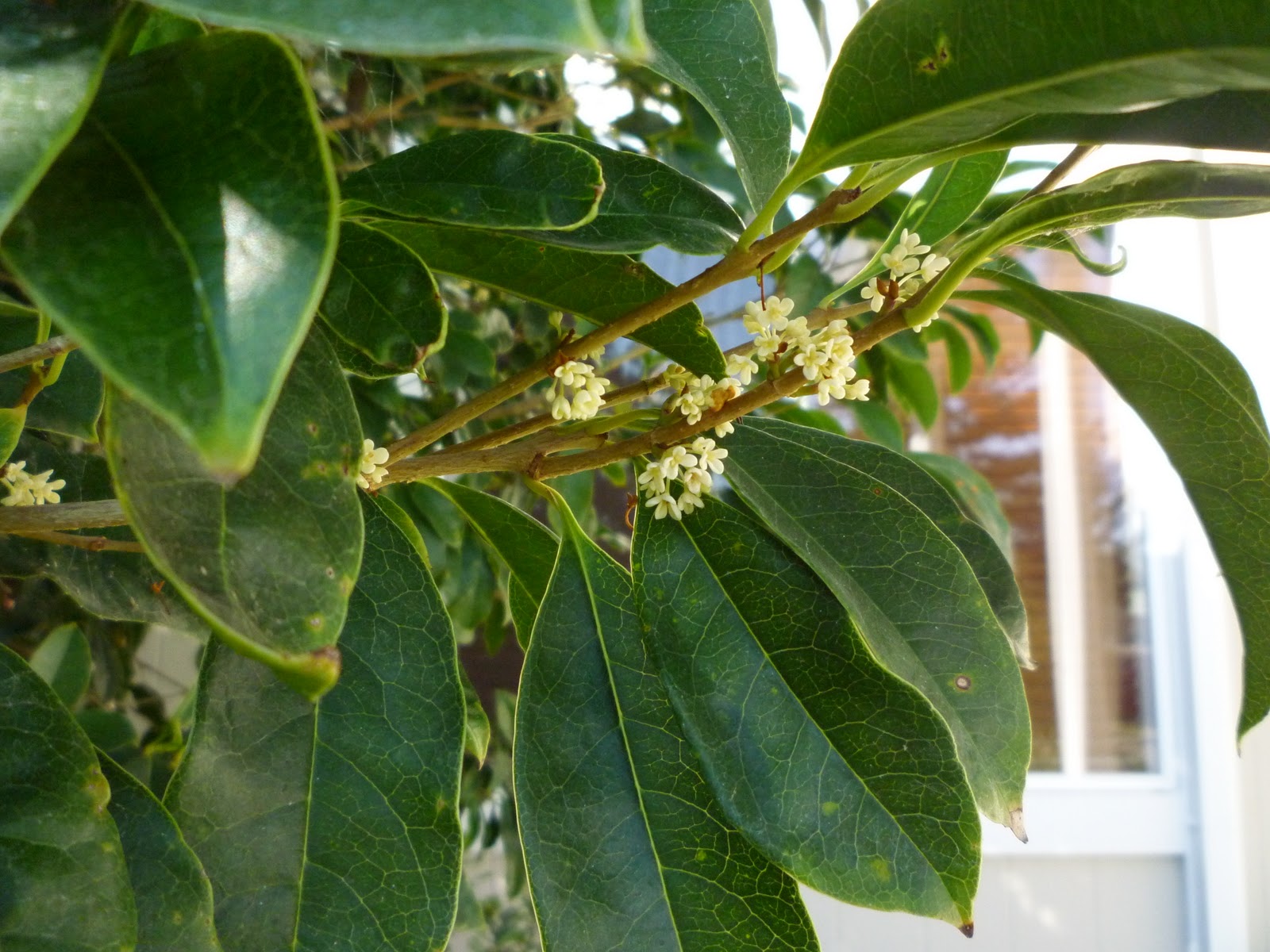
When Debbie at Artful Aspirations posted about her sweet-smelling bush, I suspected a near relation, perhaps even a twin, to my Osmanthus fragrans. She said she bought her plant because of its common name Tea Olive; I had only known mine as Sweet Olive.

Not many days later M.K. at Through a Glass, Darkly, who was not a follower of Debbie’s blog, posted photos of her “holly bush,” with descriptions of its “heady and rich” scent reminiscent of gardenia.

The challenge of describing various scents is always of interest to me. I wonder if an individual flower is easier to pin down than a whole rain forest. We usually have to say that any given smell is something like another. Having grown up in an orange grove, I didn’t confuse osmanthus with orange blossoms, but upon my first encounter I did envision some woman along the route of our neighborhood stroll setting an apricot pie to cool by the window.

Surely osmanthus is its own heady aroma that nothing else is quite like. Last year, at the end of a post about how various other scents link to my grandmother, I tried to describe its effect on me.

One website that sells many essential oils for their aromatherapy benefits describes Osmanthus fragrans as “Friendly, lively, intriguing, what’s new, what’s next, early morning excitement, setting out on a whole new journey.”

Peet’s has blended a black tea with osmanthus blossoms, which might add some extra excitement to those mornings when I choose it over plain black or green.They say “its pleasant aroma could be described as a combination of apricot, chamomile, and orange flower.” They don’t make it all year long; stocking up would be necessary if you want to be assured of having it when you want.

After she heard about osmanthus, M.K. began to wonder if her hollies might actually be Tea Olives. In the meantime I had been reading about fragrant holly bushes and found that there are hundreds of types of holly, and some of them do look a bit like osmanthus. One osmanthus looks so much like holly that its common name is False Holly. Wikipedia mentions that osmanthus flowers can be various colors, even dark orange, and that in China it is traditional to mix some osmanthus jam into millet gruel.

You can see on that page a photo of an orange-flowered osmanthus taken in Japan. All of the photos here on my blog were taken just this week in my yard.  B. and I planted the bush about 20 years ago on the advice of  horticulturist friend. If we had known how big they get, we’d have started it out farther from the house.

Wikimedia also has this whole page of related photos.

Some of my other favorite botanical scents are lemongrass and rose geranium. I have a big bush of the geranium in a pot on the patio, and in my cupboard some essential oil of lemongrass to add by drops to hand soap. So far I’ve only enjoyed my osmanthus when it happens to fill the air with its essence, and that occasion always takes me by surprise and humbles me by the extravagant gift. “The osmanthus is blooming!”  I will announce, if someone is around. This happens at least twice a year; do I really need the oil extraction at other times?

The people on the planet of Perelandra in C.S. Lewis’s novel by that name had an admirable way of making the most of every experience. They considered an actual event in time to be only the smallest part of anything that they did or that happened to them. The anticipation was also to be enjoyed for all it was worth, and the memory of the incident or act would be savored into the future. In this way even the most lovely and desirable events were completely satisfying whether or not they took place more than once in a lifetime.

When one comes upon a strong aroma, say, walking into a house where bread is baking, or walking out one’s front door to the scent of osmanthus, if the stimulus continues for a time the olfactory receptors get desensitized or something; in any case, you stop noticing, until you go out and come back again. So I don’t know, if I had only smelled osmanthus once, if I could have made much of the experience. I’m not too good at paying attention, if that’s what’s necessary.

But I’ve had decades of being enveloped by the sweetness and the love that the Sweet Olive aroma signifies to me. I think I’ll just try to bask in it for a few seconds longer next time I pass by, or sit on the step and drink it in as long as my nose will keep sending the message to my brain. And if we move to a colder climate I’m sure I’ll be busy enough sniffing the air in that place without trying to import gifts that belong to the memorable past.

Owls, Lepers, and More Around the Net

In just two days’ tootling around some of my favorite places on the Internet I have found items worth sharing in several categories: humor, animal photos, Bible study, a recipe and a quilt — just a sampling of this week’s surprises in that wide world.

Gumbo Lily shows photos of the darling owls in her own back yard. She often encounters wildlife to capture with her camera, illustrating the ranch life she captures with her pen (um…keyboard).

Angie got me laughing again, this time about Internet spam, of all things. Spam with a Scottish twist.

M.K.’s recent post To Touch a Leper, got me thinking on the wonderful and mysterious fact of Christ’s life and how it is health and cleanness.

A quilter-blogger Who Loves Baby Quilts and doesn’t own a sewing machine made a sweet mini quilt she refers to as a mug rug. Now I know what to call my own treasured little rug given to me some time ago. I’m showing both sides, which I have tried to keep pretty by not using it when my mug contains cocoa.

Last, a simple and simply yummy-sounding Greek dessert that requires not much more than opening a container of good yogurt.

A Metaphor and a Journal – C.S. Lewis

 
Because I was helped on my journey to Orthodoxy by Touchstone Magazine, and certainly also by C.S. Lewis, my eye was caught this morning by word of a debate on the extent and meaning of Lewis’s metaphor of a house with rooms, in his book Mere Christianity. The subtitle of Touchstone is A Journal of Mere Christianity, so it is understandable that the editors would have an interest in keeping true to a proper understanding of the author. By the way, the current issue of the journal features an article on how the new Narnia films “Subvert Lewis’s Hierarchical World,” and another article reviewing a book that treats the development of the author’s view of women. Those are both available for reading on the website.