All posts by GretchenJoanna

Unknown's avatar

About GretchenJoanna

Orthodox Christian, widowed in 2015; mother, grandmother. Love to read, garden, cook, write letters and a hundred other home-making activities.

Chocolate & Pumpkin & Spice

Everyone, it seems, is talking and writing about every variety of pumpkin bread possible, which they have baked and posted recipes for, and the (pumpkin?) seed sprouted in my mind and bore fruit last night, when I put all these ideas together and came up with my own batch that was pretty much perfect. My thanks to all of you who made my mouth water and my imagination start working.

Pumpkin & Chocolate Chip Muffins
This made 30 smallish muffins and two mini-loaves

3 1/2 cups unbleached flour
2 teaspoons baking powder
2 teaspoons baking soda
1 1/2 teaspoons salt
1 1/2 teaspoons ground cinnamon
1/2 teaspoon allspice
1 teaspoon nutmeg
1 29-oz can pumpkin (about 3 1/2 cups)
1/3 cup white sugar
1 cup dark brown sugar
3/4 cup olive oil
4 large eggs
2 teaspoons vanilla
1 tablespoon finely grated fresh ginger
3/4 cup buttermilk
2 cups Ghirardelli 60% cacao chocolate chips
3 cups toasted walnuts, chopped

Combine flour, baking powder, baking soda, salt, cinnamon, nutmeg and allspice in a medium bowl; whisk to blend. Using electric mixer, beat pumpkin and sugars until blended. Gradually beat in eggs, vanilla, oil and ginger. Stir dry ingredients into the pumpkin mixture alternating with buttermilk in three additions. Stir in nuts and chips last.

Fill lined muffin cups 3/4 full with batter; likewise mini loaf pans that have been greased or lined with parchment.

Bake muffins at 375 degrees, 30-45 minutes, depending on size of cup and whether your oven is convection, until a toothpick comes out clean — though it can be hard to tell with all that chocolate in there! Bake the mini loaves about an hour. Cool in pans.

Upon eating the first muffin I thought I hadn’t put in enough spice to suit, but today they were the perfect combination of tender and moist, with lots of soft dark chocolate not quite melted in, and dreamy flavor, probably just the right amount of spice. I wouldn’t mind if they had still less sugar, but I’ll be cautious about changing that ingredient too much and maybe not liking the resulting change in the crumb texture.

I took this recipe at epicurious.com for my jumping-off place, after reading all the reviews that told the many ways people changed the original. I mostly combined many of their changes to customize mine; and I was in such a hurry to get my loaves and muffins done before my bedtime, I forgot to take a picture. This tiger does have something to do with the recipe, because he was carved from a pumpkin by Pippin some years ago.

After Mr. Glad and I enjoyed my creations with breakfast, most of the remainder went into the freezer to bring out when there are more people around to enjoy them. I hope that will be soon, but I’ve had my fix, which I think will keep me for a while.

Fall Garden Report

My husband and I have been cleaning the yard up this week. I’m putting in some greens for the winter, and some cooler-season flowers, and we are already talking about how to improve our harvest next summer. So I thought I’d write notes about this summer’s results.

Butternut Squash:  6 fruits (two of them pretty small) from 16 plants. Considering we didn’t have a warm summer that isn’t too bad. (My best year was 10 larger fruits from 20 plants.) But, also considering that B. doesn’t like squash, I might give that space to tomatoes next summer, when we will be making the Concerted Tomato Effort. The butternuts in the store aren’t as good, but I can live with that.

Tomatoes: We grew 8 plants, 8 different varieties this year. Terrible year for tomatoes, but the scorecard for the various ones:
*Early Girl: Still the most dependable, and the flavor in September can’t be beat. I want to plant two of them next year.
*Grape: This is the 4th year I have grown these, and they are wonderful in all the usual ways, except that this year for some reason the fruits were tinier than grapes.
*Green Grape: These were vaguely grape-shaped, but huge for a cherry type, more like a small plum. The flavor was good and they were healthy and productive, so I might plant them again. I like having a green cherry for the color in salads and such.
*Andy’s Polish Pink: We got at most 3 good fruits from this plant, and when we pulled it up, its roots were not deep. Early in the season the tomatoes were mushy. It’s not worth trying again to see if more heat would improve them.
*Faribo Goldheart: The few fruits we got were tasty and beautiful orange tomatoes. A couple of them were the largest of all our tomatoes this year. Worth trying again.
*Orange Fleshed Purple Tomato: I picked this up at the big box store, part of their effort to stock a few heirlooms. It didn’t make many tomatoes and they were so disappointing–now I forget all the reasons–that we pulled the plant out early.
*Yellow Cherry: This has been the best of the lot this summer. It’s quite a bit like Sungold, but its skins aren’t so thin. It’s been a good producer and very sweet.
*Black Cherry: It was hard to tell when these were ripe, and when they were, they quickly got soft, and their flavor was blah, so I don’t want to plant them again even though the bush was productive.

Peppers: Nothing produced well, of the Anaheims or Pimientos or the other two interesting ones. But they were in a spot that didn’t get enough sun. More and more of the garden is like that, unfortunately. B. wants to plant Pimientos again next year in a place where they did really well in the past.

Basil and Arugula: Always easy, and did as well as usual. Actually better–last year the basil seemed to suffer, maybe from too sunny a spot. This year I put it back in the old place, where it gets no sun until the hottest afternoon rays. The picture is of arugula seeds I collected.

Lemon Cucumber: We got enough for our use, which is very minimal. I may not plant these next year because they are available locally at the market, and we need the space for other things.

Green Beans: Blue Lake are the best! We got a good amount, and since we love them so much, we will probably plant them again, and maybe in the same spot, as it is one of the few places where the runners can’t disappear into a tree or the neighbor’s yard.

New Zealand Spinach: Some of these starts I planted in a too-shady spot, and they never really grew. The others were in a place that gets sunshine all day long, and they grew vigorously, but the leaves are small.  The stems are tough on this plant so I haven’t bothered to use much. I’d like to try this old favorite again next spring, in a place with a little shade.

Washington – The Rain Forest

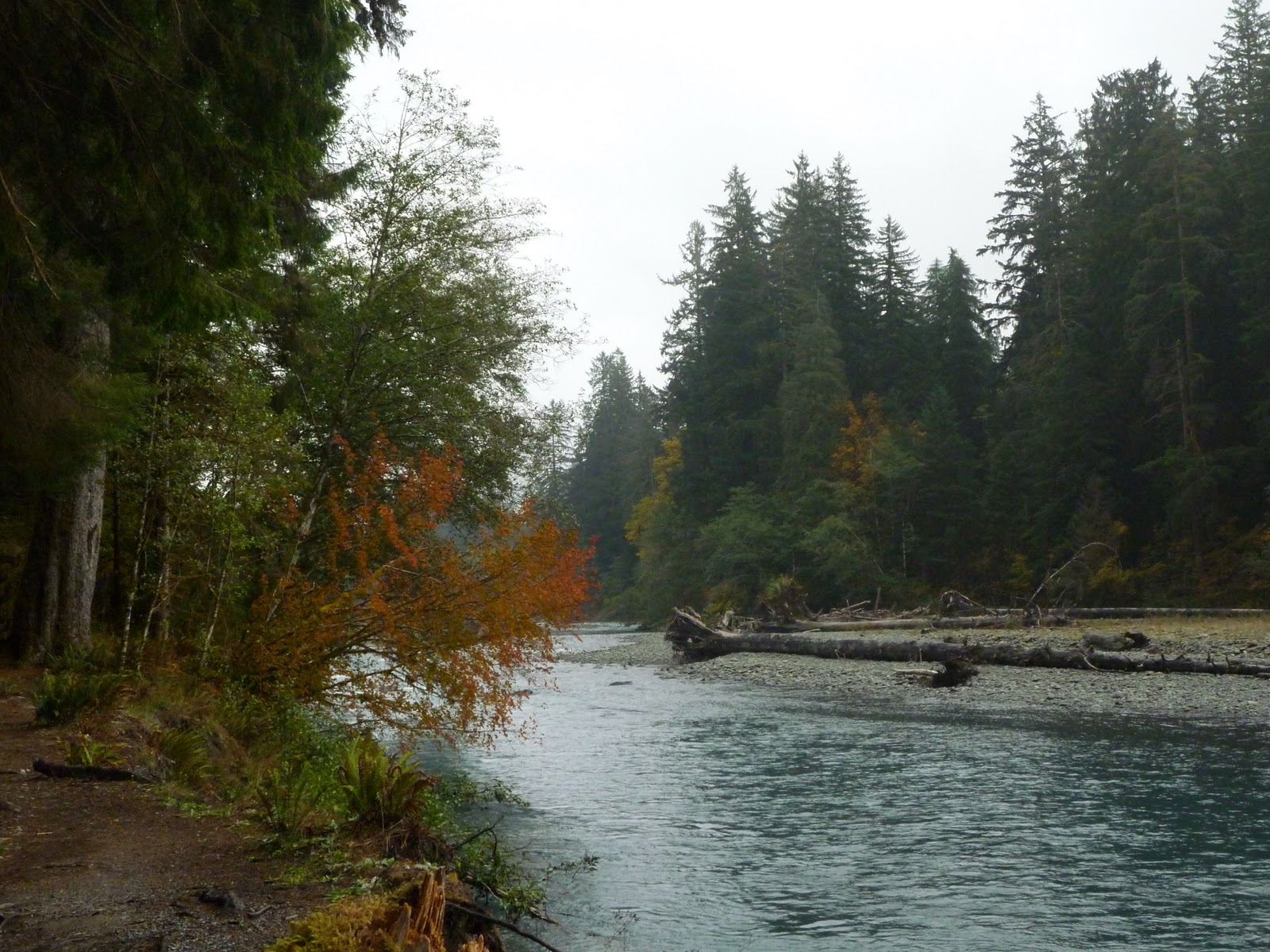
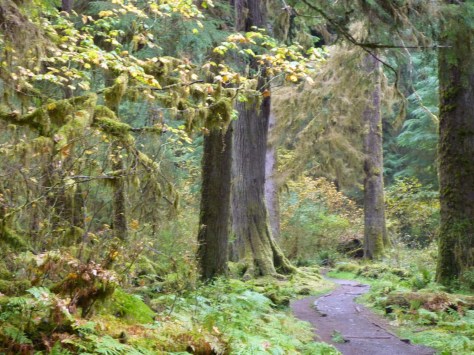
The rain forest surprised me. It wasn’t chilly, even though it was cool; perhaps the humidity served as a blanket. The towering complexity wasn’t too overwhelming, because my camera helped me to isolate and literally focus on various particulars.

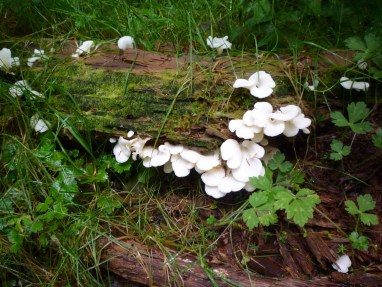
My favorite plants were the exotic fungi, because they stood out from the multitude of mostly green colors.

They say there are several thousand plant species in there, and I imagined it would be a trial to take a day hike through all that jumble and jungle of green sameness. Instead, it was strangely invigorating. Is there more oxygen than average in a rain forest, what with all those plants exhaling? It was as exciting as the beach.

We had the slightest drizzle as we entered, but not enough to warrant covering my head. Even that amount of moisture waned and my hair didn’t get wet — only pleasantly fluffy, a welcome relief from the usual flat.

Autumn was beginning to give some color accents, especially in the form of the big leaf maples that arch throughout the canopy and drop their leaves over everything.

Hoh….the very name of this forest is like a mother’s calming hush, or a version of the meditative Ohm. I got to thinking of the shape of the letters themselves as the circumference of a Sitka Spruce trunk with branches on the sides.

It seems that the word Hoh by itself has endless possibilities, but in any case it seems to be the only name possible for this place, so quiet and deep. The Hoh River runs through it.

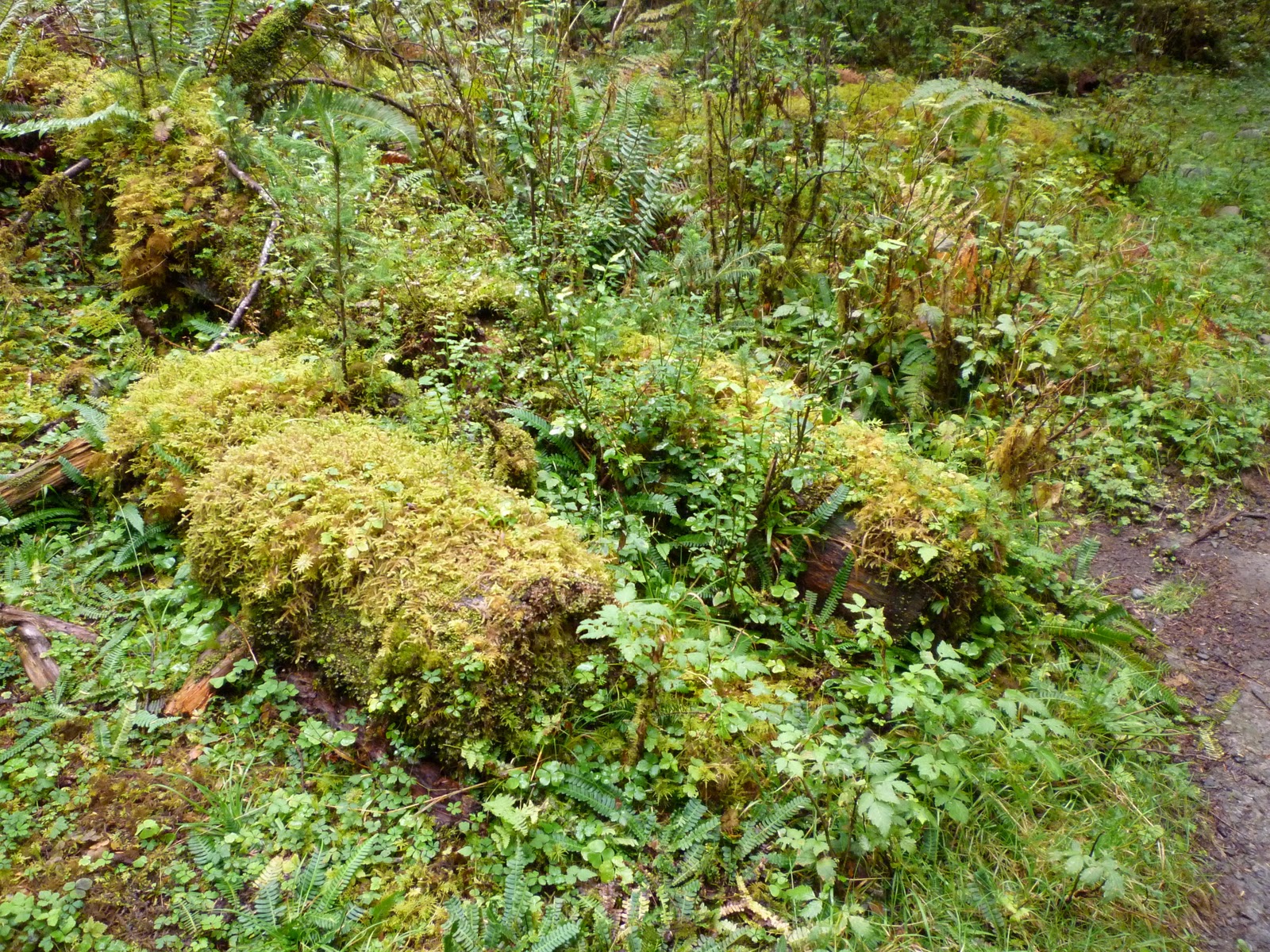
Wherever a stump stands, several plants will use it for a seedbed, so that a conifer, a fern and a deciduous tree will often make a bouquet on the stump. But a log lying horizontal becomes a pasture of low and thick lichens and moss.

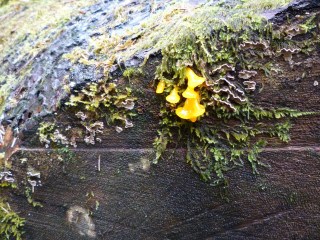
Below: Gray leaf lichens were in abundance, lying around everywhere, and also growing on trees. If there were a contest for the brightest fungi, the yellow one would get my vote.

This area of the world boasts the tallest (Sitka) spruce tree and the tallest (Red) cedar tree in the world. I couldn’t guess what most of the evergreens were, their lowest branches were so high up, and everything blanketed with spongy green lace. But I think this one is a Douglas-fir (it’s written like that because it’s not a true fir.)

 Leafy lichens abound. I guess this is one?

I was surprised when Mr. Glad said we should turn around and go back out. We’d been hiking two hours and it didn’t seem to have been more than about 40 minutes. By that time I wasn’t living in the moment, though. Time was flying because I had caught a whiff of the moist rain forest scents. Funny I didn’t notice right away. But when I did, I couldn’t just enjoy the mystery and deliciousness of these smells, but I had to start thinking about how I would describe them, if only to myself, so I could remember them.

I will probably never come back here! was my thought, and I will never smell this again. So why did I waste time thinking about it, I now wonder. Why not just drink of the thrilling sensory Now? And why were the disciples not content to just be in Christ’s presence at His transfiguration?

They were trying to make provision for the future, and prolong the experience, as I was hoping to provide myself with some words to take with me. I couldn’t hope to make the moment last, as we were walking fairly briskly by then, getting closer and closer to the outside where the opportunity would be gone.  I was lagging behind and noticing that the mix of wild aromas changed with the changing terrain, but they were always bewitching. Do people get addicted to smells? It could happen here.

Time was running out, and it did run out, ten days ago now. I kept thinking about the words for several days, but as expected, there was no way to improve on whatever poor metaphors I came up with while my senses were being bombarded.

The smell of the rain forest was something like eating a cookie fresh from the oven, a cookie made of fermented wild mushrooms and hazelnuts, with one’s head in a bucket of vanilla ice cream.

This was a new smell for me, with no links to my grandmother or anything in my past. There was no way to focus on it the way a camera helps one to focus visually — and no way to deliberately preserve it, though my mind has no doubt filed this input in a purer form than the silly image I worked so hard to invent. Perhaps elements of that exotic forest atmosphere exist elsewhere, and if so, they might someday come to me on a moist breeze and I’ll be taken back to the Hoh.


Washington – Homesickness Cured

In an essay titled “The Inside of Life,” G.K. Chesterton said that he envied Robinson Crusoe being shipwrecked on an island. He talks about “the poetry of limits,” which I am learning is the category where my own favorite life-poems are found. I found another one just last week.

At the beginning of our trip to Washington I was homesick — the first time I recall being plagued by that feeling when actually away from home, though I probably did complain over it right here at the peak of our remodeling project.

There’s never been a year when I took so many trips as 2010. It’s one of those things that is really different about my life nowadays and that I’m learning to adjust to. I’m just a homebody threatening to turn agoraphobic if I get pushed too far. The good old days were the ones when our family’s only car was not available to me and I didn’t have the option of driving to town. I “had to” stay home.

Time wasn’t enough for me to do a proper job preparing for our trip. As G.K.C. also says in that essay, “Life is too large for us as it is: we have all too many things to attend to.” I didn’t seem to have the right clothes, but when I noticed that, it was too late to buy or sew the right ones. I was self-conscious about looking odd until the day I could put on my hiking boots and paint-spattered fleece for the trail.

I always like to write postcards when traveling, so I packed a list of addresses along with some stamps into a zippered pouch along with my pocket calendar and a little prayer book; then the whole thing got left at home in the flurry of departure. All week I wondered if I had lost it at the airport or somewhere on the way, and I felt a bit lost without those props to my usual routine of being me. I couldn’t remember the addresses of most of the people I wanted to favor with a picture and note.

The first night of the journey we stayed with B.’s cousin and her husband who have a house looking out on Hammersley Inlet. They are warm and loving, and I was glad for the time to get to know them better.  It was rejuvenative to walk along the shore and collect large oyster shells, in the company of someone else who appreciated their beauty. Anne didn’t think it strange that I deliberated so much over each one I picked up, and she actually seemed to like talking about the reasons why one or another would be more worthy of carrying around for the rest of the trip. After washing three of my favorite potential soap dishes in the kitchen sink I forgot to take them with me the next morning. Somehow that was o.k. The collecting had been the important part.

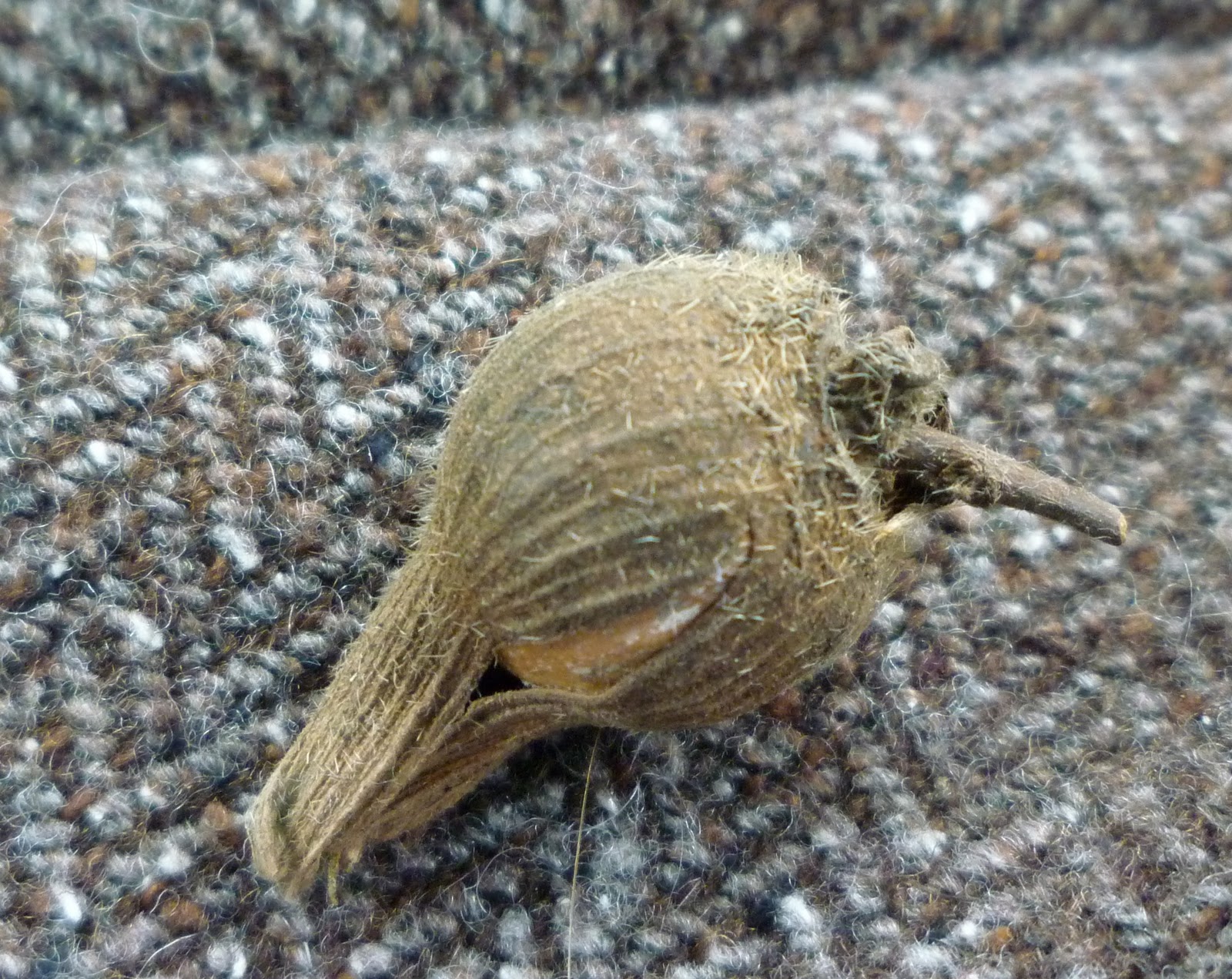
We walked with our Bremerton friends also, in the forest nearby, where my beloved “May” showed me piggy back plants, and filbert nuts hanging on the tree; a hazelnut went into my pocket and made it all the way home.

Just making the acquaintance of these tangible natural artifacts was comforting. If I had to leave their territories so soon and move on like an unwilling gypsy, at least I could snap a picture, or kidnap a small nut, to prolong the connection.

On our way to the Lake Quinault Lodge we got lost and spent a couple of hours getting back in the right direction. Rural Washington doesn’t have as many road signs as one could want, and of course, there are all those waterways that confused me when I was trying to be B.’s navigator. Robinson Crusoe didn’t have all this complexity of terrain, and what he had to deal with, he also had time aplenty for. Again, from G.K.C., “What dullness there is in our life arises mostly from its rapidity: people pass us too quickly to show us their interesting side.” Canals and roadsides, too, I find.

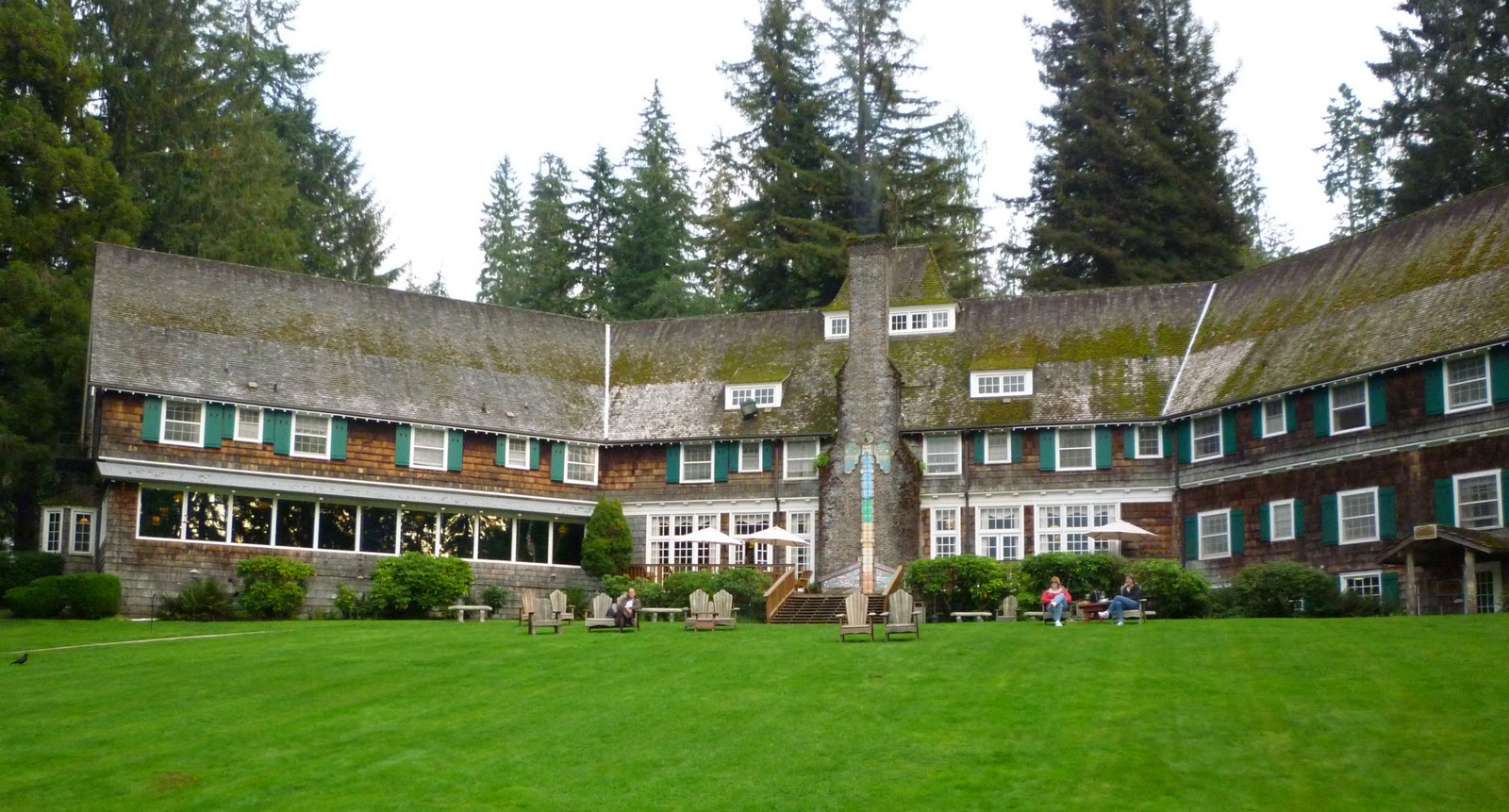
We had a reservation for three nights where B. had stayed with his family long ago, a classic inn built in 1926.  F.D.R. also stayed here in 1938 when he was considering whether to make a national park on the Olympic Peninsula. He decided yes, and the rain forest was preserved.

Olympic National Park is kind of like a wheel with spokes going in, but no hub; we had to drive long distances from the outer rim of the park into the choice areas. On the way along the rim to our first spoke, we spent time on Ruby Beach, where the surf crashed and the air was bracing. Just now I was wondering how it compares with the eastern coast in latitude, and after a bit of hunting and pecking around the Net I can tell you that it’s similar to Prince Edward Island, and still well south of the British Isles.

My attention was quickly drawn downward to the smooth and varied pebbles comprising the beach, and I picked up one after another as I noticed their peculiar colors and patterns. Quoting Chesterton, “This desire to be wrecked on an island partly arises from an idea which is at the root of all the arts–the idea of separation.” I removed some of these stones from their vast and cluttered background so I could consider each individually. And I myself had been separated from all my home responsibilities and from all but one talking human. No multitasking necessary.

In that essay that I had read only recently, Chesterton uses literature as a specific example of the artistic principle he’s considering, but it seems to me it is broadly useful for explaining why some activities are just as bracing to my mind and soul as that ocean air.

According to this idea, one appeal of reading a novel is that the number of people we meet there is limited. “Romance seeks to divide certain people from the lump of humanity, as the statue is divided from the lump of marble. We read a good novel not in order to know more people, but in order to know fewer….instead of this bewildering human swarm which passes us every day, fiction asks us to follow one figure (say the postman) consistently through his ecstasies and agonies. That is what makes one so impatient with that type of pessimistic rebel who is always complaining of the narrowness of his life, and demanding a larger sphere. Life is too large for us as it is….All true romance is an attempt to simplify it, to cut it down to plainer and more pictorial proportions.”

Topographically, logistically, socially, the greater Seattle area is way too large for me. Its vastness and complexity weigh on me like an overcast day. Walking with one or two friends is good — more circumscribed and easier to enjoy. But a small pebble is just right. I stuffed my pockets with pebbles, and breathed as heartily as I could of that oxygen-rich and moist air. I sat on a log and did not want to leave.